

Build a business plan indoor playground founders, retail landlords, and SBA lenders can rely on by settling three operating numbers before signing a lease. Define your core visitor age range, measure the minimum ceiling clear height inside your shell, and prepare a full startup budget that separates factory hardware from build-out costs and working capital. Most generic templates spend dozens of pages on mission statements and overlook galvanized framing clearances, mall landlord engineering approvals, and cross-border manufacturing lead times. This guide draws on direct commercial manufacturing experience from Zhenghan’s Wenzhou facility alongside U.S. Small Business Administration (SBA), UK GOV.UK, and U.S. CPSC resources to explain how to open an indoor playground and build a credible indoor play business plan in 2026.
ContentsMake your indoor playground business plan template ready for commercial underwriting by organizing the proposal around the eight sections below. Support each claim with the checks in the matching guide chapter.
| Plan Section | What Landlords and Lenders Verify | Matching Guide Chapter |
|---|---|---|
| 1. Executive Summary | Single-site focus (0–6 vs. 3–12), opening schedule, capital gap | Drafted last from Sections 2–8 |
| 2. Company & Ownership Model | Legal entity (LLC/Ltd/Corp), independent brand vs. franchise agreement | Franchise or Independent |
| 3. Market Analysis | Household density under age 12 within 15–20 minutes, indirect party competition | Market Research |
| 4. Facility & Zoning Plan | Total leased area, lowest obstruction height, slab load, fire exits, use class | Location and Size |
| 5. Attractions & Equipment Supply | Builder track record, structural frame specs, market safety standards | Location and Size + Opening Checklist |
| 6. Pricing, Revenue & Operations | Primary cash engine (parties vs. memberships vs. passes), staffing hours | Revenue Streams and Pricing |
| 7. Financial Plan & Startup Costs | Four-part budget split, break-even volume per month, three-month reserves | Startup Budget + Profit Margins |
| 8. Opening Schedule & Risk Controls | Reverse timeline (minimum ~6 months), buyer-managed customs clearance, liability cover | Opening Checklist + FAQ |
One practical limit applies to an SBA-style traditional business plan for bank lending or a shorter investor memo. It needs real commercial rent and local labor rates. Generic spreadsheets copied from supplier blogs often fall apart when a lender adds those costs.
Market Research
Your market research in the indoor playground industry should establish two things within a realistic drive radius. Confirm that local households fit your play concept and identify gaps in cleanliness, age separation, or weekend party capacity at existing venues. Headlines claiming billions in global entertainment revenue tell a landlord little about whether families within 15 minutes of your retail center will buy passes on a rainy Tuesday.
Define your target audience before estimating floor capacity. Squeezing toddlers, tween thrill-seekers, and parent dining into a compact first venue creates noise problems and awkward sightlines. A typical starter play space around 300 m² (roughly 3,229 sq ft) works more reliably with one clear business model. That could be an early-childhood soft play cafe for ages 1 to 6—pairing calm parent coffee seating with low cushioned climbers—or a multi-level adventure center for ages 3 to 12 with a gated toddler nook. Parents judge cleanliness and child visibility within seconds of walking through the door, so a clear concept helps build their trust.
Include direct indoor play venues and other weekend party options in your market analysis. Seasoned operators note that when birthday events drive major sales, country clubs, church halls, community centers, sports academies, and home backyard rentals compete with soft play centers for the same party budget. Track competitor pricing, parking difficulties, party capacity, and recurring parent complaints within a 15- to 20-minute radius. Your business needs a difference families can actually see.
Birth rates only tell you part of the story. Profitability still depends on whether local parents will pay enough per visit to cover commercial rent and payroll. Test demand through local parent focus groups, traffic checks near neighboring grocery stores or pediatric clinics, and comparable lease data from commercial brokers before committing earnest money to a lease.
Once you have defined your local target market, screen property listings against the dimensions and clearances your attractions need.
Location and Size
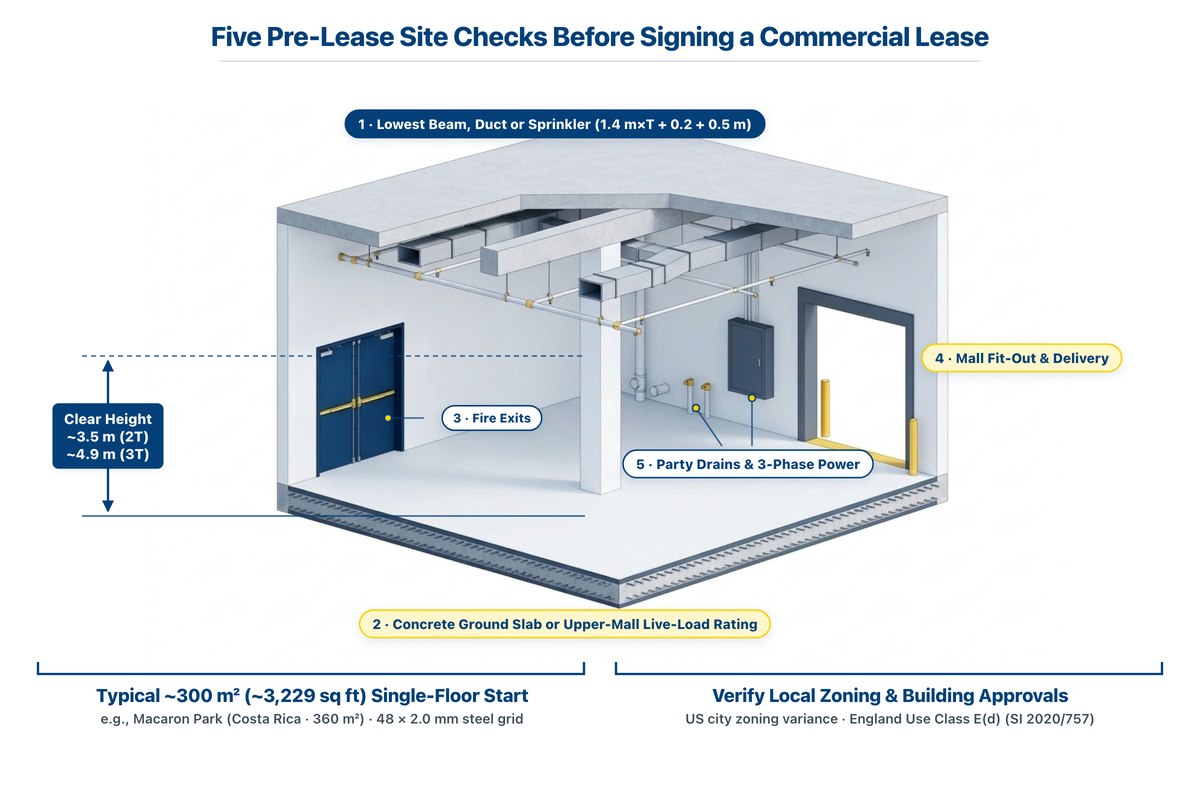
Most first-time independent indoor playground owners we work with start at around 300 m² (roughly 3,229 sq ft) on a single floor, often paired with a restaurant in a standalone building or housed in an established shopping mall. For a delivered example near that scale, Macaron Park in Costa Rica spans 360 m² (about 3,875 sq ft) and combines a central maze play structure, a sensory sandpit, role-play areas, small trampolines, foam pits, and a ninja obstacle course.
Check ceiling clearances early to avoid expensive redesigns. Multi-level climbing structures need specific vertical clearances. At Zhenghan, load-bearing indoor soft-play towers use 48 mm outer-diameter galvanized steel tubing with a 2.0 mm wall and standard 1.4 m (about 4.6 ft) deck tiers. Our factory design rule adds 0.2 m (about 8 in) top frame clearance plus 0.5 m (about 20 in) clearance below overhead fire sprinklers. That requires roughly 3.5 m (about 11.5 ft) unobstructed height for a 2-tier build and 4.9 m (about 16.1 ft) for 3 tiers. Always measure clear height from the finished concrete floor to the lowest steel truss, HVAC duct, lighting track, or sprinkler head, including in buildings with angled roof peaks.
Check and record five site conditions in your facility plan before signing a commercial lease.
| Site Inspection Point | What to Measure Before Lease Signing | Operational Cost if Discovered Late |
|---|---|---|
| Unobstructed clear height | Measure floor to lowest beam, HVAC duct, and sprinkler across all bays | A 3.4 m ceiling forces dropping tiers, losing vertical slide drop, or shrinking structure footprint |
| Concrete slab & load capacity | Verify flat concrete ground slab or upper-mall structural live-load rating | Upper shopping mall decks frequently cap concentrated loads below multi-level steel and high guest density |
| Fire compartmentation & sprinklers | Review sprinkler drop heads, rated fire exits, and smoke-zone rules locally | Internal party walls or dense overhead netting can trigger costly sprinkler head relocations |
| Mall landlord fit-out gates | Confirm approved operating hours, noise insulation, glazing rules, and work hours | Malls often prohibit daytime welding/drilling and require stamped engineering drawings prior to handover |
| Party room water & power | Map sanitary floor drains, grease traps (for food prep), and three-phase electrical supply | Trenching a cured concrete slab later adds heavy contractor charges and weeks of municipal permitting |
Land-use approval depends on local law. In the United States, SBA launch guidance calls for checking municipal zoning ordinances with your city planning office before leasing. Play centers in light-industrial flex spaces frequently need conditional-use variances compared with strip retail. In England, indoor sport, recreation, and fitness facilities fall broadly under Use Class E(d) per SI 2020/757, subject to local planning authority confirmation for your exact address. Regional business rates rules also apply in England and Wales, with Scotland and Northern Ireland operating separate systems.
Keep two limits in mind. Use 300 m² (~3,229 sq ft) only as a common starter footprint, and our 3.5 m / 4.9 m calculation only as Zhenghan’s structural engineering guideline. Confirm statutory municipal code requirements locally. Larger regional parks, such as our PINGULI Play House delivery in Budapest at 1,250 m² (roughly 13,455 sq ft) or Play Park Lincoln in Monterrey at 2,915 m² (roughly 31,377 sq ft) with a 7 m ceiling, need warehouse spans for wide circulation lanes, high ropes, or large trampoline courts. Before committing to a lease, send dimensioned floor drawings with column grids and minimum clear heights so you can get a layout and quote that fits your shell.
Franchise or Independent
The choice between an indoor play franchise and an independent brand determines your upfront fees, monthly gross royalties, vendor restrictions, and control over the venue. Franchise systems provide operating manuals, registered branding, and vendor relationships at substantial upfront and ongoing cost. Independent business owners control ticket pricing, menu margin, local theming, and direct manufacturer purchasing.
Publicly filed U.S. Franchise Disclosure Documents (FDDs) show the scale of investment and ongoing fees. Large trampoline-park franchise systems require substantial capital and warehouse space. Urban Air’s 2026 FDD Item 7 lists $2,852,887 to $5,441,558 for 2.0 locations (rising to $7,944,050 for 2.5 formats), plus a $100,000 franchise fee, 7% gross royalty, and 6% local marketing. For dedicated indoor play centers, a 2025 FDD secondary summary for Momi Land (sites spanning 5,000–20,000 sq ft / ~465–1,858 m², via FDD Exchange) reports a $50,000 initial franchise fee, a 7% gross sales royalty (minimum $1,000 per month), a 1% brand ad fund, $199–$300 monthly software fees, required affiliated equipment purchasing, and total initial investment estimates of $305,400 to $544,000 (allocating $100,000–$150,000 to equipment and $50,000–$150,000 to leasehold improvements).
| Comparison Criterion | Indoor Play Franchise Route | Independent Venue + Direct Factory |
|---|---|---|
| Initial brand / territory fee | Commonly $30,000–$50,000+ upfront (Momi Land 2025 FDD cites $50,000 first center) | $0 franchise fee; preserves upfront capital for construction and working cash |
| Recurring revenue cut | Typically 7% royalty + 1%–6% ad contributions deducted off gross sales | 0% royalties; 100% of gross sales stays inside your operating account |
| Equipment sourcing & theme custom | Bound to designated supplier catalogs and fixed brand appearance (FDD Item 8) | Free 2D/3D custom design (initial layout and budget typically in ~7 days), tailored mascot/IP theming, direct Wenzhou manufacturing |
| Support & brand recognition | Formal training program and established name recognition in clustered regions | You create local marketing and daily customer service SOPs with factory setup/training manuals |
| Geographic eligibility | Most U.S. FDD networks restrict unit sales to North America | Works globally across the Americas, Europe, UK, and local neighborhood retail plazas |
Some prospective owners also look at buying an existing indoor playground business for sale to skip build-out permitting. Check three details before valuing the assets. Review the remaining lease term and landlord assignment approval, inspect structural bolts, EPE padding, and PVC covers for wear, and confirm whether the original safety certificates under ASTM F1918 or EN 1176 legally transfer to the new entity.
Use these FDD figures within their original scope. Momi Land’s 2025 filing covered a 3-unit Ohio company-owned group with zero franchised outlets at the time, built around a larger 5,000–20,000 sq ft (~465–1,858 m²) center format. Scaling those costs down in direct proportion to a 300 m² urban unit would give a misleading budget. Operators considering large trampoline-anchored parks can also read our breakdown comparing franchise vs. independent amusement venues.
Startup Budget
Build your startup costs chapter around four budget categories—custom equipment fabrication, international logistics and installation, local construction and compliance, and pre-opening reserves. Check what any online “average build cost” actually includes. Sample business plan blogs often quote unverified figures like $30,000 to $150,000 without saying whether fire sprinklers, concrete floor prep, shipping containers, or three months of payroll are included.
Zhenghan offers an early financial planning benchmark of roughly USD 120 per square meter (around USD 11.15 per sq ft) of total leased venue space, FOB China, covering custom CAD design and equipment production (2026 rate). For a 300 m² (roughly 3,229 sq ft) single-floor unit, that gives an illustrative early equipment estimate around USD 36,000 FOB China. Use that figure with two qualifications. USD 120 per m² is solely an early-stage planning estimate, never a fixed binding quotation. Your fixed contract quote depends on the final layout density, themed panels, slides, and deck height. We deliberately do not publish a fixed percentage claiming equipment equals X% of total investment, because commercial rent, local contractor labor, and municipal fire codes vary widely by region.
| Startup Budget Bucket | Concrete Cost Items | How Commercial Quotes & Responsibilities Work |
|---|---|---|
| 1. Design & Play Equipment (FOB China) | 48 mm × 2.0 mm steel structure, slides, safety nets, EPE foam, 0.45 mm PVC cladding, ball pit (0.9 mm PU leather surround, BPA-free PE balls), toddler soft play, free 2D/3D drawings | Budgeted initially near USD 120 per m² (~USD 11.15 per sq ft) of gross leased area; fixed after design lock; 30% T/T deposit / 70% prior to dispatch |
| 2. Freight, Import Duties & Installation | Graded export packing, ocean container freight (billed on finished cargo volume), port handling, import duties/VAT, site erection | Zhenghan coordinates ocean booking to your port; buyer handles customs clearance; install via owner crew with manual OR Zhenghan technicians at USD 150 / technician / day plus travel, lodging, meals, and visas |
| 3. Building Fit-Out, Deposits & Permits | Landlord security deposit, architectural drawings, HVAC, fire sprinkler drops, commercial flooring, party walls, reception furniture, POS system, general liability insurance | Sourced locally in your home currency; gather at least two licensed general contractor bids before applying for bank loans |
| 4. Pre-Launch Marketing & Working Capital | Storefront signage, local website & online booking, social media launch ads, pre-opening staff training payroll, sock/cafe stock, minimum 3 months cash cushion | Bridges negative or thin initial weekday cash flow while party bookings and recurring memberships build |
Import duty rates for equipment shipped from China depend on exact national tariff subheadings, origin declarations, and trade policy updates. Never hardcode a guessed tariff percentage into an SBA loan forecast. Check current classifications through official government portals—the U.S. CBP importer guide and USITC Harmonized Tariff Schedule (HTS), the GOV.UK Trade Tariff, or the EU TARIC database—and ask a licensed customs broker for a landed quote using your factory proforma invoice. Owners commonly fund the project through a mix of personal savings, SBA 7(a) loans, commercial equipment leases, and negotiated Tenant Improvement (TI) credits from landlords. A zero-cash plan is rarely enough to cover lease deposits and insurance binding. For the effect of larger multi-zone footprints on shipping volume and total build expense, see how full-venue equipment, shipping, and fit-out costs stack up, and review factory supply terms in buying indoor playground equipment from China.

Revenue Streams and Pricing
Build healthy revenue streams around one primary income driver and one weekday stabilizer before taking on six separate business lines on opening weekend. Venues that depend entirely on walk-in open play passes face sharp swings with rainstorms, sunny summer days, and school schedules. Rent still comes due when Tuesday mornings are quiet.
Commercial indoor play centers draw on five core revenue sources.
| Income Category | Commercial Role in Cash Flow | Operational Load & Risk Balance |
|---|---|---|
| Birthday party packages | High-margin weekend anchor booked in advance with non-refundable deposits | Demands private party rooms, smooth host handoffs, cleaning gaps, and strict outside-food rules |
| Daily open play admissions | Top-of-funnel community trial pulling new neighborhood families into the venue | High seasonal and weather volatility; low forward visibility if unsupported by recurring sales |
| Memberships & multi-visit packs | Stabilizes predictable recurring cash per month and brings regulars midweek | Requires member perks (discount cafe items, exclusive hours) and disciplined billing automation |
| Coffee bar, snacks & grip socks | Lifts revenue potential per family while guardians supervise toddlers from nearby seating | Adds health department permitting, inventory waste management, and cafe labor coverage |
| Morning classes & play sessions | Monetizes slow weekday windows via sensory play, music, or toddler readiness hours | Easier to manage through part-time partner instructors than expanding full-time payroll |
Keep focus tight inside a 300 m² (~3,229 sq ft) space. Adding extensive hot-kitchen dining, elaborate craft camps, drop-off daycare licensing, and a packed event schedule at once can overwhelm a lean floor crew and weaken customer service. Set prices around what parents in your zip code will pay, check competitor ticket tiers in person, and pair weekend party bookings with steady weekday recurring passes.
Profit Margins
Treat any single average profit margin or guaranteed payback month with caution. Each venue’s net income depends on monthly rent, loaded payroll taxes, utilities, and party bookings. Check whether historical unit figures in franchise disclosures show gross sales or actual store profit. Momi Land’s 2025 FDD secondary summary (transcribed by FDD Exchange across all three Ohio company-owned locations under a 5,000–20,000 sq ft franchise format) discloses 2024 average annual gross sales of $528,770 (median $581,506). The summary omits lease expense, staffing hours, insurance premiums, and net profit. The figures reflect that larger-format system, so a 300 m² unit needs its own forecast. Online “300 m² sample P&Ls” listing three full-time staff at USD 5,000 total monthly wages and an assumed “19% Year-1 ROI” quickly fall apart when banks apply real minimum wages, payroll burdens, and electricity rates.
Before relying on positive monthly profit in your financial plan, test three costs that regularly erode projected margins for business owners.
- Uncompensated owner hours: If your model only breaks even because you schedule yourself 50 hours per week on desk check-in and cleaning without drawing a salary, your venture cannot afford a hired manager and lacks true business margin.
- Fixed lease ratio during quiet weekdays: When base rent, CAM charges, commercial property taxes (or England & Wales business rates), and insurance consume too much revenue across slower Tuesday–Thursday schedules, weekend crowds merely pay fixed overhead. Run an honest break-even analysis: divide fixed monthly expenses by your net contribution margin per paying guest after consumables and card fees.
- Maintenance, sanitation, and part replacement: High-wear safety nets, replacement balls, torn vinyl seams, and HVAC filter cycles need dedicated monthly reserve lines once opening-year excitement settles.
Because store margins swing heavily with city rent, loaded labor taxes, and party scheduling, we state transparently what Zhenghan publishes versus leaves to your local data: we provide our factory hardware planning rate, production brackets, and warranty schedule above, while deliberately withholding generic equipment-percentage rules, assumed average profit margins, or forced revenue defaults in financial tools. Replace online guesses by testing your real lease quote, contractor bid, ticket pricing, and local wage schedule in the Indoor Playground Budget and Payback Calculator below. If you leave the equipment quote box blank, the tool estimates custom design and factory hardware at our early planning rate of roughly USD 120 per m² (FOB China), based on total leased area. Replace that estimate with your written quotation when you have one. You supply all construction, shipping, visitor counts, ticket spend, rent, and payroll inputs, with zero forced revenue presets. The simplified math excludes interest, taxes, and seasonal swings. You can also test multi-zone trampoline scenarios with the same engine in our trampoline park startup cost guide.
Indoor Playground Budget and Payback Calculator
Enter what you know. Leave a field empty if you do not have the number yet.
Equipment uses our first-budget rate of about USD 120 per m² of total venue area, FOB China, for design and equipment; every other figure is yours. The result leaves out loan interest, taxes and seasonality.
Get a fixed equipment quote for your layoutOnce conservative guest volume produces comfortable monthly profit and an acceptable payback horizon in your calculator test, work backward to organize site preparation, factory manufacturing, and regulatory permitting on a single master calendar.
Opening Checklist
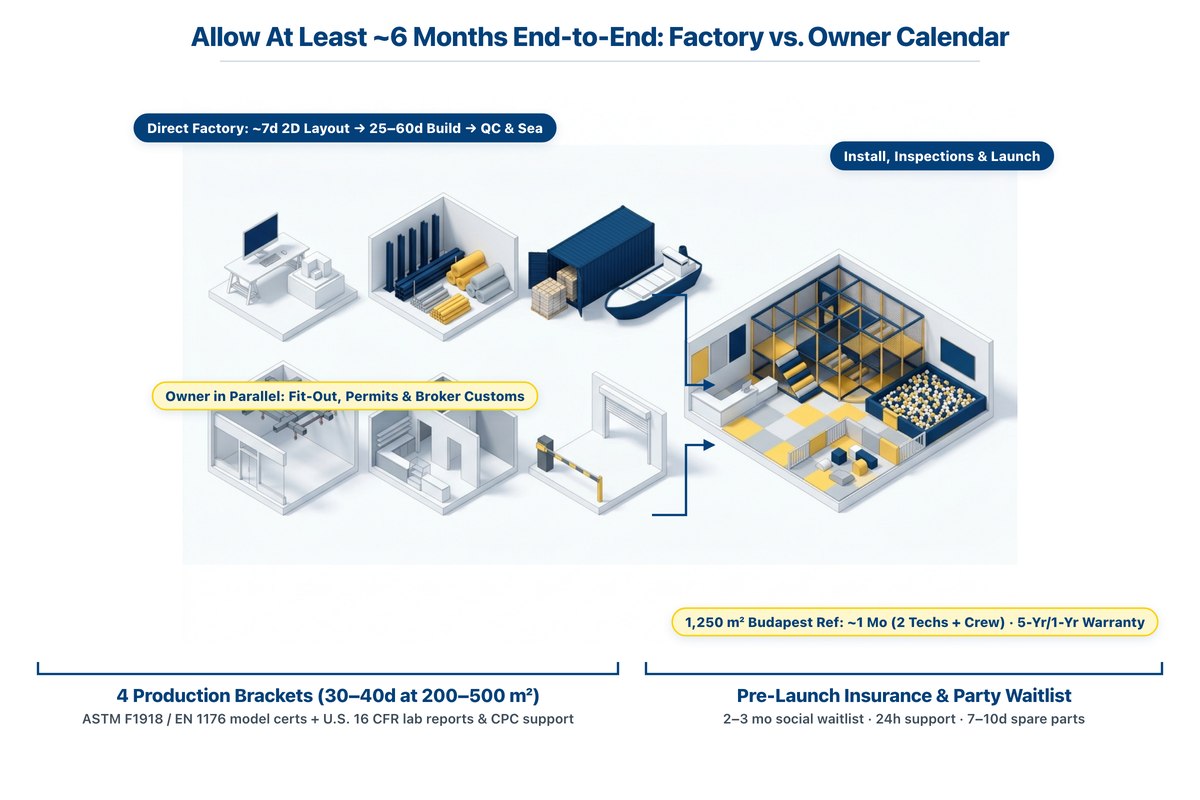
Allow at least about six months from lease commitment to grand opening for an independent imported playground project, with extra time for slow municipal permitting or shopping-center design reviews. Buyers run into preventable rent burn most often when they track factory manufacturing days and overlook ocean transit, broker customs clearance, site construction coordination, and pre-launch marketing.
| Execution Stage (Work Backward) | Primary Owner | Verified Timing & Key Output | Common Opening Blocker Avoided |
|---|---|---|---|
| 1. Site measurements & age brief | Owner (architect / broker) | Accurate floor plan, column spacing, minimum clear height, target ages | Leasing shell with low sprinkler drops, weak upper-floor slab rating, or unzoned industrial status |
| 2. Free 2D/3D design & fixed price | Zhenghan design team | Initial 2D layout and preliminary budget typically within 7 days; 3D theme visuals, free revisions, and fixed quote once zones lock | Changing party walls or slide landing zones after production drawings freeze |
| 3. Equipment production | Zhenghan (starts on 30% T/T deposit) | Floor areas below 200 m² (~2,153 sq ft): 25–30 days · 200–500 m² (~2,153–5,382 sq ft): 30–40 days · 500–2,000 m² (~5,382–21,528 sq ft): 40–50 days · 2,000 m²+: 50–60 days | Waiting until containers depart China before hiring local contractors for HVAC, sprinklers, and party-room plumbing |
| 4. Quality check, balance & sea freight | Zhenghan ships; Owner settles balance | Pre-shipment factory walk-through (in person or live video); 70% balance + actual cargo sea freight settled; ocean booking to destination port | Budgeting rigid shipping guesses without accounting for final cubic meter volume and peak-season ocean rates |
| 5. Destination port clearance | Owner (with customs broker) | HS tariff filing, duty/VAT payment, container trucking to retail dock | Assuming FOB export price covers port brokerage, import tax, or doorstep unloading |
| 6. On-site structure installation | Owner crew (manual/remote engineering) OR Zhenghan technicians (USD 150 / tech / day + travel) | Real reference: on our Hungarian reference PINGULI Play House (Budapest delivery rated at 1,250 m² / ~13,455 sq ft, 2025 repeat client), the first set installed in about 1 month with 2 technicians plus local workers | Containers sitting in paid storage while concrete floor curing, lighting rails, or power drops lag behind |
| 7. Inspections, insurance & launch | Owner | City fire/occupancy permit, liability & property policies active, 2–3 months of social media pre-launch party waitlist, staff safety training | Applying for commercial liability insurance too late without matched structure compliance records |
Get your equipment safety documentation in order before buying hardware or applying for commercial insurance. Multi-level indoor play structures from Zhenghan carry model-specific certifications under ASTM F1918 (North America) and EN 1176 (Europe), while trampoline areas follow ASTM F2970 and EN ISO 23659—and our tested play structure models also hold U.S. 16 CFR mechanical and flammability test reports. As the U.S. CPSC’s public guidance on playground equipment explains, commercial public-use structures rely on voluntary consensus safety standards alongside federal U.S. children’s product rules where toy attachments or chemical limits apply (such as 16 C.F.R. part 1250 and phthalate rules under part 1307). For U.S. importers, we prepare a Children’s Product Certificate (CPC) backed by applicable third-party test reports. Because standalone toddler areas, ball pits, carousels, and themed elements fall outside multi-level climbing frame certificates, confirm your target country early so our team can specify which standards and documents apply to each zone, and review our US and European safety standards and test reports alongside our step-by-step design, production, and installation workflow.
After installation wraps up, equipment carries a five-year warranty on the steel frame plus a one-year warranty on soft goods, mats, nets, and other parts, backed by 24-hour after-sales support and typical 7 to 10 day dispatch on spare parts—policies worth citing directly inside the Operations section of your business plan.
FAQ
Can you start an indoor playground business with no money?
Starting from zero cash is rarely practical. Retail landlords expect multi-month lease deposits, municipal inspectors charge plan-review fees, and insurers require paid binders before opening. Founders can reduce personal cash outlays by pairing savings with U.S. SBA 7(a) loans, commercial equipment financing, and negotiated landlord Tenant Improvement (TI) allowances in multi-year retail leases.
How much does it cost to open an indoor playground of around 300 m² (3,229 sq ft)?
Your all-in launch budget has to reflect local construction costs, HVAC modifications, commercial deposits, and three-month payroll reserves, which vary widely by city. For custom design and factory hardware alone, Zhenghan’s 2026 early planning figure sits near USD 120 per m² (roughly USD 11.15 per leased sq ft), FOB China. That puts an initial planning estimate for 300 m² near USD 36,000 FOB China before crating, ocean shipping, duties, installation, local construction, and launch reserves. Use your project layout quote and local contractor bids to replace estimates in our calculator above.
What ceiling height and floor setup do you need for a 300 m² indoor playground?
Under Zhenghan’s engineering rule for 48 mm × 2.0 mm galvanized multi-level soft play structures, standard 1.4 m deck tiers stack with a single 0.2 m top frame allowance and 0.5 m clearance below overhead sprinkler heads. That translates to roughly 3.5 m (~11.5 ft) minimum unobstructed height for two levels and 4.9 m (~16.1 ft) for three levels, measured strictly beneath the lowest structural beam, duct, lighting rail, or sprinkler head across a concrete slab. Verify mall live-load rules, fire compartmentation, and party-room drains before finalizing rent terms.
What kind of insurance do you need for an indoor playground?
SBA and commercial insurance checklists prioritize Commercial General Liability (CGL) for guest injury claims, Commercial Property insurance for installed structures and cafe equipment, and Workers’ Compensation where required locally. Before equipment fabrication, confirm in writing with insurance brokers whether underwriting requires ASTM F1918 or EN 1176 structure documentation (plus ASTM F2970 / EN ISO 23659 if adding trampoline zones), a U.S. Children’s Product Certificate (CPC) backed by applicable test reports, or additional third-party documents for secondary soft-play items.
How long does it take to write the plan and open an indoor playground?
Plan for at least around six months end-to-end for an independent imported facility, with extra time for slow local permits or mall fit-out approvals. Zhenghan typically delivers initial 2D layouts and preliminary budgets within 7 days, follows with 3D renderings and fixed contract pricing once the layout is set, and completes factory manufacturing in 25 to 60 days based on total area brackets (30–40 days for 200–500 m²). On our Hungarian reference PINGULI Play House (catalog delivery listed at 1,250 m² in Budapest), the first set took about one month to install (2 factory technicians alongside local workers). Ocean transit and buyer-handled customs clearing depend on destination port schedules.
How do I verify how to open an indoor playground without falling for fake business plan P&L templates?
Remove pre-filled revenue guesses and suspiciously low payroll figures from downloaded spreadsheets before presenting them to landlords or lenders. Verify every input. Get a written letter of intent stating base rent plus CAM/tax rates, two local general contractor bids aligned to city fire rules, and written insurance indications. Calculate staffing costs using local wages and realistic open hours, and request a layout-specific CAD quotation from Zhenghan based on your actual building shell.
Turn Your Floor Plan Into a Fixed Equipment Layout and Budget
Before signing a lease or finalizing funding worksheets, send us your measured building plan, lowest clear height below beams and sprinklers, city, and core age group to get a layout and quote. Our engineers deliver a free initial 2D layout and preliminary budget typically within 7 days, followed by 3D concept renderings and fixed itemized equipment pricing once zones are confirmed—giving you concrete hardware numbers, shipping container sizing, and factory lead times for every financial table in your business plan.
Authoritative References Used in This Guide
- U.S. Small Business Administration (SBA) — Write your business plan & Apply for licenses and permits / Get business insurance (sba.gov, accessed November 2026)
- UK Government (GOV.UK) — Write a business plan (gov.uk/write-business-plan, accessed November 2026) · SI 2020/757 Town and Country Planning Use Class E(d) · GOV.UK Trade Tariff (gov.uk/trade-tariff)
- U.S. Consumer Product Safety Commission (CPSC) — Playground Equipment Business Guidance (cpsc.gov/Business–Manufacturing/Business-Education/Business-Guidance/Playground-Equipment, accessed November 2026)
- U.S. CBP / USITC & European Commission — Importer/Exporter Tips, Harmonized Tariff Schedule (HTS), and EU TARIC
- Momi Land Franchise 2025 FDD Summary — Secondary FDD transcript via FDD Exchange (fddexchange.com/fdd/momi-land-2025/, accessed November 2026; 3 company-owned U.S. locations, 5,000–20,000 sq ft) & Urban Air 2026 FDD Item 6/7 disclosures
Send your building floor plan, lowest ceiling clear height, target city and age mix for a custom 2D layout and FOB China budget within ~7 days.
Get a Free Layout and Budget