

Commercial indoor playground equipment cost starts near USD 120 per square meter, or around USD 11.15 per square foot, based on total leased floor area. This FOB China benchmark covers custom layout engineering and commercial equipment for 2026 planning—including the main play structure, standard equipped toddler zones, and play-area EVA floor mats. It belongs in a different category from the USD 135 to USD 1,274 home-use playsets and wooden jungle gyms sold on consumer retail sites. Treat it as an early planning baseline rather than a fixed binding contract price; export packaging and ocean shipping, destination customs duties, site installation, and building renovation work are excluded. Because USD 120 per m² is only an initial estimate for a standard mixed playground, adding higher-cost attractions such as ninja obstacle courses, aerial adventure attractions, or ropes courses pushes up your overall equipment price. If your venue is strictly a pure low-age frameless soft-play space with no multi-level steel structure at all, it does not share that mixed-playground per-m² baseline and is quoted directly from your actual layout plan. For the rest of your launch budget, use our indoor playground business plan guide.
ContentsEstimate Your Budget and Payback
Put factory pricing, ocean transit, installation costs, tenant construction, and reserve capital in one budget. An equipment invoice alone misses container drayage, landlord security deposits, fire sprinkler adjustments, concrete slab leveling or reception-area flooring, and opening cash reserves. Comparing the full startup budget with expected local visitor revenue shows whether a proposed play space fits your funding before steel fabrication begins.
Keep factory quotes separate from local construction costs when comparing markets. Single-level spaces around 300 m² (3,229 sq ft) inside suburban shopping malls face different permitting fees and contractor wages than a 2,500 m² (26,910 sq ft) standalone warehouse, even if both source durable equipment from the same manufacturing line. A vendor quote covers the engineered commercial products and drawings. Real estate, monthly labor, ticket prices, and municipal licensing depend on your local market.
The calculator uses your inputs to guide playground planning and keep projections tied to your project. Enter total leased floor area to calculate a baseline FOB China equipment budget at USD 120 per m² (about USD 11.15/sq ft). A formal custom indoor playground quote automatically replaces that benchmark when you enter it. Operating inputs start blank, with no assumed attendance or fixed payback months. Totals exclude corporate taxes, loan interest, and seasonal attendance shifts.
Enter your building square footage, local contractor buildout bids, regional freight estimates, and conservative daily traffic below to set an investment budget before comparing equipment types.
Indoor Playground Budget and Payback Calculator
Enter what you know. Leave a field empty if you do not have the number yet.
Equipment uses our first-budget rate of about USD 120 per m² of total venue area, FOB China, for design and equipment; every other figure is yours. The result leaves out loan interest, taxes and seasonality.
Get a fixed equipment quote for your layoutWhat Drives the Price
Floor area alone tells you little about the final equipment bill. Structural height, engineering complexity, high-thrill attractions, material specifications, and custom theming separate commercial indoor playground solutions far more sharply. Two spaces measuring 400 m² (4,306 sq ft) can have very different factory costs: one may hold ground-level foam toddler blocks, while the other has tall galvanized decks with multi-lane slides, ninja obstacles, and suspended aerial trails. Knowing where the design needs engineering hours and steel tonnage helps you cut costs while preserving play capacity.
Heavy Thrill Add-Ons: Ninja Courses, Aerial Adventure, and Ropes Courses
Adding ninja courses, aerial adventure attractions, and overhead ropes courses costs more than a traditional padded maze because of heavier structural and safety work. Suspended routes require reinforced trusses, overhead rigging anchors, specialized fall-protection features, landing pits, and custom connectors that take longer to fabricate and assemble than standard pipe grids. Giant fiberglass slides and sculpted 3D entrances also add custom tooling and hand-finishing.
There is no reliable flat percentage for these additions because spans and heights vary by layout. Manufacturers quote dynamic attractions from scaled drawings; expect early estimates to rise when ninja tracks or high ropes occupy major floor share, and name them in your initial brief.

| Price Driver | Engineering Impact on Manufacturing | Zhenghan Specification Standard | Pricing Effect Across Identical Footprints |
|---|---|---|---|
| Structural Tiers & Ceiling Height | Each vertical level adds structural piping, deck boards, safety netting, and climb transitions | 1.4 m (4.6 ft) standard tier height; factory clearance formula: tiers × 1.4 m + 0.2 m + 0.5 m below sprinklers → 3.5 m (11.5 ft) for 2 tiers, ~4.9 m (16.1 ft) for 3 tiers | Expanding from 2 levels up to 3 levels multiplies vertical tonnage within zero extra rent area |
| Ninja, Aerial & Ropes Zones | Dynamic adult/teen loads need reinforced beams, rigging anchors, specialized fall-protection systems, and deep foam pits | Quoted from your layout drawings and obstacle spans rather than covered by the rough early benchmark | Adding these higher-cost attractions increases total equipment investment noticeably above a baseline estimate |
| Galvanized Frame Tubing | Heavy wall steel maintains bolted joint stiffness across years of high-capacity daily play | Galvanized structural steel tubing measuring 48 mm diameter × 2.0 mm thickness | Thin tubing appears cheaper initially yet flexes prematurely under busy weekend traffic |
| Pads, Covers, & Netting | Dense protective wrapping resists scuffing and vinyl splits at active slide mouths and net tunnels | Board + EPE foam + 0.45 mm PVC decks; 0.9 mm PU leather on ball pools and themes; machine-woven nylon safety nets | Higher gauge covers add initial unit weight while cutting multi-year maintenance bills |
| Slides & Electric Features | Large spiral or fiberglass runs and motorized rides demand custom molds, freight volume, and electrical assembly | Molded plastic, stainless steel, or fiberglass slides; board/PU/EPE motor carousels | Anchor multi-lane slides and moving rides pack high capital concentration per floor bay |
| Bespoke Playground Design | Re-skinning templates limits engineering hours; hand-carved mascots and proprietary branding raise labor costs | Complimentary design: initial 2D layout & budget draft in ~7 days, followed by 3D renderings across jungle, candy, macaron, neon, or custom themes | Heavy 3D character theming adds dedicated sculpting hours independent of play square footage |
Keep one distinction clear when budgeting for height: our allowance of 0.2 m (0.7 ft) top clearance and 0.5 m (1.6 ft) under sprinkler pipes for every 1.4 m (4.6 ft) deck tier is Zhenghan factory design guidance rather than local municipal code. Verify fire sprinkler drop zones, slab load ratings, and emergency exits with your architect early. Irregular columns and low ductwork can require custom steel cuts and add engineering work.
Price by Size and Type
Venue size shapes attraction mix, circulation, age separation, and lead time. Compact cafe corners suit shorter runs; regional parks need multi-story towers, teen zones, and multiple containers. Once approved renderings reach our workshop, production follows four size tiers: spaces of 200 m² or smaller (at most 2,153 sq ft) take 25 to 30 days, 200 to 500 m² (2,153 to 5,382 sq ft) spaces take 30 to 40 days, 500 to 2,000 m² (5,382 to 21,528 sq ft) venues require 40 to 50 days, and facilities larger than 2,000 m² (21,528 sq ft) take 50 to 60 production days.
| Venue Scale Bracket | Typical Operating Setting | Typical Zone Mix & Delivered Examples | Factory Production Duration (Post-Approval) | Cost Estimation Boundary & Fit |
|---|---|---|---|---|
| Compact Zone: 200 m² or Less (≤ 2,153 sq ft) | Cafes, family restaurants, retail corners, boutique childcare | Padded toddler soft play, ball pool, compact twin-slide climber, EVA mats, perimeter edging | 25 to 30 days | Boutique rooms often center on pure frameless soft play or custom corner geometry; quote directly from your floor plan |
| First-Time Storefront: 200 to 500 m² (2,153 to 5,382 sq ft) | Single-floor standalone centers (paired with dining) or mall inline spaces (~300 m² / ~3,229 sq ft frequent starting scale) | Delivered case: Costa Rica’s Macaron Park at 360 m² (3,875 sq ft) combining central maze, sensory sandpit, role-play bays, trampolines, foam pits, and ninja zone | 30 to 40 days | Good fit for early planning near USD 120 per m² (about USD 11.15/sq ft) FOB China prior to drawing lock-in; ninja add-ons increase final sums |
| Mid-Size Play Center: 500 to 2,000 m² (5,382 to 21,528 sq ft) | Anchor mall play destinations, suburban multi-age venues | Delivered case: Budapest’s candy-themed PINGULI Play House at 1,250 m² (13,455 sq ft) with multi-tier climbing structures, trampolines, and toddler zones (owner ordered a second set) | 40 to 50 days | Gross-area FOB planning works cleanly across mixed zones; fiberglass megaslides and elaborate custom sculpting shift final quotes |
| Family Entertainment Center: Above 2,000 m² (above 21,528 sq ft) | High-ceiling regional warehouse parks targeting ages 1 through teens | Delivered case: Monterrey’s Play Park Lincoln (Mexico), finished in 2025 under a 7 m (23 ft) ceiling spanning 2,915 m² (31,377 sq ft) with varied slides, ball pools, interactive climbing structures, high ropes challenge courses, and trampoline areas | 50 to 60 days | Ropes courses and major trampoline bays require custom engineering pricing; compare full-hall trampoline pricing at trampoline park startup and equipment costs |
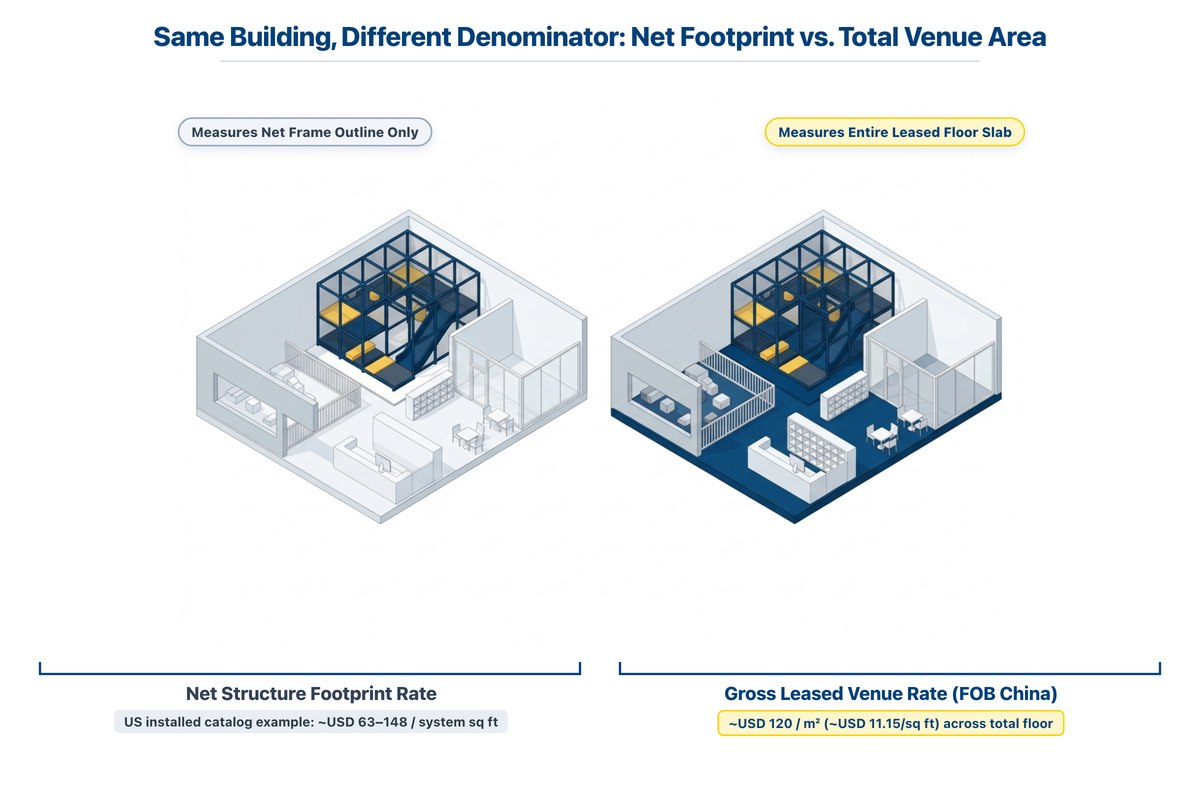
Online prices often look inconsistent because suppliers use different area measurements and delivery scopes. One supplier’s 2026 guide (Luckyplay), for instance, quotes broad ranges—USD 25 to USD 75 per sq ft for equipment alone or USD 75 to USD 250 per sq ft turnkey—without saying whether the rate applies to the structure footprint or the whole leased space. Catalog listings offer a more concrete comparison, though these figures reflect a single US provider. In its 2026 published US listings, Indoor Playground Creations includes US shipping, professional crew assembly, and an 18-month limited warranty in starter pricing. A 19 ft × 24 ft × 11.2 ft tall space-themed setup (456 sq ft / ~42 m² net structure area) lists at USD 61,908, and a wider 29 ft × 44 ft × 8 ft layout (1,276 sq ft / ~119 m² net structure area) lists at USD 80,784. A narrower 16 ft × 36 ft × 10.5 ft tall model (576 sq ft / ~54 m² footprint) lists at USD 85,307—more expensive than the 8-foot-tall system with more than twice its floor footprint—while a two-story 40 ft × 24 ft × 9.8 ft unit (960 sq ft / ~89 m² footprint) lists at USD 115,100.
| Pricing Method Contrasted | What Area Number Divides the Price | Scope Bundled Into Quoted Price | Practical Reason Totals Diverge |
|---|---|---|---|
| North American Delivered System Catalog (Indoor Playground Creations, 2026 published figures) | Net structure footprint only (456 to 1,276 sq ft / ~42 to 119 m² system outline) | Play structure, US domestic shipping, turnkey installation crew, and 18-month limited warranty | Concentrates packed multi-tier steelwork, domestic freight, and US assembly onto net frame footprint (~USD 63 to USD 148 per system sq ft), plus vertical height beats flat floor spread |
| Direct Chinese Factory Early Benchmark (Zhenghan 2026 Planning Rule) | Gross leased building slab (such as a ~300 m² / ~3,229 sq ft total unit with reception, seating, and aisles) | Custom 2D/3D CAD planning, complete play equipment, equipped toddler zones, and play-area EVA floor mats on FOB China terms | Spreads the full play package across aisles, dining space, and active zones (near USD 120 / m² or USD 11.15/sq ft), keeping export packing, sea transit, customs duties, assembly, and building renovation separate |
Compare both the area basis and included scope before applying any rate. Applying a whole-venue FOB planning rate only to a net structure footprint underbudgets multi-tier equipment, whereas applying US installed catalog rates across an entire leased storefront overstates hardware costs. Contract totals for Macaron Park (360 m² / 3,875 sq ft) and Monterrey’s Play Park Lincoln across its 2,915 m² (31,377 sq ft) hall depend on each attraction mix and remain confidential under client agreements. Budget from total leased area first, then lock in a fixed price once renderings are approved. Next, check whether your venue is a mixed multi-level playground or a pure frameless toddler room.
Soft Play vs Multi-Level Structures
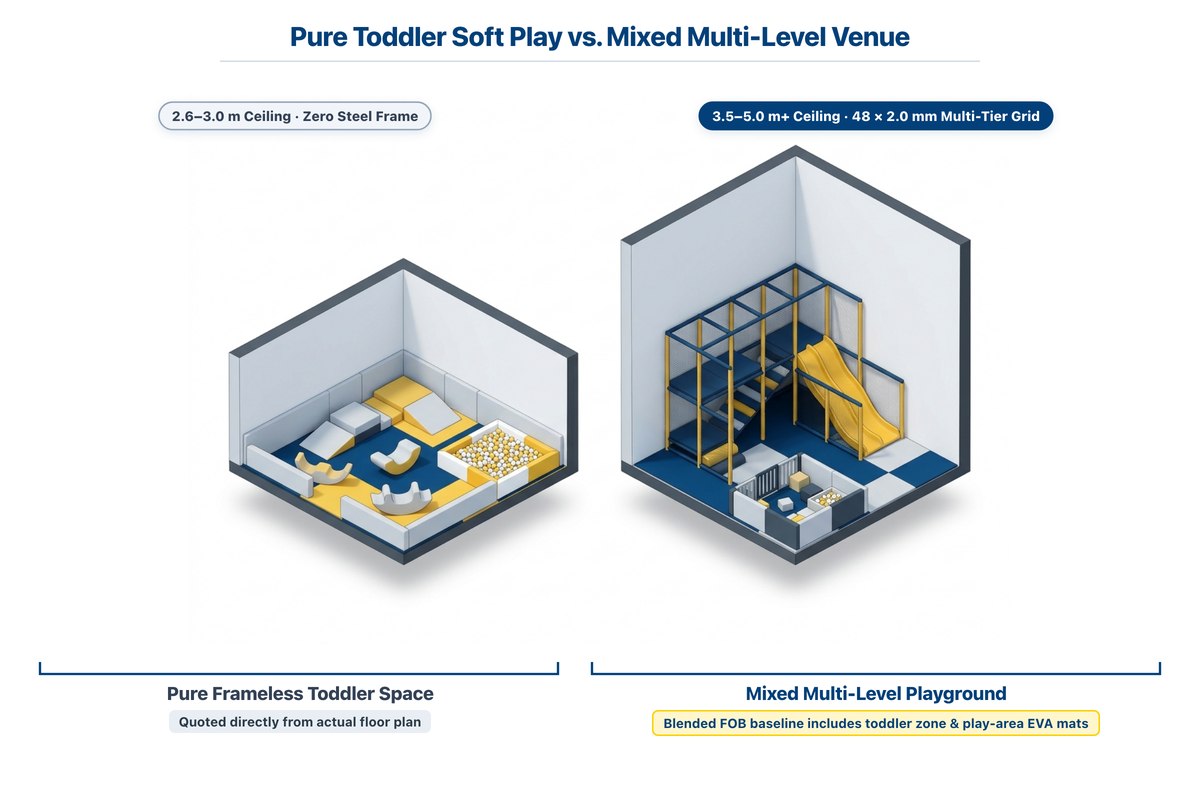
A pure low-age frameless soft-play venue and a mixed multi-level indoor playground do not follow the same per-square-meter pricing estimate. When you build a standard multi-level indoor playground with us, the dedicated toddler area, ball pool, and play-zone EVA floor mats are already included inside that blended ~USD 120 per m² FOB China venue estimate. Only when an entire storefront consists strictly of frameless toddler soft play—with no multi-level steel climbing structure at all—does that mixed-venue rate stop applying; pure low-age spaces are priced directly from the actual floor plan.
Pure low-age soft play venues serve young children under adult supervision (ages 1 to 6 across soft obstacles and 2–6 EVA building-block areas, and ages 1 to 8 in shallow ball pools). They use EPE and sponge foam obstacles, gentle toddler slides, EVA building blocks, play-area EVA floor mats, and low ball pits with BPA-free thick-walled PE play balls. Padded surrounds and themed foam blocks use abrasion-resistant 0.9 mm PU leather, with no structural steel frame. Mixed multi-level indoor playgrounds center on 48 mm diameter × 2.0 mm wall galvanized steel climbing frames for primary traffic aged 3 to 12 (with netted obstacle routes for ages 5 to 12), paired in the same venue layout with supervised toddler zones and EVA safety mats. Their main frames carry suspended board decks, 0.45 mm PVC vinyl wrapping, machine-woven nylon safety netting, and engineered plastic, fiberglass, or stainless steel slides.
| Engineering & Procurement Factor | Pure Toddler Soft-Play Venue (No Frame) | Mixed Multi-Level Playground | Budgeting Guidance for Buyers |
|---|---|---|---|
| Primary Support Structure | Self-supporting contoured EPE/EVA/sponge blocks, padded borders, zero steel frame | 48 mm diameter × 2.0 mm wall galvanized steel grid plus integrated toddler zone and EVA mats | Heavy structural fabrication, bolted couplers, and tall netting alter hardware costs fundamentally |
| Recommended Target Age | Built for toddlers and early learners (2–6 block sets, 1–8 ball pits, adult supervision) | Ages 3 to 12 on main frames (net climbs 5 to 12) plus dedicated toddler areas (1–3 / 2–6) | Mixed playgrounds serve siblings across age brackets under one coordinated venue quotation |
| Clear Ceiling Clearance | Suits compact standard retail ceilings (~2.6 m to 3.0 m / ~8.5 to 9.8 ft) | Zhenghan rule: 1.4 m (4.6 ft) tier + 0.2 m top + 0.5 m sprinkler gap → 3.5 m (11.5 ft) 2-tier, ~4.9 m (16.1 ft) 3-tier | Low storefronts suit pure frameless soft play; high ceilings convert overhead air into guest capacity |
| Core Fabrication Materials | EPE foam, sponge foam, painted board, EVA blocks & floor mats, 0.9 mm PU leather surrounds, BPA-free PE balls | 48 mm × 2.0 mm steel piping, board decks, EPE foam, 0.45 mm PVC wraps, machine-woven nylon nets, slides, EVA floor mats | Vinyl sewing density, molded slide tooling, and structural steel cutting drive dissimilar labor hours |
| Safety Documentation Scope | Confirm destination requirements per item before production begins | Tested multi-level play structures carry ASTM F1918 (US) and EN 1176 (EU) certificates + 16 CFR test reports | Never presume a frame test certificate automatically extends to standalone toddler foam blocks |
| Per-m² Estimate Fit | Does not share the mixed-venue m² rate; quoted directly from your actual floor plan | Blended early FOB baseline (~USD 120/m² or ~USD 11.15/sq ft) already covers the main frame, toddler zone, and EVA mats | Use ~USD 120/m² for mixed multi-level venues; request a layout-specific quote for pure frameless toddler rooms |
This distinction matters most for boutique play cafes and low-ceiling retail spaces. A 250 m² (2,691 sq ft) play cafe dedicating most of its floor to coffee tables and a small frameless toddler enclosure has a very different equipment bill from a 300 m² (3,229 sq ft) indoor playground combining multi-tier climbing frames, a toddler area, and full play-zone EVA matting under one quotation. Send your floor plan and target ages first so the budget reflects your exact zone layout.
Shipping, Installation and Hidden Costs
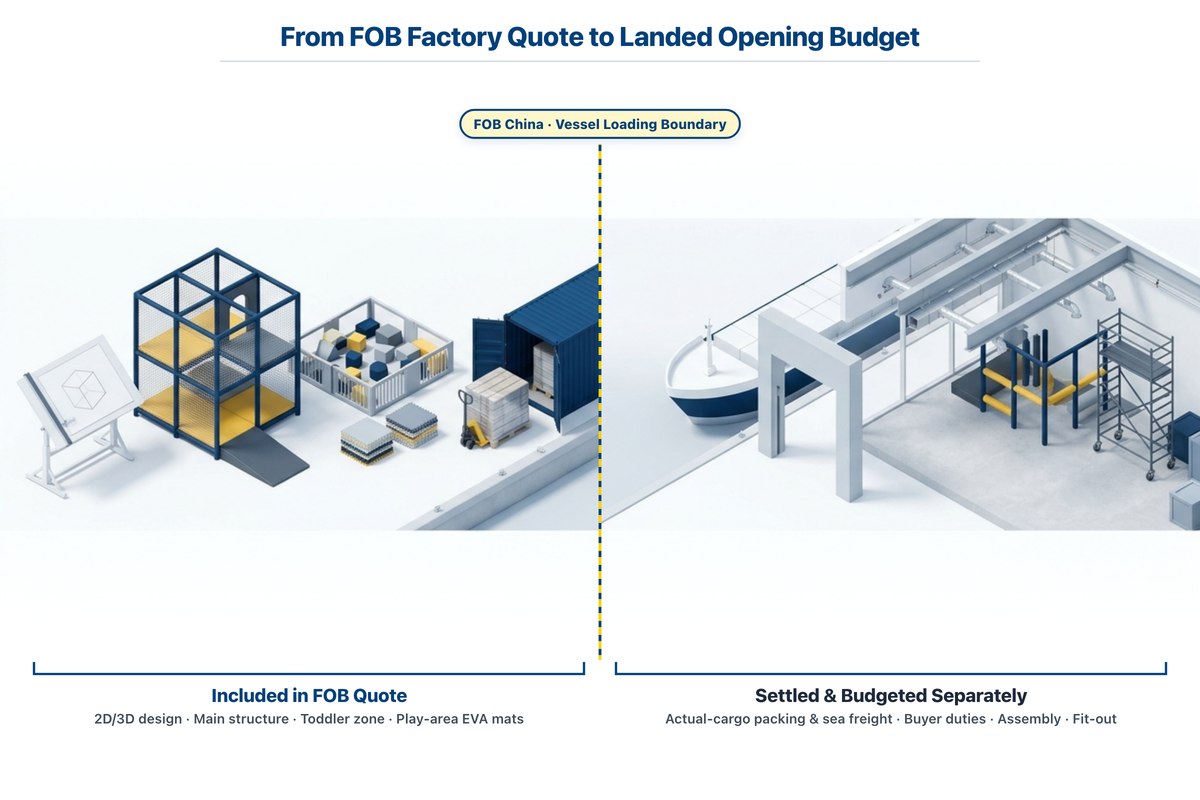
An FOB China equipment quote leaves five post-factory areas to budget before opening: export packing with ocean shipping, customs duties, installation costs, building fit-out with insurance, and ongoing wear-part upkeep. Buyers who focus only on factory equipment totals can run short of cash when containers arrive and electrical, sprinkler, and assembly bills come due. Budgeting for these items upfront helps prevent late project delays.
Under International Chamber of Commerce Incoterms 2020 definitions, FOB (Free On Board) China means the seller loads the finished goods aboard the nominated outbound vessel at the Chinese export port, and the buyer assumes ocean transport charges and maritime risk from loading onward. Fiberglass spirals, padded steel tubes, EVA mats, and soft blocks pack differently from design to design, so export packing and ocean shipping follow finished cargo volume after production completes. Standard factory payment uses T/T wire transfers: a 30% deposit starts production, then the 70% balance plus actual freight settles prior to shipment.
The buyer handles destination customs clearance and duties with a licensed customs broker in the arrival country. Do not assume a single tariff percentage. U.S. Customs and Border Protection (CBP) importer guidance calls for checking classification in the USITC Harmonized Tariff Schedule (HTS), submitting vessel Importer Security Filing (ISF “10+2”) records ahead of departure, and requesting written CBP binding rulings when mixed equipment assemblies make duty assessment unclear. British operators check commodity codes, tariffs, and VAT through GOV.UK Trade Tariff; European buyers check non-EU third-country rates in the European Commission’s TARIC database.
There are two installation options. Owners with capable local crews can self-install at zero factory technician fee using our detailed installation manuals and online technical guidance. For on-site support, Zhenghan technicians cost USD 150 daily per technician; the buyer covers return flights, lodging, meals, visas, and necessary local travel, and arranges local workers on site to assist our technicians. Installation time depends on venue size and layout. On our 1,250 m² (13,455 sq ft) Budapest installation for PINGULI Play House (whose owners ordered a second facility set after that first project), two dispatched technicians worked with local workers hired by the owner to complete assembly in approximately one month.
| Landed Expense Line | Assigned Responsibility | Pricing Mechanics & Factory Standard | Hidden Trap to Prevent Early |
|---|---|---|---|
| Export Packing & Ocean Transit | Factory packs cargo & arranges sea freight; buyer pays before shipment | Calculated from actual cargo cubic volume once production finishes, paid alongside the 70% pre-shipment balance | Unplanned container demurrage charges, inland port-to-mall chassis drayage, or missing unloading dock access |
| Destination Clearance & Duties | Buyer or buyer-appointed customs broker handles import declaration | Assessed locally via US CBP / USITC HTS schedules, GOV.UK Trade Tariff, or EU TARIC rates by country of origin | Unfiled US ISF “10+2” notices or inconsistent bill-of-lading naming stalling port release |
| On-Site Equipment Assembly | Buyer’s own team (with manual) or Zhenghan technicians + local helpers | Self-assembly avoids technician fees; factory specialists bill USD 150/day each plus travel, with local workers arranged by buyer | Inviting technicians before wet concrete cures, ceiling lights finish, or rented scissor lifts reach site |
| Building Fit-Out & Liability Cover | Venue owner & general contractor | Play-area EVA mats ship with our equipment; owner budgets concrete slab prep, HVAC, sprinklers, restrooms, lighting, insurance | Mall landlords demanding Class A flame spread documentation or municipal inspectors requiring wheelchair egress upgrades |
| Warranty & Ongoing Maintenance | Zhenghan factory support post-handover | Once site installation finishes, warranty coverage runs five years on structural framing and one year across other components, backed by 24-hour replies and 7-to-10-day spare-part dispatch | Failing to keep spare fastenings, net ties, or replacement PVC pole covers ready before peak holidays |
Coordinating building readiness alongside sea freight keeps handover on schedule. Because play-zone EVA floor mats ship inside our container with the equipment, your contractor only prepares a clean, level concrete slab and finishes reception or cafe flooring before delivery. Set sprinkler elevations before booking freight so assembly starts once cargo clears port. Review export terms in our guide to buying indoor playground equipment from China and project stages on our design-to-installation delivery process page.
How to Compare Quotes
When comparing three commercial quotes, check four things before judging the total: material gauges, the area behind the square-meter rate, post-factory exclusions, and verifiable safety certification records. A polished PDF can omit padding thickness, price only the steel cage, or leave freight and installation out of the summary until the contract is signed.
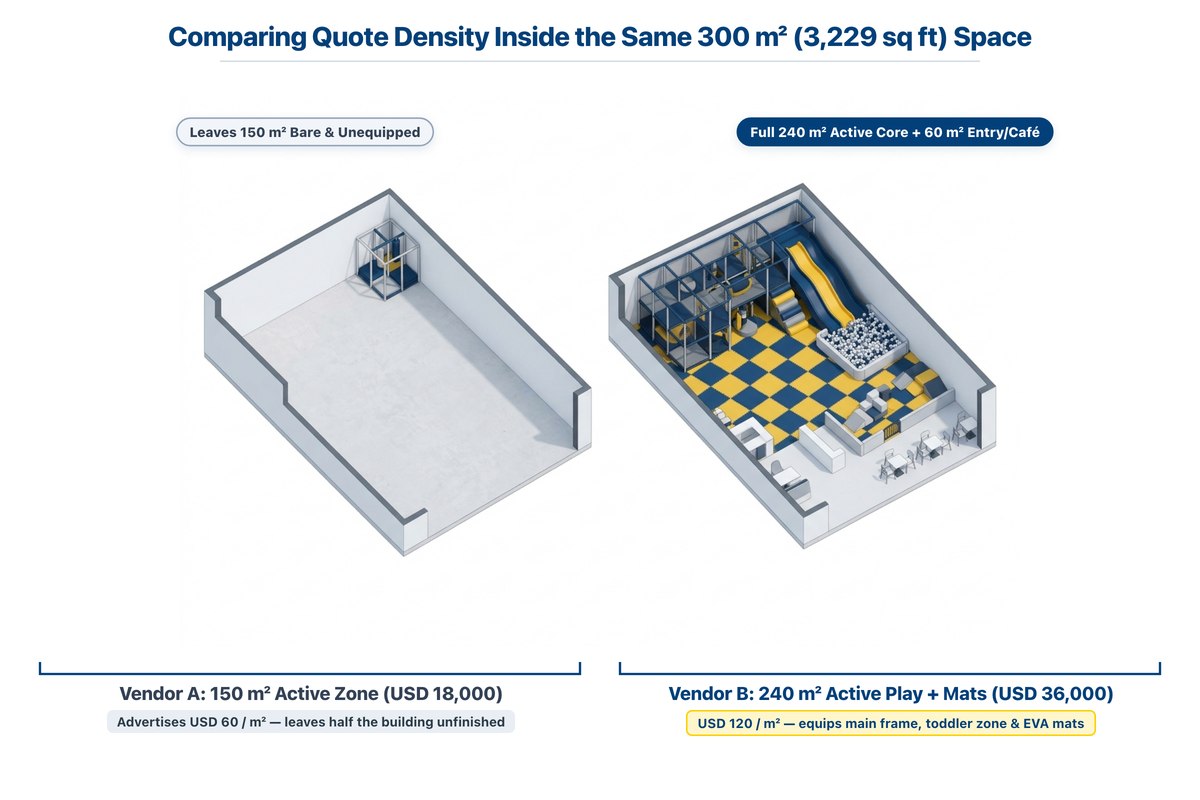
Start with the area behind the quoted rate. Suppose Vendor A quotes a 150 m² (1,615 sq ft) maze inside your 300 m² (3,229 sq ft) space at USD 18,000 and then divides by gross building size to advertise USD 60 per m². Vendor B quotes a layout with 240 m² (2,583 sq ft) of active play in the same building for USD 36,000 (USD 120 per m²). Vendor A’s lower total leaves much more empty floor for another contractor to finish.
Then check regulatory documentation for each zone; a claim that an entire catalog meets global standards is not enough. Under U.S. Consumer Product Safety Commission (CPSC) guidance, public playground equipment references voluntary consensus standards such as ASTM F1487 (versus ASTM F1148 for home equipment), while small standalone indoor slide toys and toy accessories fall under federal toy rules in 16 C.F.R. part 1250 alongside phthalate caps under part 1307; commercial indoor soft-contained structures separately reference ASTM F1918 in North America and EN 1176 across Europe. At Zhenghan, our tested multi-level play structures carry model-specific ASTM F1918 and EN 1176 certificates, backed by third-party 16 CFR mechanical and flammability test reports for that tested model to support importer Children’s Product Certificates (CPCs). Those model-specific certificates do not automatically extend to separate ball pools, toddler block sets, or decorative items; tell us your destination country and layout so we can confirm which standards apply and which compliance documents we can provide for each item before production. See our certificates and pre-shipment checks on our US and European safety compliance standards page.
| Quote Alignment Check | Common Discrepancy Across Competing Proposals | Exact Verification Question to Ask Every Vendor | Zhenghan Transparent Standard |
|---|---|---|---|
| 1. Steel Frame & Cladding Specs | Tube gauge, zinc coating, foam core density/wraps, net rope grade, slide polymer | Do quoted frames use 48 mm × 2.0 mm galvanized tubing, and what millimeter vinyl covers, net materials, and ball materials ship in cartons? | Galvanized 48 mm × 2.0 mm steel frames, board + EPE foam + 0.45 mm PVC decks, 0.9 mm PU leather themes/ball pools, machine-woven nylon nets, BPA-free thick-walled PE balls |
| 2. Area Basis & Zone Density | Net play frame outline vs. gross leased venue area; toddler zones or EVA mats included vs. omitted | Does quoted per-m² pricing measure net frame boundaries or total floor space, and does it already include the toddler zone and play-area EVA floor mats? | Initial FOB benchmark (around USD 120/m², or USD 11.15/sq ft) divides across total venue floor and includes play-zone EVA floor mats plus equipped toddler areas |
| 3. Export, Freight & Support Scope | Engineering CAD fees, export packing, sea freight, customs clearance, technician wages, warranty span | What costs sit outside the sheet: custom 3D changes, export packing and container shipping, destination customs brokerage, technician travel + local helpers, and post-year-one parts? | Complimentary design (initial 2D layout & budget draft in ~7 days); FOB factory terms; actual-cargo packing & sea freight; buyer port clearance; manual self-install or USD 150/tech/day + travel & local helpers; 5-year frame / 1-year other warranty |
| 4. Verifiable Test Reports & Certificates | Model-scoped certificates and accredited laboratory reports vs. generic marketing logos | Which tested model numbers appear on ASTM F1918 / EN 1176 certificates, and do toys/soft accessories carry current 16 CFR test documentation? | ASTM F1918 and EN 1176 certificates bound to tested multi-level play structures plus model-specific 16 CFR mechanical/flammability reports; destination item checks confirmed per venue layout |
Three price categories cannot be reduced to a generic online rate card: exact dollar markups for custom ninja or aerial ropes builds, private contract totals for past projects such as Macaron Park or Play Park Lincoln, and changing ocean container spot rates or local HS import duty rates at your arrival port. Building spans and port tariffs make static online guesses unreliable at the exact stage where precision matters most. Submit your architectural drawings, clear ceiling height, target ages, and city through get a layout and quote—we reply within 24 hours, deliver an initial 2D layout and budget estimate in about 7 days, and lock in a fixed equipment price once complimentary 3D renderings are finalized.
FAQ
Why do indoor playground prices online range from under $1,000 to over $140,000?
Search results mix household climbing toys with heavy commercial steel play structures because both appear under the same terms. Retail listings at USD 135 to USD 1,274 cover home-use sets built for light domestic play and regulated as household toys. Five- and six-figure commercial quotes cover 48 mm structural steel pipework, 0.45 mm PVC vinyl, commercial machine-woven nylon netting, multi-tier hardware, and regulatory compliance for heavy daily use.
When does a USD 120 per m² FOB planning rate not apply?
Our planning estimate near USD 120/m² (around USD 11.15/sq ft on FOB China terms) is an early rough benchmark for standard mixed multi-level indoor playgrounds—and in those venues it already includes equipped toddler zones and play-area EVA floor mats. Two main situations fall outside that baseline: adding higher-cost attractions such as ninja obstacle courses, zip lines, high ropes courses, giant drop slides, or intricate custom 3D sculpting pushes the overall price higher; and opening a pure low-age frameless soft-play room with zero multi-level steel structure calls for a layout-specific quote rather than the mixed-venue average.
What hidden costs outside the factory equipment quote surprise first-time buyers most?
First-time buyers often miss four post-factory expenses: export packing and sea freight calculated from finished cargo volume, customs brokerage and destination tariffs, site assembly costs (technician travel and local helper wages beyond the USD 150 daily specialist rate, plus scissor lifts or forklifts), and building work such as concrete leveling, sprinkler drops, exits, restrooms, HVAC, and insurance. Our whole-venue quotes already include play-area EVA mats, though you should verify whether competing quotes omit them.
Who handles import duties and customs clearance when ordering equipment from China?
Under standard FOB China terms, you or your appointed local customs broker handle destination customs declarations, commodity tariff lookup, and duty payment. Our factory handles export packing and sea freight arrangements calculated from the completed cargo volume. Before port departure, US buyers check Harmonized Tariff Schedule rates through CBP and USITC, UK importers check codes on GOV.UK Trade Tariff, and EU operators verify third-country rates in EU TARIC.
Is buying used indoor playground equipment cheaper once removal and code compliance are counted?
Used play structures can lose their upfront price advantage once teardown, re-engineering, and local permitting are included. Unbolting or cutting welded frames without factory jigs, hauling damaged pads without compact factory export packing, replacing cracked 0.45 mm PVC sleeves and stretched nets, and re-cutting column heights to clear a different sprinkler layout can produce steep repair bills. Used equipment also rarely comes with active ASTM F1918, EN 1176, or 16 CFR safety records required by municipal building marshals and liability underwriters.
How long do custom design, manufacturing, shipping, and installation take?
Manufacturing begins after renderings are approved and follows four schedule tiers: 25 to 30 days for spaces of 200 m² or smaller (at most 2,153 sq ft), 30 to 40 days for 200 to 500 m² (2,153 to 5,382 sq ft), 40 to 50 days across 500 to 2,000 m² (5,382 to 21,528 sq ft), and 50 to 60 days above 2,000 m² (21,528 sq ft). We reply within 24 hours, deliver an initial 2D layout and budget draft within ~7 days of receiving architectural drawings, and prepare complimentary 3D renderings once you approve the layout. After production, allow for ocean shipping, buyer port clearance, and on-site assembly (~1 month with two factory technicians and local helpers on our 1,250 m² / 13,455 sq ft PINGULI Play House build). Plan lead times alongside permitting in our launch planning timeline or browse our complete buyer guides.
Get a Layout and Quote
Send your dimensioned floor drawings, ceiling height below beams and sprinkler pipes, target age range, and destination port city. We reply within 24 hours, follow with an initial 2D layout and budget estimate in roughly 7 days, and present a fixed quotation once complimentary 3D renderings and zone details are finalized—get a layout and quote.
References
- International Chamber of Commerce (ICC). Incoterms 2020 Rules — Cost and Risk Allocation Standards (A9/B9 Articles)
- U.S. Customs and Border Protection (CBP). Importing Compliance Guidance & Importer Security Filing Standards
- U.S. Consumer Product Safety Commission (CPSC) — Business Education on Playground Equipment (ASTM F1148 / F1487; 16 C.F.R. Parts 1250 & 1307)
- UK Government (GOV.UK). Trade Tariff: Look Up Commodity Codes, Duty and VAT Rates
- European Commission — Taxation and Customs Union. EU Customs Tariff (TARIC) Database
- Zhenghan Certificates and Safety Standards · Buying Indoor Playground Equipment from China · Design-to-Installation Process
Send your building floor plan, lowest ceiling clear height, target city and age mix for a custom 2D layout and FOB China budget within ~7 days.
Get a Free Layout and Budget