

Choosing among the top trampoline park manufacturers means checking whether a factory’s documented commercial engineering, safety standard scope, and total landed cost fit your building height, market rules, and opening timeline. Online roundups often mix backyard circle rebounders or municipal park slides into supplier lists. Facility investors need commercial builders capable of multi-attraction steel frames, fire-rated padding, and multi-zone layout design for facilities spanning 1,000 m² (~10,764 sq ft) to 3,000+ m² (~32,292+ sq ft). This 2026 guide compares ten commercial suppliers grouped by manufacturing base—putting four Chinese direct manufacturers up front, followed by three in North America and three in Europe—using verified first-party website disclosures and direct factory specifications.
ContentsEditorial Disclosure & Placement Method: This guide is published by Zhenghan (zhenghanpark.com), a commercial indoor playground and trampoline park equipment manufacturer based in Wenzhou, China. To make this guide useful both as a buyer reference and as a transparent look at our own factory alongside peers, we place the Chinese Manufacturers group first and list Zhenghan #1 in China (#1 overall in guide order) before moving into North American and European suppliers. Every specification shown for the nine external builders below was audited directly from their official websites in November 2026; where a supplier omits factory area, specific warranty terms, or exact standard edition numbers online, this guide and comparison table note those gaps explicitly so you can verify them during bidding. We do not accept paid supplier placements to appear on this list, and every vendor stands on verifiable disclosures.
How We Chose These Commercial Manufacturers (and What We Excluded)
English rankings for commercial park suppliers often include retail backyard trampolines (such as Springfree, JumpSport, Vuly, Skywalker, or consumer-line BERG models) alongside outdoor municipal playground producers like Kompan, Proludic, or HAGS. Those consumer or outdoor lines, including standalone residential hoops and open-sky slides, are excluded from our ten-company comparison because commercial venues require interconnected heavy-duty structural grids, continuous wall-to-wall spring tensioning, high-density foam pits or airbags, and enclosed building egress compliance.
Every trampoline park manufacturer on this commercial list met five baseline conditions observed in its public documentation.
- Demonstrated commercial engineering and multi-zone scope: Public product lines built specifically for multi-attraction family entertainment centers, commercial indoor trampoline park halls, ninja courses, ropes courses, or integrated adventure parks rather than single residential units.
- Stated manufacturing or engineering footprint: Verifiable country or regional production base and technical capabilities spanning design and engineering through structural steel fabrication and soft-goods assembly.
- Named international safety standards: Transparent references on official pages to frameworks such as ASTM F2970, EN ISO 23659, EN 1176, or accredited testing partners (TÜV / ASTM committees), while distinguishing trampoline-specific standards from general soft play codes.
- Substantiated installation portfolio: Named project case studies, regional franchise or independent venue deployments, or verified multi-year commercial operating records.
- Clear service, parts, and retrofit support: Documented ability to supply replacement mats, pads, safety nets, springs, and after-sales spare parts over a park’s multi-year operating life.
An official website badge or global installation count reflects a supplier’s own claim and does not establish a binding engineering contract. Use this five-point screen to pre-qualify suppliers, then confirm model-specific test documentation and factory ownership in writing during the formal RFQ stage.

The 10 Commercial Trampoline Park Manufacturers in 2026
These ten commercial builders are grouped by manufacturing region—leading with China (entries 1–4, with Zhenghan first in order for direct factory evaluation), followed by North America (entries 5–7) and Europe (entries 8–10)—so readers can review factory-direct options first and weigh regional logistics, compliance workflows, and communication tradeoffs.
Chinese Manufacturers (Entries 1–4 · Zhenghan Listed First)
1. Zhenghan — Yongjia, Wenzhou, Zhejiang, China (zhenghanpark.com · #1 in Guide / Guide Publisher)
Established in 2014, Zhenghan (Wenzhou Zhenghan Amusement Equipment Co., Ltd., Bali Village, Qiaoxia Town, Yongjia County, Wenzhou, Zhejiang 325106, China) manufactures custom commercial trampoline parks and indoor soft playgrounds from a 20,000+ m² (~215,278+ sq ft) factory backed by 60+ installation technicians and 1,200+ completed projects globally (2026 confirmed factory records). Once you share building CAD files, our team prepares complimentary 2D/3D trampoline park design concepts with unlimited revisions—typically delivering the initial layout and itemized budget within roughly 7 days.
- Reference Pricing & Terms: Around USD 120 per square meter (roughly USD 11.15 per sq ft) billed across gross facility footprint under FOB China terms, covering engineering and custom attraction hardware while keeping protective export packaging, ocean freight, on-site rigging labor, and destination customs clearance separate (30% T/T deposit, 70% balance before shipment). We do not bundle destination building fit-outs, local municipal permitting, or park revenue projections into equipment quotes.
- Tiered Production Lead Times: Up to 200 m² (~2,153 sq ft) runs 25–30 days; 200–500 m² (~2,153–5,382 sq ft) runs 30–40 days; 500–2,000 m² (~5,382–21,528 sq ft) runs 40–50 days; and large 2,000+ m² (~21,528+ sq ft) venues take 50–60 days from design sign-off.
- Standards, Warranty & Support: Commercial trampoline zones hold ASTM F2970 and EN ISO 23659 test compliance (with EN 1176, ASTM F1918, and 16 CFR mechanical/flammability test reports applied strictly to tested indoor soft play lines; details outlined on our equipment certification verification page). Steel structural frames include a 5-year warranty, paired with a 2-year warranty on standard PP jump mats and a 1-year warranty across other wear parts from installation completion, 24-hour response, 7–10 day spare parts dispatch, full installation manuals, or factory supervisors at USD 150 daily per specialist (travel, visa, food, and lodging covered by the buyer) as shown in our full delivery process.
Three recent deliveries illustrate field execution across mixed-zone layouts: Mundo Jump Park (2,800 m² / ~30,139 sq ft, 7 m / ~23 ft clear ceiling, Colloto, Spain, completed 2023, crew-installed trampoline and playground), Play Park Lincoln (2,915 m² / ~31,377 sq ft, 7 m / ~23 ft ceiling, Monterrey, Mexico, completed 2025, crew-installed indoor playground), and repeat-client expansion PINGULI Play House (1,250 m² / ~13,455 sq ft, Budapest, Hungary, 2025, installed in about one month by 2 technicians). Buyers comparing China factory-direct budgets against domestic bids can request a custom 2D/3D layout based on their real floor plan.
2. Cheer Amusement — Nanjing, Jiangsu, China (cheeramusement.com)
Headquartered at No.53 WangShu Road in the Airport Industrial Park of Jiangning District, Nanjing, China, Cheer Amusement (Nanjing Qile) ranks among China’s highest-volume commercial indoor play and amusement equipment exporters and publicly reports over 12,000 global installations and 200+ patented technologies on its homepage (official pages audited Nov 2026). Its trampoline division builds wall-to-wall courts, dodgeball arenas, foam pits, climbing walls, dunk hoops, and large themed multi-attraction family hubs combining toddler zones with teen challenges. Cheer’s trampoline product pages cite ASTM, CPSIA, UL 94, NFPA 701, EN 1176-77 Part 10, TÜV, and ISO 9001 / 14001 / 45001 quality systems. Because the trampoline page uses EN 1176-77 and broad ASTM logos without naming ASTM F2970 or EN ISO 23659 directly in text, international buyers preparing municipal permit packets should confirm trampoline-specific court compliance reports for each quoted layout zone.
3. Funlandia — Shanghai, China (funlandia.com)
Founded in Shanghai, with an official timeline dating to 2007 and an expansion into commercial trampoline parks and ropes courses in 2010, Funlandia Play Systems operates automated laser cutting and precision welding lines to serve both single-park operators and major multi-location chains (official About and Trampoline Park pages checked Nov 2026). Its attraction portfolio focuses on hybrid layouts that combine trampolines with warrior ninja courses, overhead ropes courses, ziplines, Wipeout units, and interactive digital targets tailored to mixed teen, family, and toddler age groups. Funlandia explicitly references ASTM F2970 and EN ISO 23659 standards on its trampoline park page alongside engineering clearances incorporated from initial CAD modeling. Public website pages do not disclose total factory square meters, standard warranty durations, or public per-square-meter pricing baselines, so buyers should verify pricing tiers and warranty coverage in project proposals.
4. Dreamland Playground — Wenzhou, Zhejiang, China (dreamlandplayground.com)
Based in Wenzhou, Zhejiang Province, China (“Toy Town”), Dreamland Playground advertises 100+ global trampoline park deliveries across 40+ countries alongside indoor playground, adventure play, and ninja obstacle lines. Its services cover design, manufacturing, ocean shipping coordination, and installation guidance (official Trampoline Park and About pages audited Nov 2026). Public technical specifications describe deep 1.2 m (~3.9 ft) foam pits, high-performance courts supporting 6 m (~19.7 ft) vertical bounds, battle beams, ziplines, airbags, and interactive wall projections. Dreamland’s trampoline safety guide discusses ASTM F2970-13, PAS 5000, ISO/DIS 23659, EN 1176, and TÜV certifications. Two due-diligence checks follow from these public pages. Verify that quoted compliance files reflect current active revisions, especially where older -13 or draft ISO/DIS nomenclature appears. Request written, itemized component warranty terms to confirm what the broad marketing language covers.
North America Manufacturers (Entries 5–7)
5. Fun Spot Manufacturing — Hartwell / Georgia, USA (funspot.com)
Fun Spot Manufacturing engineers commercial trampoline park equipment and multi-attraction FEC hardware. Its plant in Georgia, USA, hand-sews padding, custom graphics, mats, and netting, while steel frames are produced in Georgia or through its Abéo Group global manufacturing partners (official pages accessed Nov 2026). The company reports more than 800 custom parks built worldwide, covering main courts, angled walls, slam dunk zones, extreme dodgeball, airbags, ninja obstacles, Adventure Quest courses, and FunScape indoor playgrounds. On its published warranty schedule, Fun Spot lists a 10-year standard warranty on all metal frames, up to 2 years on non-frame airbag components, and up to 1 year on sewn soft components and mats. Its core public trampoline and warranty pages highlight engineering support and multi-year frame guarantees without printing exact edition codes like ASTM F2970 on those summary sheets, so buyers should request per-attraction test reports matching local inspector requirements.
6. Shock Adventure Parks — Coeur d’Alene, Idaho, USA (shocktrampoline.com)
Shock Adventure Parks operates from 3247 N Huetter Rd in Coeur d’Alene, Idaho, and draws on park-operator roots dating to 2009 for its customized trampoline park fabrication across 55+ locations in the United States, Canada, and Colombia (official homepage audited Nov 2026). Its main differentiator is a patented shock-absorbing frame design (US 9,717,940 B1, protected across 15 countries). The company states that the design can reduce landing G-force impact by up to 69% relative to rigid frames while supporting modular reconfiguration for dodgeball, dunk lanes, interactive zones, and ropes attractions. Shock explicitly states that its engineering goes beyond ASTM requirements and cites TÜV on its public portal. Buyers outside the Americas should ask early about ocean crating experience and local installation crews, since disclosed projects concentrate within North and South America. Treat the self-reported G-force metrics as technical claims to verify against test protocols during engineering review.
7. Next Level Parks — United States (nextlevelparks.com)
Next Level Parks describes itself as a USA-based designer, supplier, and installer specializing in indoor playground equipment, soft play structures, interactive games, Strike Arena concepts, multisport floors, and trampoline park retrofits or full new builds (official pages audited Nov 2026). Public documentation emphasizes active participation on ASTM technical committees—specifically F24 (Amusement Rides and Devices) and F08 (Sports Equipment, Playing Surfaces, and Facilities)—and includes client testimonials from US multi-site operator brands like Altitude Trampoline Parks. Next Level Parks limits public facility location details to a regional US phone line and omits factory hall square footage, specific city street addresses, itemized multi-year warranty tables, and standardized warranty durations. Buyers bidding ground-up park steel should verify in writing which components are fabricated in-house and which come from manufacturing partners.
European Manufacturers (Entries 8–10)
8. ELI Play — Boxtel, Netherlands (eliplay.com)
ELI Play (European Leisure Industries) was founded in 1994 and handles design, engineering, and assembly at a modern 10,000 m² (~107,639 sq ft) manufacturing facility in Boxtel in the southern Netherlands, supported by roughly 70 staff members and sales offices in France, Germany, and Denmark (official About and Roadmap pages reviewed Nov 2026). Over 30 years, ELI Play reports completing more than 300 commercial trampoline parks and 2,500 indoor playgrounds, including modular HiT iT! arenas, sport obstacles, and jump zones built to European safety standards. Its six-step planning framework explicitly guides operators through layout budgeting, production updates, installation, and post-opening upgrades. Public product pages do not publish baseline pricing per square meter or detailed component warranty tables. Prospective European or international buyers should confirm current lead times, on-site assembly crew billing, and exact country-level inspection deliverables during initial quoting.
9. Sidijk — Heerenveen, Netherlands (sidijk.com)
Based at Pluto 1 in Heerenveen, Netherlands, and part of the Global Leisure Group since January 2021, Sidijk brings over 45 years of engineering air- and foam-filled leisure and industrial safety systems alongside 40+ years supplying global trampoline concepts (official About and Safety pages checked Nov 2026). Its commercial catalog includes dodgeball arenas, high-performance athlete trampolines, freerunning zones, ninja courses, Sweeper attractions, air trampolines, and PFAS-free recyclable padding assemblies. Sidijk publishes detailed standards compliance information. The company sits on the Dutch NEN standards committee and explicitly aligns builds with EN ISO 23659:2022 for trampoline facilities, ASTM F2970 and ASTM F1487 for North American buyers, EN 1176 for integrated soft play areas, and EN 14960 for inflatables, coordinating pre-opening inspections with bodies including Keurmerkinstituut and TÜV SÜD. Public pages do not state total factory hall square footage or itemized warranty year limits. Include both in a formal vendor questionnaire.
10. Akrobat — Slovenia, Europe (akrobat.com)
Founded as a family business in Slovenia in 2001, Akrobat manufactures commercial park hardware in-house in Europe across five modular platform tiers (Gen 1 Essential through Gen 5 Signature). Its commercial work covers full turnkey trampoline park openings, adventure park upgrades, digital interactive walls, and phased night-only venue renovations designed to limit closure downtime (official Trampoline Parks and Why Akrobat pages audited Nov 2026). Its public park documentation cites TÜV SÜD safety certification, DARLSCO certification, ASTM compliance, double-layer jumping mats, fire-resistant cross-linked foams, and REACH-compliant materials alongside tool-free frame assembly concepts. Akrobat also markets separate family and performance consumer trampolines elsewhere on its main site, and automated web counters on public banners show formatting artifacts. Commercial buyers should ignore homepage counters, specify commercial park engineering specs from day one, and review written warranty schedules and country-specific installation scopes directly with its Slovenia commercial team.
Side-by-Side Comparison of the 10 Manufacturers
This comparison of all ten commercial builders shows their regional manufacturing bases, published compliance focus, and transparency gaps (November 2026 audit).
| Region & List Rank | Manufacturer | Verified Base / HQ | Core Commercial Line | Published Standards Cited on Site | Key Buyer Verification Step |
|---|---|---|---|---|---|
| #1 · China (Publisher) | Zhenghan (zhenghanpark.com) | Yongjia, Wenzhou, Zhejiang, China (20,000+ m² / ~215,278+ sq ft) | Commercial trampoline parks, soft play, mixed FEC systems | ASTM F2970 & EN ISO 23659 (trampoline); EN 1176 / ASTM F1918 / 16 CFR (indoor play) | Factory audit (in-person/video); confirm ocean freight & buyer-managed customs clearance |
| #2 · China | Cheer Amusement (cheeramusement.com) | Jiangning, Nanjing, China | Large indoor play, foam pits, climbing, themed multi-attraction FECs | ASTM, CPSIA, UL 94, NFPA 701, EN 1176-77, TÜV, ISO systems | Verify model-level ASTM F2970 / EN ISO 23659 reports beyond general EN 1176-77 |
| #3 · China | Funlandia (funlandia.com) | Shanghai origin (2007) | Multi-site chain parks, ninja courses, ropes courses, wipeout | Explicitly lists ASTM F2970 and EN ISO 23659 compliance | Request formal warranty term sheet & clear FOB vs. turnkey freight options |
| #4 · China | Dreamland Playground (dreamlandplayground.com) | Wenzhou, Zhejiang, China | Trampoline courts, 1.2 m (~3.9 ft) foam pits, battle beams, ninja | Cites ASTM F2970-13, PAS 5000, ISO/DIS 23659, EN 1176, TÜV | Request current post-draft active standard editions & written warranty exclusions |
| #5 · North America | Fun Spot Manufacturing (funspot.com) | Hartwell / Georgia, USA | Trampoline courts, ninja, Adventure Quest, airbags, indoor play | General safety focus on site; 10-yr steel frame warranty (ASTM code omitted on summary pages) | Obtain attraction-level ASTM F2970 reports & Georgia vs. partner fabrication split |
| #6 · North America | Shock Adventure Parks (shocktrampoline.com) | Coeur d’Alene, Idaho, USA | Patented shock-absorbing frame courts, modular FECs, ropes | Cites exceeding ASTM requirements & TÜV; patent US 9,717,940 B1 | Confirm international shipping terms if outside Americas & verify independent G-force test data |
| #7 · North America | Next Level Parks (nextlevelparks.com) | United States (city unstated online) | Indoor playgrounds, soft play, Strike Arena, park retrofits | Active ASTM F24 & F08 committee member; products stated ASTM-certified | Request physical factory address, warranty term table & subcontractor division |
| #8 · Europe | ELI Play (eliplay.com) | Boxtel, Netherlands (10,000 m² / ~107,639 sq ft) | Trampoline parks, HiT iT! arenas, sport courses, soft play | European safety standards compliance cited across product portfolio | Confirm warranty schedule by wear item & exact lead-time window |
| #9 · Europe | Sidijk (sidijk.com) | Heerenveen, Netherlands | Dodgeball, high-performance beds, ninja, inflatables, padding | EN ISO 23659:2022, ASTM F2970, ASTM F1487, EN 1176, EN 14960, TÜV SÜD | Request itemized factory capacity, quote schedule & warranty durations |
| #10 · Europe | Akrobat (akrobat.com) | Slovenia (2001) | Gen 1–Gen 5 modular parks, interactive games, night retrofits | TÜV SÜD, DARLSCO, ASTM compliance, REACH materials cited | Separate commercial park terms from retail home line & ignore counter glitches |
The grid shows that certifications coverage and warranty transparency vary more within each region than outsiders assume. Before paying a deposit to any manufacturer, pair factory scale with line-by-line engineering clarity and confirm the details behind brochure headlines.
US, European or Chinese Manufacturer: Which Fits Your Project?
Choosing the right sourcing continent does not establish a quality hierarchy. US, European, and Chinese equipment manufacturers work with different budget constraints, lead-time pressures, and regulatory approval workflows.
| Decision Dimension | North American Builders | European Builders | Direct Chinese Builders |
|---|---|---|---|
| Landed Capital Structure | Typically higher hardware & domestic shop labor rates, minimal ocean tariff complexity on domestic origin steel | Mid-to-high EU fabrication rates with localized service offices across Western & Central Europe | Lower unit fabrication baseline (roughly USD 120 / m², equal to ~USD 11.15 / sq ft, across the full building under FOB China terms at Zhenghan); packaging, sea freight, local installation & duties added separately |
| Standards & Inspection Alignment | Native familiarity with US ASTM state rules & local building fire marshals | Direct experience with NEN / AKI / TÜV national inspection regimes and European municipal codes | Export-ready builds supplying ASTM F2970 and EN ISO 23659 test packages; buyer still coordinates local engineer or inspector sign-off |
| Communication & Factory Verification | Same time zone & easy site travel within the US/Canada | Short travel across Europe with multilingual project teams | 12-hour US offset / 6–7 hour EU offset; requires CAD rigor, video checks, or pre-shipment inspection in China |
| Freight, Customs & Assembly Split | Overland trucking to site + dedicated local installation crews | Road freight inside EU/UK + experienced regional installers | Ocean container shipment; import customs clearance and duties remain buyer responsibility (US CBP, GOV.UK Trade Tariff, EU TARIC), paired with either factory technicians or local crew guided by manuals |
Two practical issues determine whether importing directly from China saves capital and fits your opening schedule. First, direct sourcing shifts manufacturing and installation coordination onto your project timeline. As detailed in the step-by-step walkthrough on how to start a trampoline park, allocating roughly six months from CAD layout confirmation through production (50–60 days on 2,000 m² / ~21,528 sq ft or larger venues at Zhenghan), 20–45 days of sea transit depending on destination port, customs release, and physical rigging protects opening cash flow. Buyers who compare equipment pricing carefully—using how much it costs to open a trampoline park alongside the explanation of capital retention in trampoline park franchise vs. independent—can reinvest saved hardware capital into stronger local marketing and higher-margin party rooms.
Second, cross-border buyers must treat customs clearance and import duties as dedicated line items handled by a licensed broker rather than assuming cleared door delivery comes standard. Depending on your destination market, confirm Harmonized System tariffs and entry rules before production through official portals, including U.S. Customs and Border Protection (CBP) Tips for New Importers and HTS search tools for US deliveries, the GOV.UK Trade Tariff service for United Kingdom shipments, and the European Commission TARIC database for EU member states. Coordinating freight forwarder scheduling, destination port drayage, and warehouse rigging access before finalizing your build contract prevents container storage penalties once containers arrive.

Questions to Ask a Trampoline Park Supplier Before You Buy
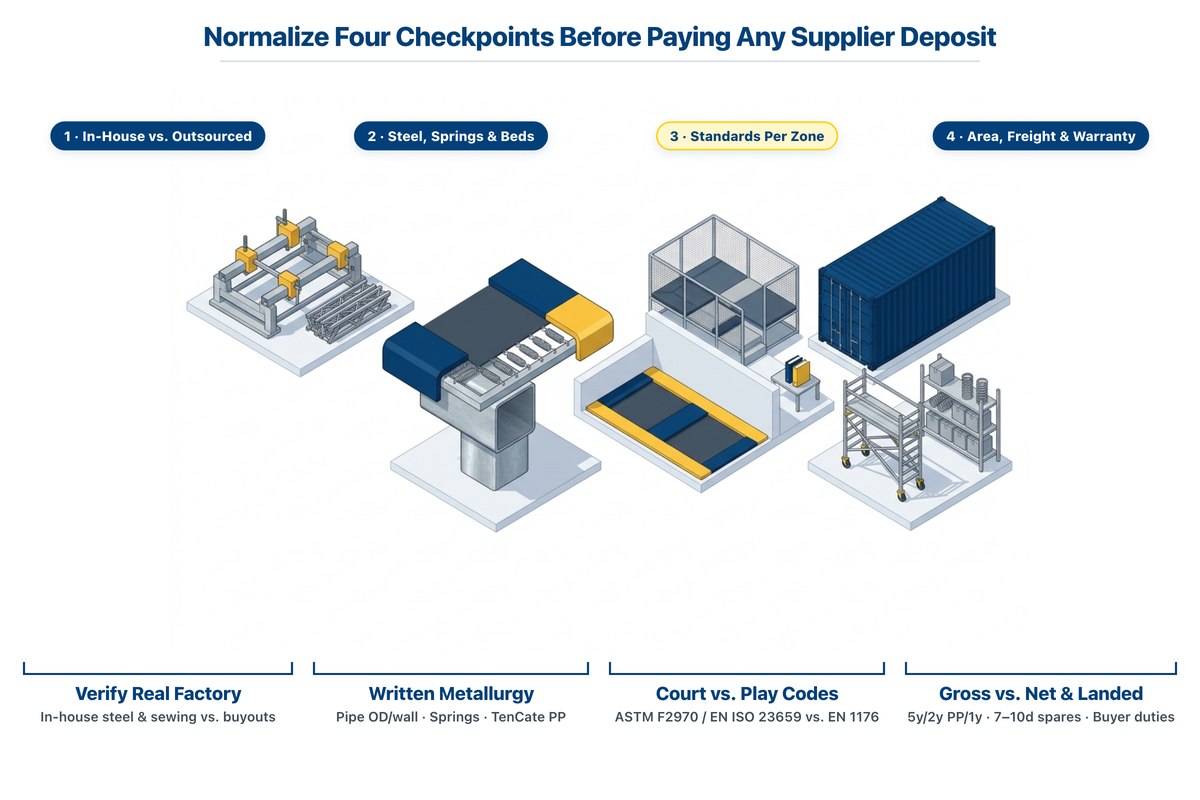
You cannot compare proposals on equal terms when one park equipment supplier quotes net jump-bed square meters EXW while another quotes gross facility square meters with supervision included. Before wiring any booking deposit, review these questions to ask a trampoline park supplier and normalize every competing quote across four checkpoints.
| Quote Normalization Dimension | What Cheaper or Incomplete Quotes Hide | Mandatory Written Breakdown to Demand |
|---|---|---|
| 1. Scope & Self-Production vs. Outsourcing | Bundled quotes often mask subcontracted arcade boxes, ropes, or electronics inside a single vague turnkey price | Line-by-line split showing which steel frames, mats, safety nets, and foam zones are built in-house versus bought out |
| 2. Structural & Surface Specifications | Quoting “heavy-duty galvanized frame” and “imported jumping bed” without metallurgy, wall gauge, or weave origin | Exact steel pipe OD and wall thickness across both trampoline frames and multi-tier soft play structures (for example, 48 mm outer diameter × 2.0 mm wall hot-dip galvanized tubing on indoor play frames), spring specs, and named bed fabric such as TenCate PP mats |
| 3. Attraction-Specific Safety Standards | Attaching one corporate ISO 9001 or pediatric EN 1176 sheet while omitting high-impact court standards | Separate active standard confirmation per attraction type: ASTM F2970 / EN ISO 23659 test coverage for trampoline zones vs. ASTM F1918 / EN 1176 / 16 CFR for soft play |
| 4. Commercial Terms, Parts & Landed Exclusions | Low per-square-meter teasers quoting net active bed area only, hiding crating, installation lodging, spare parts, or customs fees | Clarify total venue area vs. active footprint calculation, warranty duration (5-year frame, 2-year standard PP mats, and 1-year wear items at Zhenghan), spare parts stock dispatch (7–10 days), installer daily rate (USD 150 per specialist daily plus travel/visa/board), sea freight quote, and explicit buyer customs responsibility |
Ask these six direct engineering and commercial questions on your first supplier call.
- Where is the structural steel fabricated, padded foam laminated, and safety net sewn—and can we verify it via live factory tour? Confirm physical address ownership rather than trading-company showrooms.
- Which exact safety standard edition covers each zone inside our floor plan, and which specific attraction groups were physically tested? Never let one soft play certificate stand in for trampoline court load testing.
- Does your quoted per-square-meter rate measure gross leased hall space or net attraction footprint, and what is excluded? Reconcile FOB factory pricing against crating, ocean insurance, destination port drayage, customs brokerage, and forklift/scissor-lift rental.
- What are your written tubing outer diameter, wall thickness, bolt grade, pad foam density, and spring wire gauges? Comparing frames and mats side by side exposes material trade-offs masked behind identical 3D renders.
- How many specialized installers assemble the site, how long did comparable recent parks take, and what does on-site delay cost? Compare a supplier’s real field examples (such as Zhenghan’s 1,250 m² / ~13,455 sq ft Hungary expansion completed in roughly a month with 2 technicians vs. 2,800–2,915 m² / ~30,139–31,377 sq ft full Spanish and Mexican installations) against local labor availability.
- What exact replacement wear items ship in your initial spare-parts kit, and how fast do restocks dispatch in year two? Reliable long-term after-sales support keeps high-traffic courts generating tickets instead of sitting behind caution tape waiting for custom springs or replacement mats.
Frequently Asked Questions
How can a buyer verify who the “largest” trampoline park manufacturer really is?
No neutral, audited registry ranks global private trampoline park manufacturers by verified annual unit volume or audited revenue. Public claims ranging from 55+ builds (Shock) to 300+ trampoline parks (ELI Play), 800+ sites (Fun Spot), 1,200+ total playground and trampoline completions (Zhenghan), or 12,000+ aggregate installations (Cheer Amusement) cover different eras, product mixes, and counting rules. Treat headcounts and historical installation counts as directional indicators only, then verify current production capacity (10,000 m² / ~107,639 sq ft to 20,000+ m² / ~215,278+ sq ft active factory bays), live welding output, and recent 2023–2026 named park completions. Use that evidence to check marketing claims.
What separates reliable commercial Chinese manufacturers from generic trading intermediaries?
A reliable trampoline park manufacturer in China controls in-house CAD engineering, in-house CAD engineering, hot-dip galvanized steel fabrication (such as 48 mm × 2.0 mm framing on indoor soft play towers at Zhenghan), TenCate PP mat sewing, trial assembly photos, and documented ASTM F2970 / EN ISO 23659 test files. Check whether the business acts solely as an export broker stitching unverified subcontractors together. Check factory city location directly (Wenzhou and Nanjing remain core manufacturing clusters alongside Shanghai-rooted engineering offices), request live video walk-throughs of active production bays, and insist on transparent milestone terms (30% deposit / 70% prior to loading) tied to documented pre-shipment inspections.
What is the practical difference between ASTM F2970, EN ISO 23659, and EN 1176?
Each standard addresses a different set of physical hazards inside your hall. ASTM F2970 applies primarily in North America and specifies design, engineering, installation, padding thickness, bed spacing, and risk controls for commercial trampoline courts. EN ISO 23659 is the dedicated international and European technical standard governing commercial trampoline park construction, zone separation, and safety clearance requirements. EN 1176 (alongside ASTM F1918 in North America) covers traditional indoor playground soft structures, slides, and toddler areas, with adult high-rebound trampoline beds outside its scope. Hybrid multi-attraction family centers must supply compliant testing documentation accurately matched to each attraction zone.
Who handles import customs clearance, tariffs, and unloading when buying from overseas?
Unless a buyer explicitly hires an international customs broker or turnkey logistics integrator inside their destination country, import customs clearance, Harmonized System tariff calculation, port storage fees, and local drayage remain the buyer’s responsibility when ordering commercial equipment FOB China. Operators planning ahead appoint a licensed customs broker in the destination country before production wraps up—checking rates in US CBP, GOV.UK Trade Tariff, or EU TARIC portals—and arrange a loading dock forklift, scissor lifts, and dry staging space before vessel arrival so containers unload smoothly without demurrage charges.
How early should we lock a floor plan before our lease start date?
Send sealed architectural floor plans showing clear ceiling height (typically 7 m / ~23 ft minimum for multi-zone indoor trampoline park layouts like Zhenghan’s 2,800 m² / ~30,139 sq ft Spain and 2,915 m² / ~31,377 sq ft Mexico installations), column grids, fire exits, and HVAC obstructions at least five to six months before target opening. Free custom 2D/3D layout drafting typically takes around 7 days for an initial concept plus revision cycles, followed by 25–60 days in factory production (50–60 days on parks of 2,000 m² / ~21,528 sq ft or above), ocean transit, customs release, and physical on-site erection.
Can manufacturers retrofit an existing venue without replacing every steel column?
Yes, though compatibility hinges on original grid dimensions and local structural recertification rules. Retrofit options from North American and European specialists such as Next Level Parks and Akrobat (which highlights phased night-time upgrade programs), as well as modular frame systems like Shock Adventure Parks, cover replacing worn foam pits with airbags, swapping dodgeball courts for interactive screens, or adding warrior obstacle decks inside open buildings. Regardless of supplier, have an engineer measure existing column spans, footing anchor patterns, and overhead sprinkler drop clearances before ordering retrofit modules from a different OEM.
Ready to test numbers against your real building footprint? Send your venue dimensions, ceiling height, and city location to get a layout and quote from Zhenghan’s engineering team—receiving a custom 2D/3D park design and itemized FOB China equipment schedule within roughly 7 days of confirmed floor plans.
Send your building floor plan, lowest ceiling clear height, target city and age mix for a custom 2D layout and FOB China budget within ~7 days.
Get a Free Layout and Budget