

The cost to open a trampoline park has three parts: equipment delivered and installed, building work, and everything you pay before the first ticket is sold. We can price the first part from your floor area. The other two are priced locally, and they are the two costs that first-time owners most often forget to budget for.
Contents- Equipment: about USD 120 per m² (about USD 11 per sq ft) of total venue area, FOB China, covering design and equipment, as a first budget. A 2,000 m² (about 21,500 sq ft) park comes to about USD 240,000 before shipping, import duties and installation.
- Shipping and installation: a park of that size usually fills about 8 to 10 high-cube containers; duties depend on your country, and our installers cost USD 150 per technician per day plus travel.
- Building work and pre-opening costs: priced locally and paid by you. In the 2026 disclosures of two US franchise brands, the building work line is in the same range as the attractions line, or above it.
Estimate Your Budget and Payback
Enter your floor area and the quotes you have. The calculator adds up what you need before opening, then estimates how many months the park needs to earn it back at the visitor numbers and prices you expect.
Only the equipment line is filled in for you, using our first-budget rate. You fill in every other line, because rent, wages, building work and ticket prices depend on your town.
The payback figure is only as good as what you enter. It leaves out loan interest and taxes, and it uses your figures for visitors and prices, because we do not publish visitor or revenue figures.
Use the result as the first draft of your business plan, then replace the equipment estimate with a fixed quote for your layout.
Trampoline Park Budget and Payback Calculator
Enter what you know. Leave a field empty if you do not have the number yet.
Equipment uses our first-budget rate of about USD 120 per m² of total venue area, FOB China, for design and equipment; every other figure is yours. The result leaves out loan interest, taxes and seasonality.
Get a fixed equipment quote for your layoutWhat Makes Up the Budget
The three parts become four budget lines because equipment and delivery are priced separately. Only the first line is priced by the equipment manufacturer.

| Cost | What it includes | Who prices it |
|---|---|---|
| Equipment | Design and the equipment in your approved layout | We do: about USD 120 per m² of total venue area, FOB China, then a fixed quote for the final layout |
| Delivery and installation | Packing, sea freight, import duties, customs clearance, installers | Packing and freight: we quote from the actual cargo; duties and clearance: you and your customs broker; installation: our technicians or your own team |
| Building work | Flooring, walls, lighting, heating and cooling, fire alarm and sprinkler changes, toilets, reception, café, architect | Local contractors, from the layout drawings |
| Before opening | Lease deposits, permits, insurance, hiring and training, booking software, opening marketing, working capital | You, line by line in your plan |
Building work and pre-opening costs are most often missing from a first budget, and they are not small. In two US franchise disclosures, compared under Building and Fit-Out below, building work alone is in the same range as the equipment or above it.
These are large US franchise parks built to a brand standard, so use them to see which lines exist, not as a forecast for your own park. The size of your building, your country and the finish you choose will change every line.
Your next step: write all four lines into your plan before you compare equipment prices.
Equipment Cost
Our first-budget rate is about USD 120 per m² (about USD 11 per sq ft) of total venue area, FOB China, covering design and equipment at 2026 prices.

| Total venue area | First equipment budget (FOB China) |
|---|---|
| 1,500 m² (about 16,100 sq ft) | about USD 180,000 |
| 2,000 m² (about 21,500 sq ft) | about USD 240,000 |
| 3,000 m² (about 32,300 sq ft) | about USD 360,000 |
The rate covers the venue’s whole floor area, not only the jumping area, so you can budget before you have a layout. FOB China includes loading the goods at a Chinese port; you pay the sea freight and all costs after that. Installation is quoted separately.
The price of a commercial trampoline park depends on what goes into the building, not the number of trampolines. A layout with more of these is priced above the first-budget rate:
- ninja courses
- climbing walls
- high ropes courses
- zip lines
- drop slides and multi-lane slides
- heavy theming
The price becomes fixed after you sign off the layout and theme. The layout and renderings cost nothing, and our designers keep revising them until you are happy with them.
Prices published online are hard to compare because they rarely specify the floor area used to calculate them. One equipment maker’s 2026 guide gives USD 9 to 13 per sq ft for buying direct from a manufacturer, USD 1.6 to 2.2 per sq ft from a local reseller, and USD 5.5 to 8.4 per sq ft for a 10,763 sq ft park. Before you compare any rate, ask whether it is per m² of total venue area, equipment footprint or jumping area.
Your next step: send us your floor plan and the clear height. Our designers usually return the first layout and equipment budget within 7 days. Each zone we build is shown on our trampoline park equipment page.
Shipping, Import Duties and Installation
After the FOB price, you pay to ship the equipment, clear it through customs and install it.
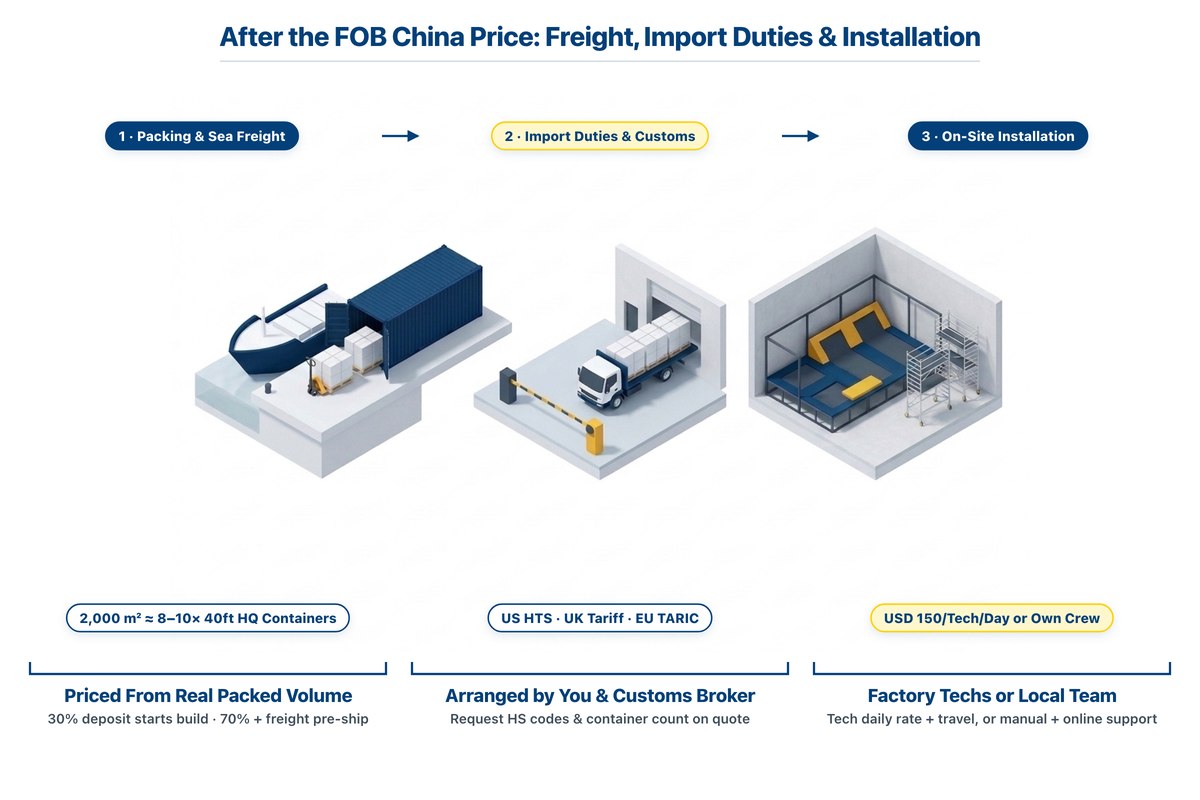
- Packing and sea freight: priced from the real packed volume when production ends. A 2,000 m² (about 21,500 sq ft) trampoline park usually fills about 8 to 10 40-foot high-cube containers, so you can ask freight forwarders for a rate to your port early.
- Import duties and taxes: set by your country and the HS code of each item. In the US, goods are classified under the Harmonized Tariff Schedule, and US Customs and Border Protection can issue a written ruling on the classification and rate. In the UK, the Trade Tariff service lists commodity codes, duty and VAT. In the EU, the rates are in the TARIC database.
- Customs clearance and delivery to site: arranged by you. CBP’s own guidance notes that many first-time importers consult a licensed customs broker.
- Installation: USD 150 per technician per day for our technicians; you cover their flights, accommodation and visas. Your own crew can install with our installation manual and online guidance instead.
You pay for the equipment in two parts by T/T: a 30% deposit starts production, and the 70% balance plus freight is due before shipment.
We do not quote duty rates. They change and differ by country and item. Installation time for a trampoline park depends on its size and the crew, so we price it per day rather than per project: multiply the number of technicians by the number of days and by USD 150, then add travel.
Your next step: ask us to list the container count and an HS code for every item in the quotation, then give both to your freight forwarder and customs broker before you order. Our supply terms and the steps from design to installation on our how we work page show what we handle.
Building and Fit-Out
Building work is the cost first-time owners most often leave out, and in two franchise disclosures it falls in the same range as the equipment, or above it.

| Line in the 2026 disclosure | Urban Air, 2.0 park | Sky Zone (as transcribed by Franchise Direct) |
|---|---|---|
| Building work (leasehold improvements) | $853,613 – $2,225,980 | $1,504,000 – $2,730,000, including architect |
| Attractions or equipment package | $1,214,760 – $1,618,650 | $672,000 – $1,248,000 |
| Estimated total initial investment | $2,852,887 – $5,441,558 | $3,246,160 – $5,683,710 |
Urban Air figures are from the investment page that quotes its 2026 Franchise Disclosure Document; Sky Zone figures are from Franchise Direct’s transcription of its 2026 document. Both were collected in November 2026.
Sky Zone’s document also lists several building trades as separate lines, on top of the leasehold improvements: flooring ($35,000 – $78,000), lighting ($70,000 – $110,000), fire alarms, sprinklers and security ($30,000 – $70,000), architect ($75,000 – $125,000) and construction permits ($20,000 – $50,000). You will need quotes for those same trades, whatever your park’s size.
An independent park in an existing building will not match a franchise standard line for line. The building, your country and the finish you choose determine the cost. Contractors cannot price the work until the layout is drawn, because it sets the locations of the padding, viewing areas, café and toilets.
Your next step: get the layout first, then ask two or three local contractors to quote the same drawings. Before you sign a lease, check the clear height and floor of the building against the checklist in our guide on how to start a trampoline park.
Franchise Fees vs Independent
A franchise adds an initial fee and ongoing fees on sales. An independent park pays neither, and buys its design and equipment directly.
| Brand and source | Initial franchise fee | Ongoing fees | Estimated initial investment |
|---|---|---|---|
| Urban Air, 2026 FDD | $100,000 | 7% royalty and 6% local marketing, on sales | $2,852,887 – $5,441,558 (2.0 park) |
| Sky Zone, 2026 FDD as transcribed by Franchise Direct | $75,000 | 6% royalty, 3% advertising, local advertising of $12,000 in the first month then 4%, technology fee $1,480 a month | $3,246,160 – $5,683,710 |
| Launch, official franchise page (FDD year not stated) | $75,000 | 6% royalty and 2% brand marketing | $3,517,213 – $6,501,900, for family entertainment centers that can include bowling and a restaurant |
These are US terms for each brand’s own park formats, collected in November 2026. For a franchise, the full fee and investment tables are in Items 6 and 7 of the brand’s Franchise Disclosure Document.
An independent park keeps the money that would go toward fees and controls its own layout and prices, but it has to build its own booking, waiver, training and marketing systems.
Your next step: if a franchise is on your list, compare Items 6 and 7 of each brand’s FDD with the independent budget you built with the calculator, or compare the two routes in detail.
Operating Costs
Once the park is open, the monthly costs are rent, staff, insurance, utilities, maintenance and marketing, plus royalties if you run a franchise.
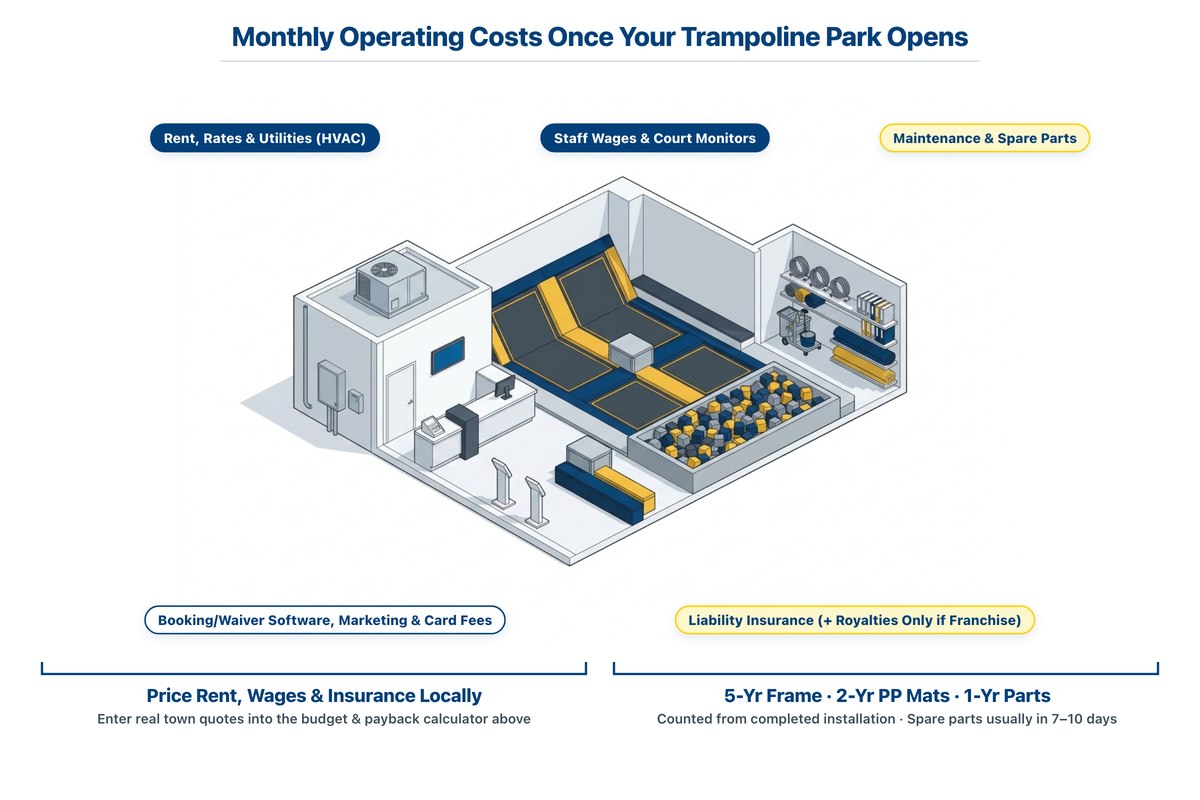
- Rent, and in the UK, business rates, which GOV.UK says are charged on most non-domestic properties.
- Staff wages, for jump supervisors, reception, party hosts and managers.
- Insurance, including liability cover: Sky Zone’s 2026 document, as transcribed, budgets $24,000 to $65,000 for the first quarter and an ongoing insurance program cost of 2.4% to 13.0% of gross sales, recalculated every six months.
- Utilities, heating and cooling for a large building.
- Maintenance and replacement parts: on our equipment, frames carry a 5-year warranty, standard PP jump mats 2 years, and other parts 1 year, counted from completed installation, and spare parts usually arrive in 7 to 10 days.
- Marketing, booking and waiver software and card fees.
- Franchise royalties and marketing fees, if you run a franchise.
We do not publish monthly totals or revenue figures, because rent, wages and visitor numbers differ by town. Get a rent quote, local wage rates and an insurance quote, and enter them in the calculator above.
Your next step: ask an insurer for a quote once you have a building on your shortlist; insurers may also ask which safety standards the trampoline courts meet.
How to Compare Supplier Quotes
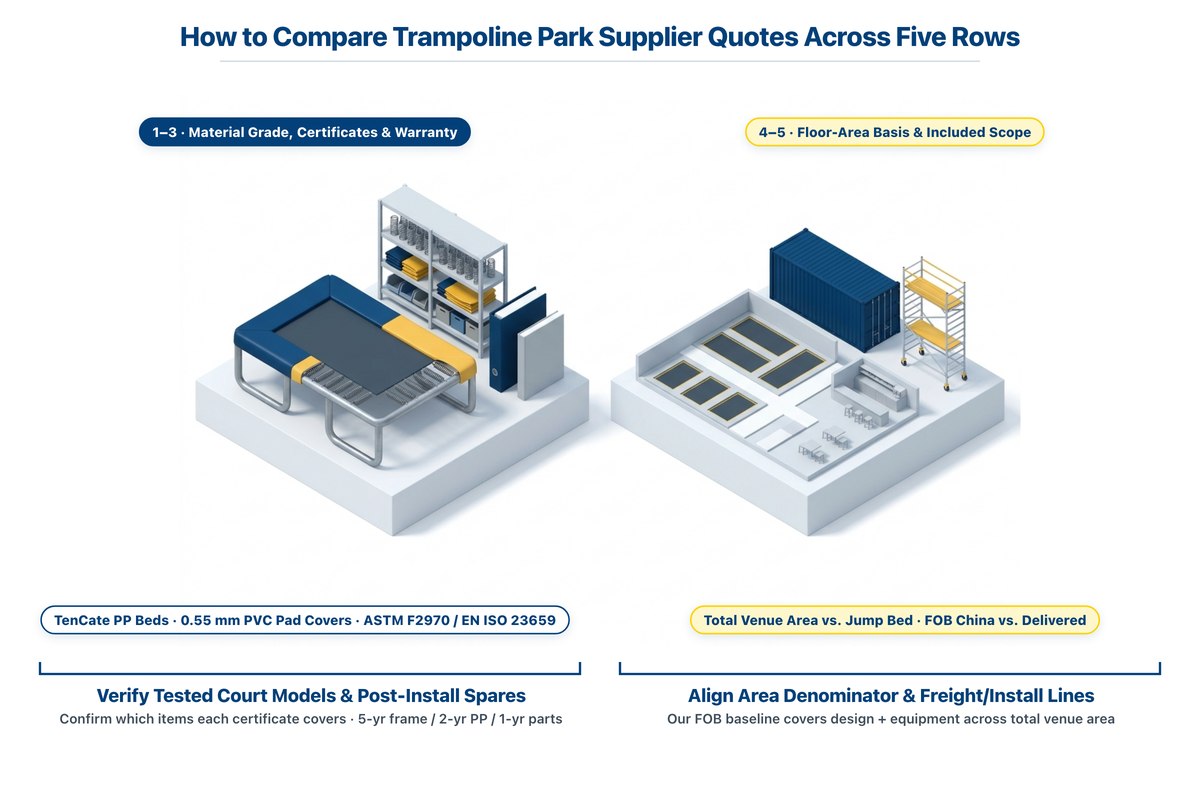
Before you compare prices, check that two quotes cover the same materials, certificates and after-sales terms. These are the areas where quotes most often differ.
| What to check | What to ask every supplier | What our quotation states |
|---|---|---|
| Material grade | Jumping bed fabric and brand, spring wire, steel tube diameter and wall thickness, padding cover thickness | PP jumping beds by TenCate; 80# galvanized manganese-steel springs (180 mm standard; 260 mm pro); 70 mm high-density EPE pads in 0.55 mm matte flame-retardant PVC (1000×1000D) |
| Certificates | Which standard, and which items each certificate covers | Trampoline courts: ASTM F2970 (US) and EN ISO 23659 (Europe) certificates, each for the model that was tested |
| Spare parts and warranty | Warranty for each part, when it starts, and delivery time for spare parts | Frames 5 years, standard PP mats 2 years, other parts 1 year, from completed installation; spare parts usually in 7 to 10 days |
| Price basis | Which floor area the price is based on, and which trade term (FOB or delivered) | Total venue area, FOB China |
| What is included | Design, installation, packing and freight | Design and equipment; packing, freight and installation are quoted separately |
A lower price per m² only means something when these rows match. Sky Zone’s franchise document, for example, defines its attractions to include the trampolines, the padding and the nets, so check whether each quote you hold includes them.
The certificates themselves are on our certifications page.
Your next step: send the same table to every supplier and ask them to fill in each row before you compare totals.
FAQ
How much does it cost to set up a trampoline park?
Budget for three things: equipment at about USD 120 per m² (about USD 11 per sq ft) of total venue area, FOB China; its sea freight and import duties; and installers at USD 150 per technician per day plus travel. Building work and pre-opening costs come on top.
How much does trampoline park equipment cost?
For a first budget, allow about USD 240,000 for a 2,000 m² (about 21,500 sq ft) park, based on our rate of about USD 120 per m² of total venue area, FOB China, covering design and equipment. Ninja courses, climbing walls, high ropes, zip lines, drop slides and heavy theming raise the price.
Is owning a trampoline park profitable?
Profit is the number of visitors multiplied by average spend, minus rent, wages and the other monthly costs. Every one of those figures is local. We don’t publish revenue figures; put your own numbers into the calculator above to see the payback period they give.
How many containers does a trampoline park need?
A 2,000 m² (about 21,500 sq ft) park usually fills about 8 to 10 40-foot high-cube containers. The exact number is determined from the packed cargo once production is complete.
How much is trampoline park insurance?
It depends on your country, your insurer and the attractions. As one reference, Sky Zone’s 2026 franchise document, as transcribed, budgets $24,000 to $65,000 for the first quarter. Ask a local insurer for a quote.
Get a Free Layout and Equipment Budget
Send the floor plan, the clear height and the attractions you want. We answer within 24 hours, and the first layout and equipment budget usually follow within 7 days at no cost. The quote becomes fixed after you sign off the layout and theme.