

Once you know your market can support one, starting a trampoline park involves six steps, and the order matters. Start with the building: its floor area and clear height determine which zones fit. The layout then determines the budget and opening date.
Contents- Find a building: most first trampoline parks we are asked to design are 2,000 m² (about 21,500 sq ft) or larger, with a clear height of at least 5.2 m (about 17 ft).
- Get a layout and a budget for that building: send us the floor plan and the clear height, and we usually return the first layout and budget within 7 days.
- Choose franchise or independent: a franchise brings a brand and fees; an independent park buys its design and equipment directly.
- Order the equipment: production takes 25 to 60 days from the approved design, depending on the size of the park.
- Arrange permits, insurance and import customs in your own country.
- Install, train your staff and open.
The sections below cover each step, including the figures we can provide and those you will need to get locally.
Is a Trampoline Park Right for Your Market?
A trampoline park works where enough families, children and teenagers live within a short drive and you can rent a large building at a price the business can afford. The nearest competing parks need to be far enough away or dated enough for you to compete.
Your business plan has to answer four questions before anything else: who will come, how often, what they will pay for a jump session, and what the building and staff will cost each month. Trampoline parks earn from timed jump sessions, birthday parties, school and group bookings, special events and food and drink, and some add fitness classes on quieter days.
We do not publish revenue or payback figures. They depend on local ticket prices, rent, wages and how busy the park is, and we have no verified numbers that would apply to your town. Base those parts of your plan on local prices and real rent quotes, not another market’s averages.
Your next step: write down your target market and the largest building you could afford to rent. The building decides everything that follows.
Finding a Building
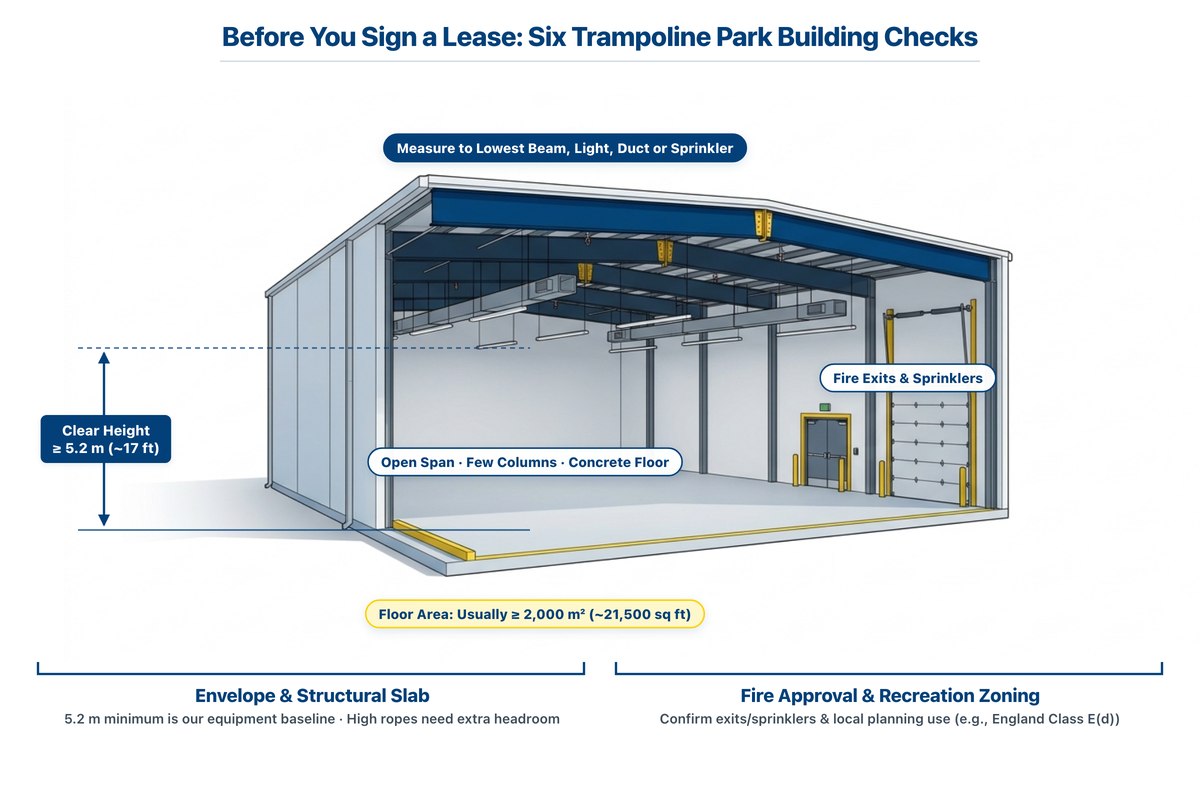
Look for an open building with a clear height of at least 5.2 m (about 17 ft) and a concrete floor, then check that the floor area fits the zones you want. For a first trampoline park, that usually means 2,000 m² (about 21,500 sq ft) or more. Mundo Jump Park in Colloto, Spain, which we delivered as a one-stop project in 2023, is a 2,800 m² (about 30,140 sq ft) trampoline park and indoor playground in a building with a 7 m (about 23 ft) ceiling.
| What to check | What we look for | Why it matters |
|---|---|---|
| Clear height | At least 5.2 m (about 17 ft), measured from the floor to the lowest beam, light, duct or sprinkler | Trampoline courts, foam pits and climbing walls need headroom, and the lowest obstruction is what limits the design |
| Floor area | 2,000 m² (about 21,500 sq ft) or more for most first parks | Decides how many trampoline courts and attractions fit, plus reception, party rooms and a café |
| Open space | As few columns as possible | Columns break up courts; existing rooms and mezzanines can be built into the layout |
| Floor | Concrete | Our layouts are designed for a concrete floor |
| Fire safety | Exits, sprinklers and fire separation that your local fire authority will approve | Changes to sprinklers or exits are building work, and they cost time and money |
| Planning use | A building you are allowed to use for indoor recreation | In England, indoor sport, recreation or fitness falls under Class E(d) of the Use Classes Order; elsewhere, ask your local planning office |
Public guides do not agree on a minimum size or height. One US equipment supplier says most US parks occupy 25,000–35,000 sq ft (about 2,323–3,252 m²); a European supplier says at least 1,500 m² (about 16,146 sq ft); neither cites a source, and the suppliers measure height from different points. The 5.2 m clear height above is our design requirement for our own equipment, not an industry standard.
That figure is a minimum for a standard layout. High ropes courses and taller climbing walls need more headroom, and a smaller building can still work with fewer zones. Other suppliers use other figures, so ask each one where they measure clear height from.
Your next step: send us a floor plan with dimensions, column positions, existing rooms and the clear height. Our designers will tell you what fits before you sign a lease, and the first layout is free. You can see the zones we build on our trampoline park equipment page.
Franchise or Independent
A franchise gives you a brand, a design and an operating system, with fees and capital requirements. An independent park avoids those fees, but you choose the design, the equipment and the suppliers yourself.

To see what a franchise asks for, read the brand’s Franchise Disclosure Document (FDD) in the US. Urban Air’s investment page, quoting its 2026 FDD, lists an initial franchise fee of $100,000, a royalty of 7% of monthly gross sales, a 6% local marketing requirement and $750,000 in liquid assets as a minimum (collected on 7 November 2026). Those are one brand’s US terms for its own park formats, not a general price for opening a trampoline park.
An independent park pays no franchise fee or royalty. You buy the design and the equipment directly from a manufacturer, run the park under your own brand and keep control of the layout, the attractions and the ticket prices. In exchange, you build your own operating system: booking, waivers, staff training and marketing.
Your next step: if you are leaning toward a franchise, request the FDD and read the fee and investment items before anything else. If you are going independent, the rest of this guide is your checklist. You can also compare franchise and independent in detail.
Budget and Financing
Budget for three things, not one: the equipment, the building work, and the money you spend before the park opens. The costs first-time owners most often leave out are the ones beyond the equipment.

| Cost | What it covers | What we can tell you |
|---|---|---|
| Equipment | Trampoline courts, foam pits, ninja courses, climbing walls and the other attractions, designed for your building | For a first budget, about USD 120 per m² (about USD 11 per sq ft) of total venue area, FOB China (the price at the Chinese port; sea freight and import costs come on top), for design and equipment (2026 pricing). Installation is not included, and packing and sea freight are calculated from the actual cargo once production is complete. The price is fixed once the layout and theme are agreed |
| Installation | Assembling the equipment on site | Our technicians at USD 150 per technician per day, with flights, accommodation and visas paid by you; or your own team with our installation manual and online guidance |
| Building work | Flooring, walls, electrics, lighting, heating and cooling, fire and sprinkler changes, toilets, reception and café fit-out | Quote it with local contractors once the layout is fixed; we do not price building work |
| Before opening | Rent and deposits before you trade, permits, insurance, hiring and training staff, booking and waiver software, opening marketing, working capital | Local costs; add them line by line in your plan |
The franchise example shows why the last two rows matter. In Urban Air’s 2026 FDD (2.0 park format, US, collected on 7 November 2026), leasehold improvements range from $853,613 to $2,225,980, compared with $1,214,760 to $1,618,650 for the base attraction equipment package. Pre-opening wages ($51,475–117,150), insurance ($13,087–77,437) and working capital ($150,000–270,000) are listed as separate lines. Your park will be a different size and in a different market, but the same budget lesson applies: building work can cost as much as the equipment.
Equipment is paid for in two parts: a 30% deposit to start production and the 70% balance plus freight before shipment, both by T/T. In the US, the Small Business Administration lists 7(a) loans, 504 loans and microloans as funding programs. In the UK, business rates are charged on most non-domestic properties, so add them to your running costs and use GOV.UK to estimate them.
Your next step: get our equipment budget for your floor plan, then add the building work and pre-opening costs before you talk to a lender, and see what it costs to open a trampoline park line by line.
Opening Timeline
Plan your opening date by working backward from installation, not forward from production. Production is only one part of the time between your order and opening day.
| Step | Who handles it | How long |
|---|---|---|
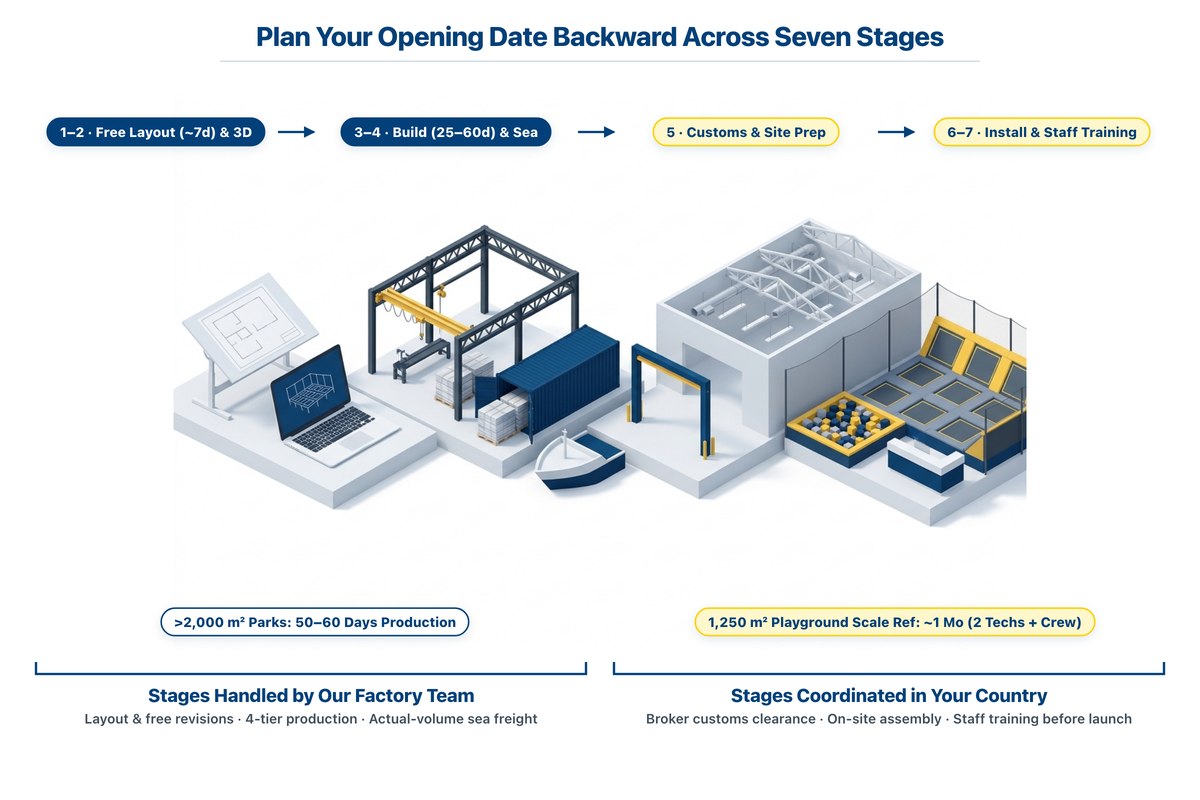
| First layout and budget | Our designers | Usually within 7 days of receiving your floor plan |
| Revisions and renderings | Our designers and you | Until you approve the design; the design is free |
| Deposit and production | Our factory | 25–30 days up to 200 m² (about 2,150 sq ft) · 30–40 days for 200–500 m² (about 2,150–5,380 sq ft) · 40–50 days for 500–2,000 m² (about 5,380–21,500 sq ft) · 50–60 days above 2,000 m² (about 21,500 sq ft), from the approved design |
| Packing and sea freight | Our team | Depends on the destination port; we give it with the quotation |
| Import customs clearance | You or your customs broker | Depends on your country |
| Installation | Our technicians, or your team with our manual | Depends on the size of the park and the team |
| Staff training and opening | You, with our staff training guides | Before your opening day |
Most first trampoline parks fall in the 50–60-day production band, and shipping, customs and installation come after that. We do not publish a standard installation time for trampoline parks, because it depends on the size of the park and the installation team. For a sense of scale only: one 1,250 m² (about 13,455 sq ft) indoor playground, not a trampoline park, took two of our technicians working with a local crew about a month to install.
We do not give a single total, because the port, the customs process and the installation team differ for every project. An opening date set from the production time alone will be too early.
Your next step: ask us for the shipping time to your port, which comes with the quotation, and your customs broker for the clearance time, before you announce an opening date. Each stage is described on our how we work page.
Equipment and Layout
Choose the zones for the visitors you expect, then let the layout decide how many of each fit in your building.

The zones we design and build for trampoline parks:
- Trampoline courts: steel frames, jumping beds and springs, for ages 6 and up
- Foam pits: 20 × 20 cm foam blocks, for ages 6 and up
- Ninja courses: for ages 6 to 14, with a simplified line for ages 4 to 6 under adult supervision
- Climbing walls: for ages 6 and up
- Rope courses: for ages 8 and up
- Zip lines: for ages 6 and up, within the height and weight limits of the equipment
- Drop slides and multi-lane slides: for ages 6 and up
Our designers prepare the layout and the renderings free of charge and revise them until you are satisfied. Once you approve the layout and the theme, you get a fixed quotation.
Our trampoline courts are certified to ASTM F2970 for the US market and EN ISO 23659 for the European market. Each certificate covers the trampoline court model we had tested. All sizes and color themes can be customized.
Your next step: list the age groups you want to serve and send them with your floor plan. For themes built around your own brand, see our custom design page.
Permits, Insurance and Safety
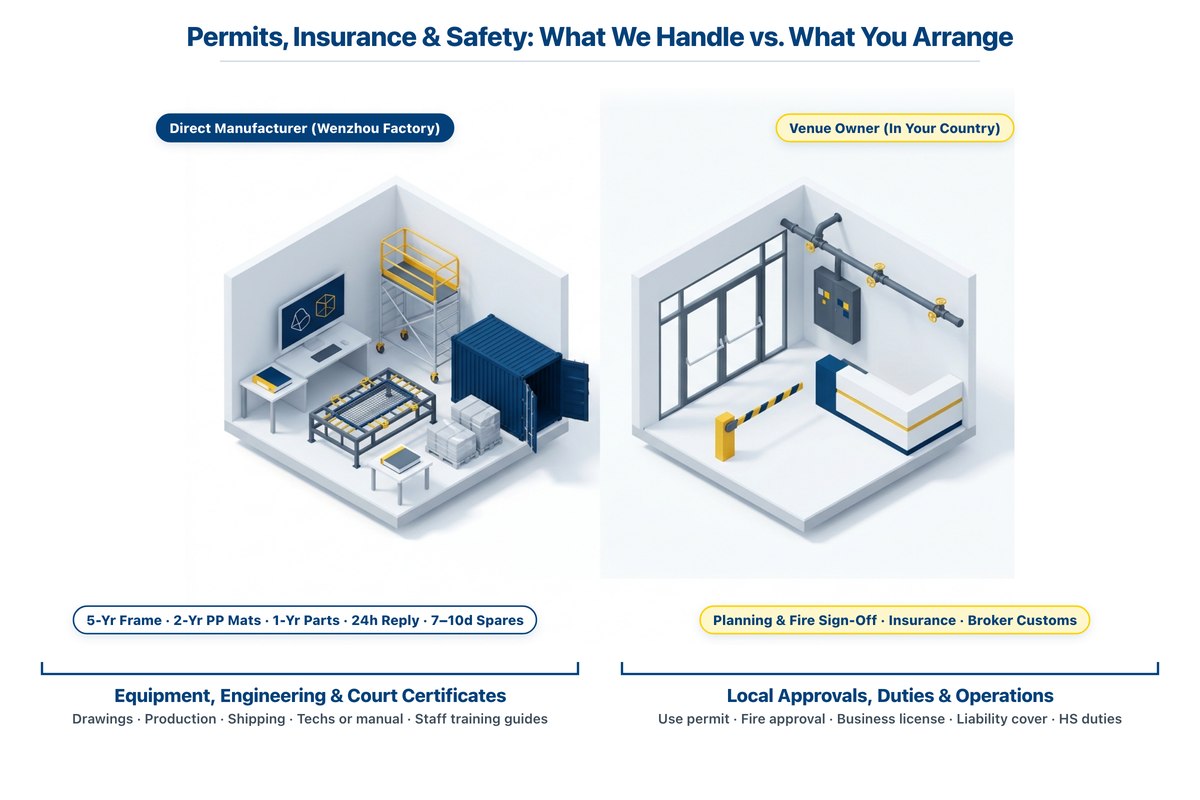
You arrange permits, insurance, fire approval and import customs clearance in your own country; the manufacturer supplies the documents required for those approvals.
| We handle | You arrange locally |
|---|---|
| Layout, renderings and engineering drawings | Planning or use approval for the building |
| Production in our factory in Wenzhou, China | Building and fire approvals |
| Packing and shipping | Business license |
| Installation technicians, or a manual and online guidance for your team | Liability insurance |
| Staff training guides | Import customs clearance and duties |
| Certificates and test reports for the trampoline courts | Hiring staff, booking and waivers |
| After-sales: replies within 24 hours and spare parts in usually 7 to 10 days | Running the park |
The warranty covers structural frames for 5 years, standard PP trampoline jump mats for 2 years, and other parts for 1 year, starting when installation is complete.
Your insurer or your inspector may ask which standard the trampoline courts meet. The answer depends on your country and your insurer, so send us their requirements and we will check them against our certificates. Ask for the HS code of each item on the quotation, so your customs broker can work out the duties before the equipment ships.
Your next step: contact the local planning office, the fire authority and an insurer as soon as you have a building in mind. You can see our certificates on the certifications page.
FAQ
How much does it cost to start a trampoline park?
It depends first on the size of your building. For the equipment, allow about USD 120 per m² (about USD 11 per sq ft) of total venue area, FOB China, for design and equipment (2026 pricing), excluding installation. Building work and pre-opening costs are extra, and in a franchise budget they can cost as much as the equipment.
How much does it cost to set up a trampoline park?
Setting up means paying for equipment and installation. Installation by our technicians costs USD 150 per technician per day, with flights, accommodation and visas paid by you. You can also use your own team with our manual and online guidance.
Do trampoline parks make money?
That depends on how many visitors come each week, what they pay, and what you spend on rent and wages. We do not publish revenue figures; base those parts of your business plan on local ticket prices and real rent quotes.
How can I build my own trampoline park?
Find the building, get a layout for it from a manufacturer, choose trampoline courts certified for your market, arrange the local permits and insurance, then install and train your staff. That is the independent route this guide follows.
How long does it take to open a trampoline park?
There is no single number. Production alone takes 50–60 days for a park above 2,000 m² (about 21,500 sq ft), and shipping, customs and installation come after that.
What ceiling height does a trampoline park need?
For our equipment, allow a clear height of at least 5.2 m (about 17 ft), measured to the lowest beam, light, duct or sprinkler. Some attractions need more headroom, so send us the actual height with your floor plan.
Can I visit your factory before I order?
Yes. You can visit our factory in Wenzhou, China, or ask for a live video tour.
Get a Free Trampoline Park Layout and Budget
Send us your floor plan with the clear height. We reply within 24 hours, and our designers send the first layout and budget, usually within 7 days, free of charge.