

Choosing between an indoor playground franchise and an independent build comes down to what you want your capital to buy: a licensed brand playbook with permanent gross-sales deductions, or full creative ownership of your venue, play attractions, and future locations. Published U.S. Franchise Disclosure Document (FDD) summaries show upfront franchise fees of USD 42,500 to USD 50,000, ongoing royalties of 6% to 7% plus 1% to 2% brand fund deductions (8% combined gross-sales deductions before local marketing or monthly tech fees), and total initial investments ranging from USD 305,400 to over USD 1.8 million. Going independent eliminates upfront licensing fees and lifetime revenue royalties—letting you channel that budget into custom play structures, safety engineering, and local marketing—provided you reserve at least 6 months to coordinate your lease, local permits, customs clearance, and launch operations alongside a direct manufacturer. This guide focuses on children’s indoor playgrounds, soft play centers, and neighborhood play spaces; if you are planning a 2,000 m²+ (21,528 sq ft+) high-ceiling adventure venue, see our companion breakdown on trampoline park franchise vs. independent ownership.
ContentsIndoor Playground Franchise Costs: Upfront Fees, Royalties, and Build-Out
Evaluating indoor playground franchise pricing requires reading past the initial franchise fee to calculate five-year total cost of ownership across Item 5, Item 6, and Item 7 of the Franchise Disclosure Document. Under the U.S. Federal Trade Commission (FTC) Franchise Rule, a franchisor must furnish a complete 23-item FDD at least 14 calendar days before you sign a binding contract or pay any money. That document separates what you pay before opening day from the weekly or monthly deductions wired to headquarters for a typical 10-year franchise term.
Across active children’s indoor play franchise systems in the United States, startup capital and floor-plate mandates vary sharply by concept tier. Published 2024 and 2025 FDD summaries (transcribed via FDD Exchange—always verify the latest state-registered filing before signing) alongside official brand disclosures illustrate three distinct scale brackets:
| Franchise Brand & Source | Typical Venue Footprint | Initial Franchise Fee (Item 5) | Ongoing Royalty & Brand Fees (Item 6) | Estimated Total Initial Investment (Item 7) | Item 19 Earnings Claim Included? |
|---|---|---|---|---|---|
| Momi Land (2025 FDD summary via FDD Exchange) | 5,000–20,000 sq ft (465–1,858 m²) | USD 50,000 | 7% gross-sales royalty (min USD 250/wk or USD 1,000/mo) + 1% ad/brand fund | USD 305,400 – USD 544,000 (includes USD 100k–150k equipment & USD 50k–150k build-out) | Yes — limited to 3 company-owned Ohio outlets (USD 528,770 avg gross sales in 2024; not net profit) |
| Hyper Kidz (2024 FDD summary via FDD Exchange) | 11,000–16,000 sq ft (1,022–1,486 m²) | USD 42,500 (+ USD 7,500–10,500 training fee) | 6% gross-sales royalty + 2% brand fund + 2%/mo local marketing + USD 290/mo tech + USD 250/mo accounting | USD 751,633 – USD 1,800,333 (includes USD 250k–900k leasehold build-out & USD 250k–400k FF&E) | No — franchisor makes no financial performance representation |
| Play Street Museum (2026 official brand cost page) | Boutique small-format neighborhood play space | Included inside total investment range | Ongoing royalty and brand support structure disclosed upon FDD request | USD 507,143 – USD 800,524 | Verify directly in current FDD |
Upfront build-out costs and equipment still come out of your own pocket—or your U.S. Small Business Administration (SBA) loan—even after paying the USD 42,500 to USD 50,000 entry fee. What catches many first-time business owners off guard is how ongoing gross-sales royalties compound regardless of your net operating margin. Because royalties are calculated on top-line gross sales (admission tickets, birthday parties, memberships, and café sales before deducting rent, payroll, utilities, or loan service), a slow winter month still triggers weekly deductions—or minimum floor payments such as Momi Land’s USD 1,000/month royalty minimum.
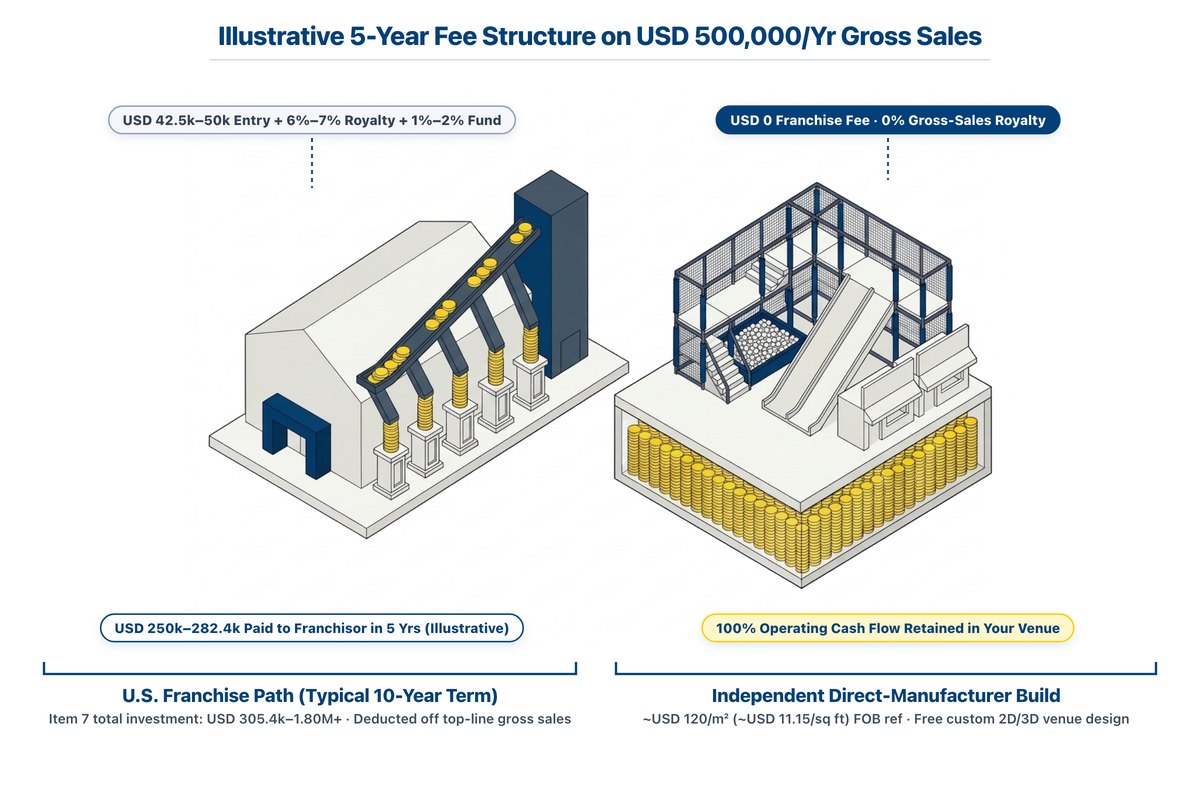
Illustrative 5-Year Ongoing Fee Math (for fee-structure comparison only, not a revenue forecast): Suppose an indoor play venue generates USD 500,000 in annual gross revenue (USD 2,500,000 cumulative over 5 years):
- Under an 8% combined royalty + brand fund structure (matching Momi Land’s 7% + 1% schedule): You remit USD 40,000 per year, or USD 200,000 over 5 years, plus the USD 50,000 initial franchise fee—totaling USD 250,000 paid to the franchisor before covering rent, staff wages, or insurance.
- Under a 6% royalty + 2% brand fund + USD 540/month fixed tech/accounting schedule (matching Hyper Kidz’s published 2024 FDD rates, excluding its 2% local marketing spend requirement): You remit USD 46,480 per year, or USD 232,400 over 5 years, plus USD 50,000 upfront (USD 42,500 franchise fee + USD 7,500 base training for up to three trainees)—totaling USD 282,400 in five-year franchise charges.
- Under an independent direct-manufacturer build: Upfront franchise fee is USD 0, ongoing gross-sales royalty is USD 0, and mandatory national brand-fund deductions are USD 0—leaving 100% of operating cash flow inside your own company to fund lease reserves, staff retention, or attraction upgrades.
What a Franchise Gives You—and What the Contract Locks Down
Paying for an indoor playground franchise buys operational scaffolding designed to shorten a newcomer’s learning curve, yet the same contract restricts how you source equipment, adapt themes, and exit the business. Understanding both sides of that trade-off prevents buyers from paying USD 50,000 for services a turnkey playground equipment manufacturer and a local commercial broker already provide without ongoing royalties.
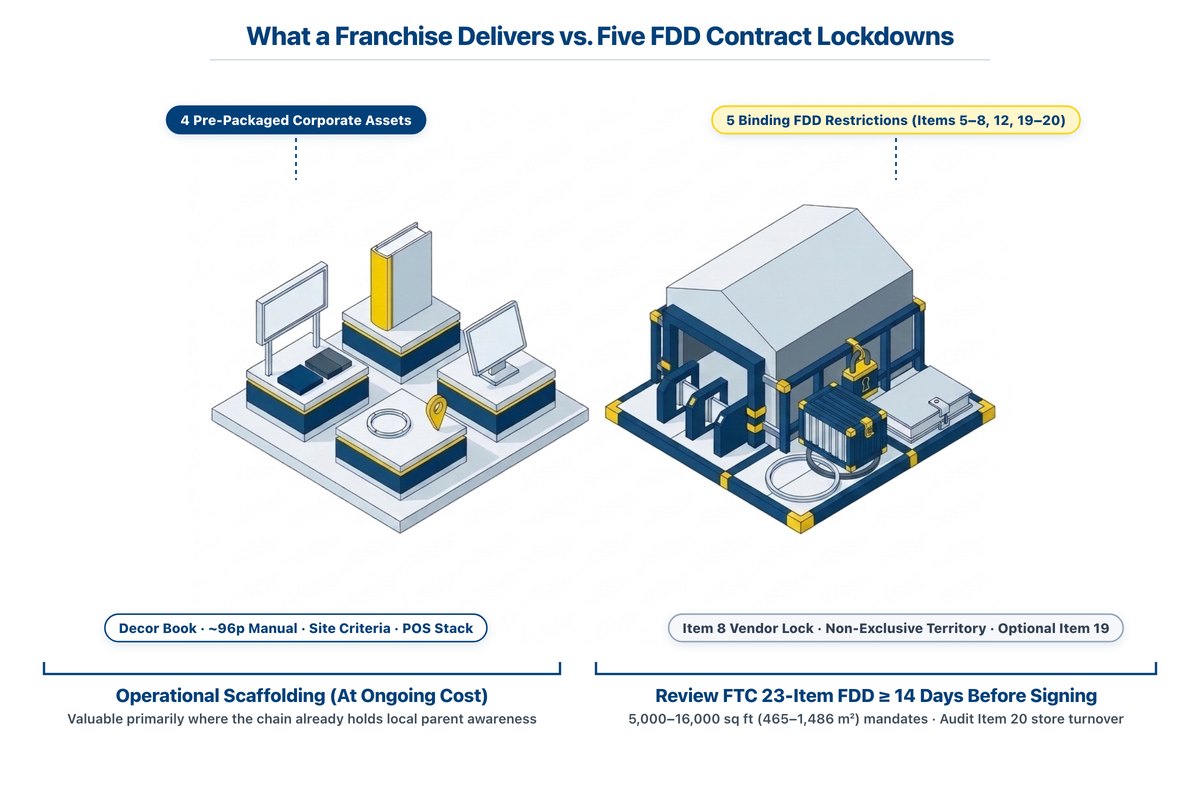
On the support side, an established franchise model typically delivers four tangible assets:
- Pre-packaged brand identity and decor book: Ready-made signage specs, color palettes, uniforms, and trademarked names that carry existing awareness in regions where the chain already operates multiple stores.
- Operations manual and pre-opening training: Loaned operating manuals (for example, Hyper Kidz’s 2024 FDD specifies an approximately 96-page manual alongside 16 classroom hours and 24 on-the-job training hours in Maryland, plus up to 14 days of opening assistance) covering check-in workflows, party hosting scripts, and cleaning schedules.
- Site selection criteria and lease review input: Demographic checklists (such as minimum child population counts within a 15-mile / 24.1 km drive radius) and headquarters sign-off on architectural drawings.
- Pre-selected software and vendor lists: Required point-of-sale (POS), digital waiver, and party booking stacks so you do not have to compare software vendors from scratch.
At the same time, FTC guidance urges prospective franchisees to scrutinize five binding restrictions inside the FDD before committing capital:
| FDD Section | What the Clause Governs | Practical Risk for Indoor Playground Investors |
|---|---|---|
| Item 5 & Item 6 (Initial & Other Fees) | Non-refundable signing fees, training fees, weekly royalties, tech fees, and transfer/audit penalties | Hyper Kidz’s 2024 FDD lists a USD 15,000 transfer fee if you sell your store and USD 290/mo tech + USD 250/mo accounting fees on top of 6% + 2% gross-sales deductions |
| Item 7 & Venue Specs (Initial Investment) | Mandatory square-footage floors and interior build-out standards | Many U.S. franchises require 5,000 to 16,000 sq ft (465 to 1,486 m²), pricing out first-time owners who want a manageable 300 m² (3,229 sq ft) neighborhood venue |
| Item 8 (Restrictions on Sources of Products) | Mandatory purchase of play structures, mats, POS hardware, and party supplies from franchisor-approved vendors | Prohibits direct factory sourcing; vendor markups or franchisor rebates can inflate playground equipment outlay well above direct manufacturing prices |
| Item 12 (Territory) | Whether your geographic radius is truly exclusive | Designated territories often contain carve-outs; Hyper Kidz’s 2024 FDD notes franchisees are not granted exclusive territorial rights and could still compete against alternative channels |
| Item 19 & Item 20 (Earnings & Outlet Turnover) | Optional earnings claims (Item 19) and 3-year openings, closures, and former-owner contacts (Item 20) | Franchisors are not legally required to provide Item 19 numbers; meanwhile, VettedBiz records show children’s gym brand Great Play (founded 2008) now lists 0 active U.S. franchise outlets—proving brand longevity requires auditing Item 20 |
Creative rigidity also affects local positioning. If your suburban shopping center already has a primary-colored plastic play gym two miles away, a franchise agreement bars you from pivoting to a pastel macaron aesthetic, adding custom neighborhood role-play houses, or tailoring attraction heights to an unusual ceiling grid without corporate approval.
Building an Independent Indoor Playground: Who Handles What
Opening an indoor playground without a franchise does not mean inventing engineering drawings, safety compliance, or assembly manuals alone—it means splitting local business execution from factory design and manufacturing. When you partner directly with an integrated commercial manufacturer, every technical milestone from 3D spatial planning to post-installation spare parts is handled by the factory team, while you retain 100% ownership of your brand name, lease terms, and operating profits.
To set realistic expectations, an independent owner should reserve at least 6 months from initial layout sign-off to grand opening. Across that timeline, responsibilities divide cleanly into five local owner tasks and six factory-delivered stages:
| Project Scope | Handled Locally by You (Independent Owner) | Delivered Directly by Zhenghan (Wenzhou Factory) |
|---|---|---|
| 1. Brand & Spatial Layout | Choose your own legal business name, local trademark, pricing tiers, and neighborhood concept | Free 2D floor plans, 3D renderings, and walkthrough videos—initial layout and budget estimate delivered in roughly 7 days after receiving your CAD/dimensioned plan, revised until you are satisfied, including custom brand mascot/IP creation |
| 2. Premises & Permits | Sign commercial lease, verify local zoning, complete floor/wall/HVAC/sprinkler renovation, and secure fire/occupancy permits | Calculate vertical clearances around real beams, columns, and sprinklers using our reference baseline (Tiers × 1.4 m / 4.6 ft) + 0.2 m (0.66 ft) top allowance + 0.5 m (1.64 ft) sprinkler gap (customizable deck heights and 3+ tiers when ceiling height allows) |
| 3. Manufacturing & Pre-Assembly | Approve final 3D design and wire 30% T/T production deposit | Fabricate play frames inside our 20,000 m²+ (215,278 sq ft+) manufacturing plant in Wenzhou (25–60 days by venue size), run 6-category pre-shipment quality checks, perform factory trial assembly on main steel frames and complex junctions, and pack components labeled by venue zone and drawing code (using protective wrap and cartons for steel/soft parts, plus export wooden crates for oversized fiberglass slides and interactive consoles) |
| 4. Ocean Freight & Customs | Settle 70% balance plus ocean freight before shipment; complete import customs clearance, tariff payments, and local tax filings through your customs broker | Calculate exact container volume once production finishes, assist with sea freight booking to your destination port, and supply Children’s Product Certificate (CPC) documentation backed by third-party 16 CFR test reports for U.S. importers |
| 5. On-Site Assembly | Release a clean, dust-free hall; provide unloading forklift/scaffolds and local helper labor | Supply detailed self-installation manuals + online engineering guidance (USD 0 factory labor), or dispatch technicians from our 60+ technician team (each with 1+ year of workshop fabrication and 3+ years of domestic and international site installation experience) at USD 150/person/day (buyer covers flights, hotel, meals, visas, and local assisting workers) |
| 6. Operations & Warranty | Select your preferred POS/waiver software, hire staff, secure liability insurance, and run local marketing | Provide staff training materials covering daily safety inspections and sanitation; start 5-year coverage on the structural frame plus 1-year coverage on remaining parts the day assembly finishes, with 24-hour replies and typical 7–10 day spare parts delivery |
Real independent venues show how this division works across both compact first-time stores and multi-unit regional brands. In Costa Rica, Macaron Park launched a 360 m² (3,875 sq ft) independent indoor play space—right in the sweet spot of most first-time operators—combining pastel color coordination, soft climbing zones, and slides without paying a dollar in franchise royalties. In Budapest, Hungary, the independent owner of PINGULI Play House launched a candy-themed play center spanning 1,250 m² (13,455 sq ft) in 2025 (assembled in about one month by two Zhenghan technicians working alongside local workers) and subsequently ordered a second set of equipment for a new project under their own independent brand—paying zero multi-unit development fees to a franchisor. You can inspect project photo and 3D layout galleries on our global projects page and review each stage of delivery on how we work from design to after-sales.

Side-by-Side Comparison: Franchise vs. Direct Manufacturer Build
Putting an indoor playground franchise next to an independent direct-manufacturer build clarifies where your money goes—and what asset you actually own at the end of a 10-year commercial lease. While franchises standardize every decision around corporate uniformity, direct factory sourcing adapts structure geometry, age zoning, and themed attractions to your exact building and neighborhood demographics.
| Comparison Dimension | U.S. Indoor Playground Franchise | Independent Build (Direct Factory Supply) |
|---|---|---|
| Upfront Licensing Fee | USD 42,500 – USD 50,000 non-refundable initial fee (+ USD 7,500–10,500 training fees on some systems) | USD 0 — 2D layout, 3D renderings, and revisions are included free |
| Minimum Venue Size | Typically locked at 5,000 – 16,000+ sq ft (465 – 1,486+ m²) on full-format Play & Party chains | Flexible: most debut independent venues occupy roughly 300 m² (3,229 sq ft) across one floor, scaling up to 2,900+ m² (31,215+ sq ft) |
| Ongoing Gross-Sales Deduction | 6% – 7% royalty + 1% – 2% brand fund (+ USD 540/mo tech/accounting on some FDDs) for 10 years | 0% ongoing royalties and 0% mandatory brand-fund fees |
| Equipment Sourcing | Locked to Item 8 approved suppliers; direct factory purchasing prohibited | Direct Wenzhou factory pricing across commercial indoor playground equipment and commercial soft play equipment |
| Theme & Attraction Mix | Restricted to corporate decor manual and pre-approved attraction modules | Full custom mascot/IP theming, custom color palettes, multi-tier frames, thickened ball pits, toddler zones, electric carousels, and themed role-play houses (mini supermarkets, kitchens, clinics) |
| Structural Materials | Determined by franchisor’s designated vendor specs | 48 mm × 2.0 mm (1.89 in × 0.08 in) galvanized steel pipe up to 3 tiers with cast-steel connectors (thicker-walled galvanized steel on taller multi-tier builds), 1.5 cm (0.59 in) moisture/fire-resistant board + 3 cm (1.18 in) high-density EPE + 0.45 mm (0.018 in) flame-retardant PVC decks, 2 cm (0.79 in) high-density EVA floor mats, 0.9 mm (0.035 in) PU leather covers, and machine-woven nylon safety netting |
| Safety Certificates & Reports | Provided through franchisor’s equipment vendor | Tested multi-level play structure models hold ASTM F1918 and EN 1176 certificates and passed third-party mechanical and flammability testing under U.S. CPSC 16 CFR (documented in lab test reports) with importer CPC support |
| Structural Warranty | Determined by the franchisor’s designated Item 8 equipment vendor | 5-year coverage for the galvanized steel main frame alongside 1-year coverage for other parts, starting when installation finishes |
| Opening a 2nd Location | Requires signing a new unit agreement and paying additional franchise/development fees (e.g., USD 85,000 3-unit fee in Hyper Kidz’s 2024 FDD) | 100% your own trademark and IP—replicate your concept anywhere with zero second-store licensing fees |
One widespread misconception is that commercial insurers only underwrite known franchise brands. In practice, U.S. and European commercial general liability underwriters evaluate physical equipment standards, fall-zone engineering, maintenance logs, and clear ADA circulation—not whether a logo on your storefront belongs to a franchisor. U.S. Consumer Product Safety Commission (CPSC) business guidance notes that public playground equipment is evaluated against recognized voluntary standards alongside mandatory federal children’s product rules (including 16 C.F.R. part 1307 phthalate limits, 16 C.F.R. part 1250 toy safety rules on applicable play attachments, and CPC documentation). You can inspect our testing scope and certificate copies on our safety certifications page.

How to Control Your Startup Budget Without a Franchisor
Most first-time independent operators do not start with a 15,000 sq ft (1,394 m²) warehouse or a USD 1 million checkbook—they open single-story indoor playgrounds measuring roughly 300 m² (3,229 sq ft) on a single level—set inside a standalone building paired with a café/restaurant or inside a neighborhood shopping mall. Going independent lets you engineer your equipment package to fit that realistic floor plate instead of stretching debt to satisfy a franchisor’s Item 7 build-out minimums.
When running early budget math on a standard mixed-attraction commercial indoor playground, use about USD 120 per square meter (about USD 11.15 per square foot) of total venue area, FOB China, as an initial factory estimate. Understanding exactly what sits inside—and outside—that planning baseline keeps your spreadsheet accurate:
- Included in the ~USD 120/m² FOB planning reference: Custom 2D/3D spatial design, the multi-tier galvanized steel play structure, full EVA foam floor matting throughout the active play footprint, plus the integrated toddler area (soft blocks, ball pool, low climbers) integrated within a standard mixed indoor playground.
- When the per-square-meter price shifts: Adding high-thrill adventure modules—such as ninja warrior courses, aerial adventure challenges, or high ropes courses—pushes overall project cost above the standard baseline due to heavier trusswork and safety-harness engineering. Conversely, a tiny venue built exclusively with frameless toddler soft play (with zero multi-tier steel main frame) does not follow the mixed-venue average and is priced directly from your approved item list.
- Budgeted separately from FOB equipment: Post-production packaging and ocean freight (calculated from actual cargo cubic volume), destination customs duties and port drayage, on-site installation (USD 0 factory labor if self-installed with local crew, or USD 150/day per dispatched technician plus travel and local assisting workers), interior leasehold build-out, and 3 to 6 months of working capital.
If our initial 7-day layout and budget estimate—or subsequent 3D proposal—comes back above your target equipment budget, our engineering team never downgrades core 48 mm × 2.0 mm (1.89 in × 0.08 in) galvanized steel pipe specs, EPE padding protection, or safety netting to cut corners. Instead, we pull three transparent cost-control levers during design revisions:
- Adjust vertical tier count: Stepping a section down from three tiers (roughly 4.9 m / 16.1 ft reference clear height) to two tiers (roughly 3.5 m / 11.5 ft reference clear height) reduces steel tonnage, decking boards, and installation labor hours while keeping ground-level play flow intact (see our commercial indoor playground design guide for full ceiling-clearance planning).
- Switch frame decorative panels from raised 3D relief to flat printed panels and trim panel quantity: Elaborate 3D sculpted decorative panels mounted onto the play frame—and wrapping excessive frame surfaces in decorative cladding—add substantial molding and hand-finishing cost. Switching all frame-mounted panels to clean flat printed panels without raised relief, and reducing decorative panel coverage to prioritize clean light theming and coordinated color palettes (the dominant preference among modern commercial operators), preserves visual appeal and play functionality at a noticeably lower cost.
- Replace expensive thrill add-ons with proven core play modules: Replacing an expensive high-ropes bridge or ninja obstacle truss with classic fiberglass slides, web bridges, or themed role-play houses keeps hourly child capacity strong without blowing your opening budget.
To run your own room dimensions, local rent, and staffing assumptions through an interactive payback model, try the calculators embedded in our indoor playground equipment cost guide and our indoor playground business plan guide.

Which Path Fits Your Venue, Market, and Expansion Plan?
Neither ownership model is universally superior for every investor; the right choice depends on your target country, building footprint, appetite for local brand building, and five-year expansion goals. Run your project through these two practical checklists before requesting franchise agreements or factory CAD drawings.
An indoor playground franchise makes sense when:
- You are opening in a U.S. metro where the specific franchise brand already operates nearby stores with proven parent recognition, and Item 20 shows steady net unit growth over the past three years.
- You have USD 305,400 to USD 1.8 million in liquid capital and financing, want a 5,000 to 16,000 sq ft (465 to 1,486 m²) standardized format, and willingly trade 6% to 8%+ of lifetime gross sales for a corporate operations manual and pre-chosen vendor stack.
- You prefer following an established corporate playbook rather than naming your own venue, choosing custom color themes, or curating local café partnerships.
An independent direct-manufacturer build fits better when:
- Your first venue is a 200 to 500 m² (2,153 to 5,382 sq ft) single-story storefront, shopping-mall unit, or play cafe hybrid—where manufacturing takes just 30 to 40 days (25 to 30 days up to 200 m² / 2,153 sq ft, counted from approved design) and eliminating a USD 50,000 franchise fee directly funds a large share of your entire play structure.
- You are building in the United Kingdom, Europe, Latin America, Canada, or the Middle East, where U.S. franchise trademarks carry zero local parent recognition and U.S. FDD build-out specs do not align with local rules—such as England’s Use Class E(d) indoor recreation planning category (subject to local planning authority confirmation) or European EN 1176 inspection frameworks. (Before importing, request the commercial product description and 6-digit HS heading from our export team and verify your exact national commodity code and tariff rate with your customs broker via official portals: USITC Harmonized Tariff Schedule for the U.S., GOV.UK Trade Tariff for the UK, or EU TARIC for European Union member states.)
- You want distinctive neighborhood positioning—such as minimalist pastel soft play, custom brand mascots, or integrated mini-town role-play houses—and want the freedom to open a second or third location under your own trademark with zero additional franchise fees, just as the owner of Budapest’s PINGULI Play House ordered a second set of equipment for a new project with zero franchise fees.
If you want to customize every square meter around your building’s exact column grid and local audience, explore how our design team develops one-of-a-kind venues on our custom indoor playground page or review direct export terms on our China indoor playground manufacturer page.

Frequently Asked Questions
Can you open an indoor playground franchise for USD 50,000?
No—USD 42,500 to USD 50,000 only covers the upfront Item 5 initial franchise fee for signing the license agreement, before buying a single slide, mat, or lease deposit. In published U.S. disclosures, total Item 7 initial investment ranges from USD 305,400 to USD 544,000 at Momi Land (2025 FDD summary), USD 507,143 to USD 800,524 at Play Street Museum (official brand cost guide), and USD 751,633 to USD 1,800,333 at Hyper Kidz (2024 FDD summary). By contrast, an independent operator opening a 300 m² (3,229 sq ft) venue skips the USD 50,000 license fee entirely and puts capital straight into equipment, interior finishes, and operating reserves.
How should I read Item 19 in an indoor playground FDD?
Read Item 19 (Financial Performance Representations) for three things: whether it exists at all (under FTC rules, franchisors can legally omit earnings claims, as Hyper Kidz does in its 2024 FDD), whether reported numbers come from franchised stores or only a handful of company-owned flagship outlets, and whether the figure shows gross sales rather than net profit. For example, Momi Land’s 2025 FDD summary reports USD 528,770 average gross sales across 3 company-owned Ohio outlets—before subtracting rent, payroll, insurance, 7% royalties, and 1% brand fees. Always call current and former franchisees listed in Item 20 to verify real-world rent-to-revenue ratios.
How does an independent indoor playground pass safety and insurance checks without a franchisor?
Safety compliance comes from certified engineering and site layout, not from a franchise trademark. Our tested multi-level indoor playground structure models carry ASTM F1918 certificates for North America alongside EN 1176 certificates for European markets (covering tested multi-tier combination structures excluding separate ball pits, unframed toddler shapes, powered carousels, or role-play houses), and passed third-party mechanical and flammability testing under U.S. CPSC 16 CFR documented in lab test reports—allowing us to issue importer Children’s Product Certificates (CPC) for U.S. customs clearance. Pairing compliant factory hardware with U.S. ADA Chapter 10 accessible route widths (or equivalent local accessibility codes) and daily inspection checklists aligns with what commercial general liability underwriters and municipal building inspectors review.
Should UK or European investors buy a U.S. indoor playground franchise?
Rarely. Most U.S. indoor play franchise brands have little consumer brand recognition in the UK or continental Europe, supply vendor lists geared toward North American domestic shipping, and build manuals around U.S. zoning rather than England’s Use Class E(d) planning category (subject to local planning authority confirmation; Scotland, Wales, and Northern Ireland maintain separate rules) or EN 1176 standards. Working directly with an export-experienced manufacturer that already holds EN 1176 certificates on tested play structure models and has delivered European projects—including installations in Spain and Hungary—avoids cross-border franchise mismatches and ongoing USD royalty wire transfers.
How do I create a cohesive brand and theme if I do not have an in-house design team?
Our Wenzhou design department provides free custom 2D layouts, 3D renderings, IP/mascot character development, and walkthrough videos, delivering an initial layout and budget within roughly 7 days of receiving your floor plan and revising until you are satisfied. Whether you want a clean modern pastel play cafe with custom role-play houses or a multi-level candy, space, or jungle adventure park, you receive a cohesive visual identity that you own 100% royalty-free.
Plan Your Independent Indoor Playground Layout and Budget
Ready to compare what your exact floor plan looks like as a royalty-free independent venue? Send us your building dimensions or CAD drawing, clear ceiling height below sprinklers, target age range, and preferred opening timeline. Our team replies within 24 hours (via info@zhenghanplay.com or WhatsApp +86 180 6626 3537) and delivers a free initial 2D layout and preliminary factory budget within roughly 7 days—with USD 0 franchise fees and 0% ongoing royalties. Visit our contact page to request your free custom layout and quote.
References
- Federal Trade Commission (FTC) — A Consumer’s Guide to Buying a Franchise: https://www.ftc.gov/business-guidance/resources/consumers-guide-buying-franchise
- U.S. Small Business Administration (SBA) — Buy an Existing Business or Franchise: https://www.sba.gov/business-guide/plan-your-business/buy-existing-business-or-franchise
- U.S. Consumer Product Safety Commission (CPSC) — Playground Equipment Business Guidance: https://www.cpsc.gov/Business–Manufacturing/Business-Education/Business-Guidance/Playground-Equipment
- U.S. Access Board — ADA Guide to Play Areas (Chapter 10: Play Areas): https://www.access-board.gov/ada/guides/chapter-10-play-areas/
- UK Government (Legislation.gov.uk) — The Town and Country Planning (Use Classes) (Amendment) (England) Regulations 2020 — Class E(d): https://www.legislation.gov.uk/uksi/2020/757/made
Send your building floor plan, lowest ceiling clear height, target city and age mix for a custom 2D layout and FOB China budget within ~7 days.
Get a Free Layout and Budget