

Buying a trampoline park franchise means paying $75,000 to $100,000 upfront and roughly 8% to 13% of monthly gross sales in recurring royalties and marketing charges. In return, you get an established brand, pre-engineered compliance plans, and a structured operating playbook. Building an independent park with direct equipment manufacturer supply eliminates those franchise fees and ongoing revenue cuts, allowing you to put equipment cost savings into better attractions, stronger safety standards, local marketing, and your own brand equity, provided you reserve around 6 months for execution and manage site selection, local buildout, customs clearance, software, and local marketing yourself.
ContentsIf you are weighing a franchise opportunity against launching under your own brand, this guide puts real 2026 Franchise Disclosure Document (FDD) figures side by side with the operational reality of direct factory sourcing.
Franchise Fees and Royalties
A major indoor trampoline or family entertainment franchise requires far more than the initial license payment, both on opening day and every month afterward.
Publicly disclosed US Franchise Disclosure Document benchmarks and official brand portals, collected in November 2026, show total initial investment ranges typically between $2.85 million and $7.94 million. Strict net worth and liquid capital requirements exclude small-capital buyers before they can even make an informed decision about site selection.
Disclosed US Franchise Cost Structures (2026 Benchmarks)
| Brand & Source Scope | Initial Franchise Fee | Ongoing Royalty & Brand Fees (of Gross Sales) | Liquid / Net Worth Minimums | Disclosed Initial Investment Range |
|---|---|---|---|---|
| Urban Air (2026 FDD Item 6 & 7, 2.0 & 2.5 models, collected Nov 2026) | $100,000 | 7% royalty + 6% local marketing expenditure | $750,000 liquid assets · $1.5M net worth | $2,852,887 – $5,441,558 (2.0) / $4,147,074 – $7,944,050 (2.5) |
| Sky Zone (2026 FDD summary transcribed by Franchise Direct, Nov 2026) | $75,000 | 6% royalty + 3% ad fund + local marketing ($12,000 first month, then 4%) + $1,480/mo tech fee + 2.4%–13.0% insurance program | $500,000 minimum cash | $3,246,160 – $5,683,710 |
| Launch Family Entertainment (Official franchise page citing Item 6 & 7, FDD year unstated, multi-attraction 25,000–35,000 sq ft / ~2,323–3,252 m² FEC) | $75,000 | 6% royalty fee + 2% brand marketing fee | Disclosed during evaluation | $3,517,213 – $6,501,900 |
| Slick City (2026 FDD Mar 2025–Feb 2026; slide-centric indoor action park, not traditional trampoline) | $75,000 | Recurring royalty & brand fund disclosed in FDD | $750,000+ cash · $3M+ net worth (single unit) | $1,490,000 – $4,700,000 (20,000–40,000 sq ft / ~1,858–3,716 m²) |
Two accounting details in those disclosures often catch first-time buyers off guard. First, royalty fees and brand funds are calculated on top-line gross sales and do not depend on net profit. The percentage is due every month, even when a slow quarter squeezes margins or higher rent takes a bigger share. Second, mandatory leasehold improvements and franchise-specified vendor packages often cost as much as or more than the attraction equipment itself. Urban Air’s 2026 FDD 2.0 table allocates $1,214,760 to $1,618,650 for the base equipment package alongside $853,613 to $2,225,980 for leasehold buildout, while Sky Zone’s 2026 transcription lists $672,000 to $1,248,000 for attractions against $1,504,000 to $2,730,000 for leasehold improvements and architecture.
What Ongoing Fees Mean Over Five Years (Illustrative Arithmetic Only)
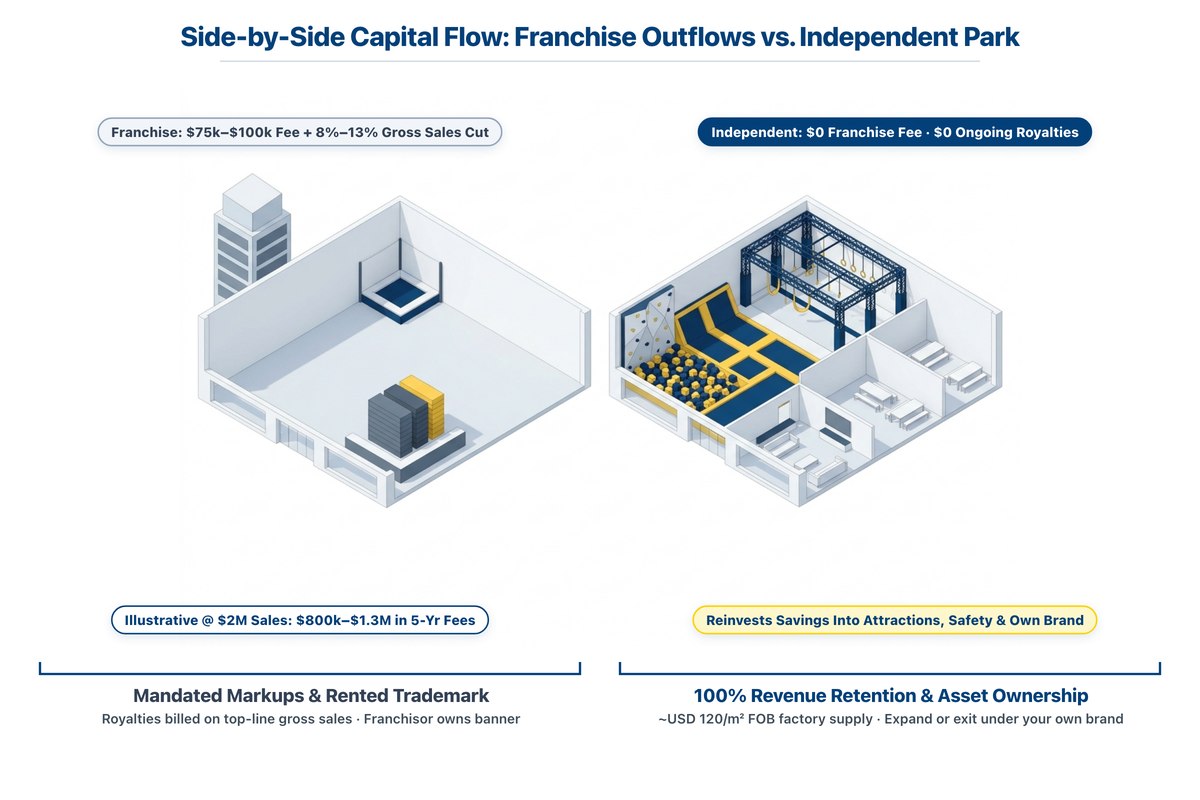
To calculate the recurring fees—strictly as an illustrative arithmetic example on an assumed revenue level, not a revenue or profit forecast—suppose a venue generates $2,000,000 in annual gross sales.
| Assumed Fee Tier (Based on Disclosed Percentages) | Annual Fee Outflow (at Assumed $2M Gross Sales) | 5-Year Cumulative Fee Outflow |
|---|---|---|
| 8% combined (e.g., Launch 6% royalty + 2% brand marketing) | $160,000 / year | $800,000 |
| 13% combined (e.g., Urban Air 7% royalty + 6% local marketing) | $260,000 / year | $1,300,000 |
These figures simply multiply disclosed fee percentages by an assumed $2,000,000 in revenue, before rent, payroll, utilities, insurance, maintenance, or debt service. Actual venue revenue varies widely by market, site size, and execution.
Ground your FDD review in each brand’s exact FDD year, Item 6 ongoing schedules (including mandatory tech, CRM, or insurance markups), and Item 7 buildout footnotes. Check any information from general franchise opportunities directories or undated broker summaries against those documents.
What a Franchise Gives You (and What It Limits)
Paying the franchise fee and a percentage of sales is essentially a way to outsource part of the launch and operation. You get faster name recognition and a ready-made operating plan, while a binding franchise agreement limits pricing flexibility, vendor choice, and long-term brand ownership.
When the fit is right, a franchise removes the early guesswork that stalls inexperienced operators.
- Immediate name recognition and built-in traffic: National or regional marketing funds help pull opening-month families who already trust the sign on the highway.
- Pre-engineered layouts and vendor coordination: You do not start from a blank warehouse; approved architects, builders, and attraction specs come packaged in the manual.
- Turnkey operational support and training: Structured staff training programs (such as Sky Zone’s mandatory multi-week headquarters and certified-park training noted in its FDD summary), POS templates, waiver workflows, and birthday party sales scripts give a general manager clear rails from week one.
- Protected territory guidelines: Contracts typically define a geographic boundary—for example, Sky Zone’s 2026 FDD transcription describes typical protected territory boundaries around a 150,000-person area (though the same text explicitly notes franchise owners receive a protected territory, not an exclusive territory).
Those same requirements create structural limits that weigh more heavily in years three through ten.
- Equipment and fit-out markups plus vendor lock-in: You pay for branded markups inside mandated attraction packages and cannot freely mix direct factory sourcing, upgrade single zones from alternative builders, or pivot attraction layouts without corporate sign-off.
- Extended franchise launch timelines: Opening under a corporate pipeline is rarely instant. Slick City’s 2026 franchise opportunity roadmap publicly maps an 8-step development process lasting 16 to 24 months from prequalification and FDD review through lease execution, lender financing, construction, and launch.
- No direct asset equity in the banner name: You pay to grow someone else’s trademark. When lease terms expire or you decide to open a second venue or sell your business, the brand identity still belongs to the franchisor—and further franchise units require additional fees.
- System M&A and corporate rebranding beyond your control: Franchisees inherit corporate-level decisions. A real example visible directly on Rockin’ Jump’s franchise website footer in November 2026 shows a notice that its Concord venue closed temporarily for rebranding to Sky Zone—a reminder that multi-brand acquisitions can reshape the banner over your door regardless of local store preference.
Before signing a franchise agreement, ask yourself one question about paying six figures and 8%–13% of gross sales. Are you buying national marketing reach you genuinely cannot replace locally, or paying mostly because you do not yet have an engineering partner to design, build, and equip the floor?
Building an Independent Park
With an independent venue, you keep 100% of your revenue and ownership of your brand, reduce initial procurement risk through direct equipment manufacturer sourcing, and free up capital. You also take direct responsibility for local execution and need to reserve around 6 months from approved floor plan to launch readiness.
Investors focused on long-term value often see an indoor park as a permanent neighborhood destination, making a rented brand license less appealing. Avoiding initial franchise markups and perpetual royalties leaves substantial capital to reinvest in higher-grade attractions, visible safety engineering, local community marketing, and building your own trademark.
The 5 Responsibilities an Independent Owner Carries Alone
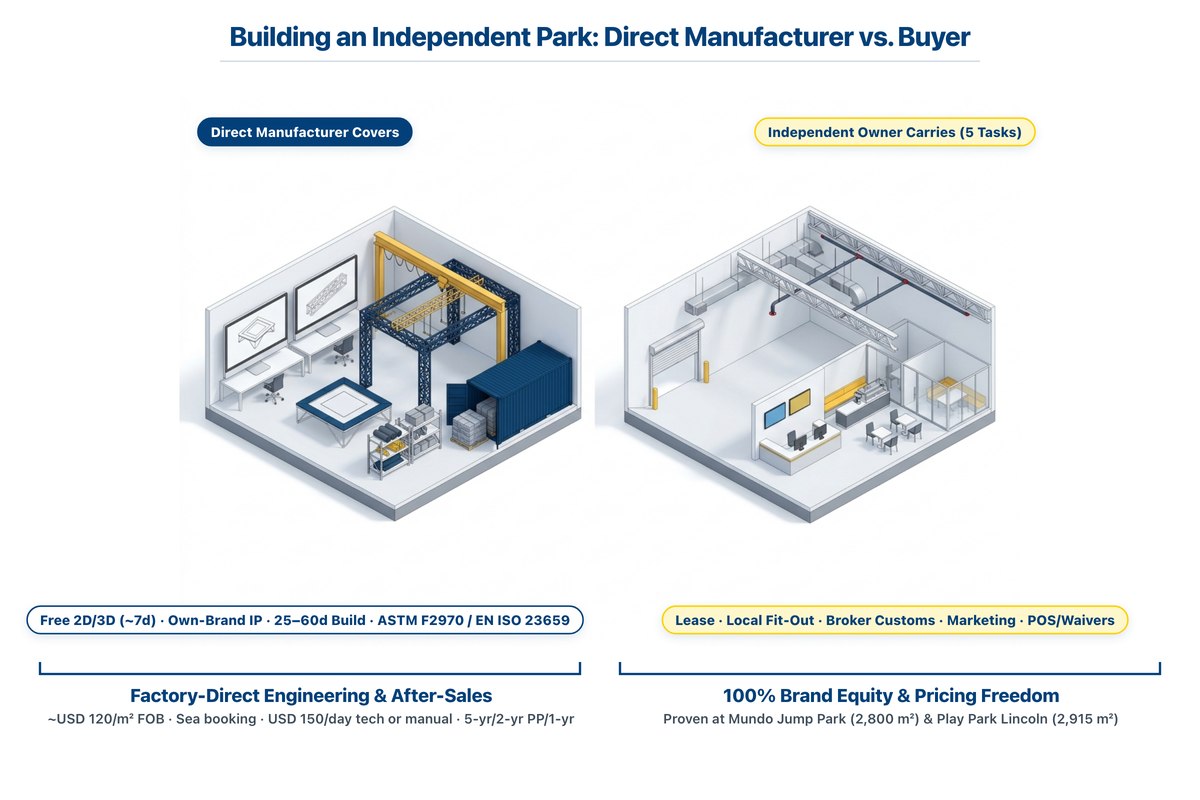
Direct factory sourcing does not make the commercial real estate side of a park turnkey. When you go independent, you take on five responsibilities.
- Building selection and lease negotiation: Evaluating clear height, column grid spacing, slab thickness, parking ratios, and tenant-improvement allowances before signing a commercial lease (see our step-by-step trampoline park startup guide for building checklists).
- Local permits, fire codes, and leasehold improvements: Hiring local architects and contractors for sprinklers, HVAC, restrooms, reception millwork, party rooms, and municipal inspections.
- Customs clearance and import duties: While Zhenghan can arrange ocean shipping to your destination port (priced separately by actual cargo volume), import customs clearance, broker filing, and destination duties or VAT remain the buyer’s responsibility.
- Local marketing and party sales engine: Building your grand-opening waitlist, school/camp partnerships, paid local search/social ads, and weekend birthday party pipeline without a national franchisor ad fund.
- Operating software, waivers, and staff SOPs: Selecting and configuring your POS system, electronic liability waiver kiosks, birthday booking platform, staffing schedule, and day-to-day safety inspection routines.
What a Direct Equipment Manufacturer Handles Instead
If you considered a franchise mainly to avoid design guesswork and sourcing problems, working directly with an experienced manufacturer covers the equipment, layout, and technical delivery at factory-direct cost.
| Delivery Stage | What Zhenghan Covers Directly (2026 Terms) | Scope & Practical Notes |
|---|---|---|
| Custom Layout & Visual Design | Free CAD custom layout, 3D renderings, and walkthrough animations with unlimited revisions until approved | First layout draft and preliminary budget typically delivered within 7 days after receiving your building CAD floor plan and clear ceiling height |
| Own Brand & IP Development | Custom theme development built around your own brand, colors, signage style, or custom mascot/IP characters | Supports building distinct visual identity instead of looking like a cookie-cutter venue; digital/arcade/VR zones can also be planned into the floor layout |
| Direct Equipment Pricing | Preliminary budget around USD 120 per m² (~USD 11.15 per sq ft) measured across the total venue area, FOB China, inclusive of layout design and equipment | Excludes installation; packaging and ocean freight quoted separately by cargo volume; fixed contract price confirmed once final layout and theme are locked |
| Production Lead Time | Four scheduled manufacturing tiers based on venue size: ≤200 m² (`2,153 sq ft`): 25–30 days · 200–500 m² (`2,153–5,382 sq ft`): 30–40 days · 500–2,000 m² (`5,382–21,528 sq ft`): 40–50 days · 2,000 m²+ (`21,528 sq ft+`): 50–60 days | Full factory inspection welcome on-site in Yongjia, Wenzhou or via live video tour before shipment (`30/70 T/T` standard payment terms) |
| Ocean Shipping & Installation Support | We can arrange ocean shipping directly (priced by actual container volume). Installation via detailed self-assembly manuals and online support, or on-site technicians at USD 150 per person per day (buyer covers round-trip flights, visas, meals, and lodging) | Customs clearance remains buyer-managed; our engineering steps are mapped in How We Work and Trampoline Park Equipment Supplier |
| Safety Standards, Warranty & Spares | Trampoline court systems certified to `ASTM F2970` and `EN ISO 23659`; 5-year structural frame warranty, 2-year standard PP jump mat warranty, and 1-year warranty on other components from installation completion; 24-hour response and spare parts typically delivered in 7–10 days | Safety standards apply specifically to tested trampoline-court equipment lines; review compliance scope on our Certifications page |
Realistic Independent Timeline: Reserve Around 6 Months
Do not plan an independent launch around aggressive 60-to-90-day social media claims. Even without a franchisor’s approval committees, you should reserve around 6 months from layout approval and production deposit to installation completion and opening readiness. That window allows for final engineering drawings, 50 to 60 days of manufacturing for a full-scale `2,000 m²+` (`21,528 sq ft+`) park, ocean transit scheduling, port customs release, coordination with local fit-out contractors, and on-site equipment installation.

Real Independent Venues Built Direct From the Factory
Two multi-thousand-square-meter international builds show how independent operators build large-format family entertainment destinations without buying a franchise territory.
- Mundo Jump Park (Colloto, Spain — Completed 2023): A 2,800 m² (~30,139 sq ft) indoor trampoline park and indoor playground hybrid with a 7 m (~23 ft) clear ceiling height. Designed and manufactured in Wenzhou under the owner’s independent concept, with Zhenghan technicians dispatched on site to complete installation.
- Play Park Lincoln (Monterrey, Mexico — Completed 2025): A 2,915 m² (~31,377 sq ft) indoor playground destination with a 7 m (~23 ft) clear ceiling height, engineered directly with the factory and installed on site with dispatched Zhenghan technicians.
Neither operator paid an initial franchise fee or ongoing gross sales royalties. Both opened nearly `3,000 m²` (`~32,292 sq ft`) flagship venues configured around their local buildings and concepts.
Side-by-Side Cost Comparison
Comparing the full costs side by side shows why equipment procurement is only half the story and why long-term cash retention differs dramatically after year one.
| Cost & Control Dimension | Trampoline Park Franchise (Disclosed US FDD Models) | Independent Park (Direct Manufacturer Supply) |
|---|---|---|
| Initial Franchise Fee | $75,000 – $100,000 upfront per location (Urban Air / Sky Zone / Launch 2026 or latest filings) | $0 |
| Design & Attraction Equipment | Franchise-specified packages: e.g., $672,000 – $1,248,000 (Sky Zone attractions) up to $1,214,760 – $1,618,650 (Urban Air 2.0 base package) | Preliminary budget ~USD 120 / m² (~USD 11.15 / sq ft) across the total venue area, FOB China (2026 reference inclusive of layout design and equipment; e.g., `2,000 m²` / `~21,528 sq ft` ≈ USD 240,000 FOB, final fixed quote set after design lock) |
| Custom Layout & 3D Renders | Included in initial/pre-opening franchise development package under brand template | Free with Zhenghan (unlimited revisions, walkthrough video, ~7-day initial layout from floor plan) |
| Leasehold Improvements & Fit-Out | Typically the largest wild card: $853,613 – $2,225,980 (Urban Air 2.0) to $1,504,000 – $2,730,000 (Sky Zone, incl. architecture) | Locally quoted by your contractors—can rival equipment cost depending on HVAC, sprinklers, and shell condition |
| Ocean Shipping & Customs Clearance | Often bundled via approved domestic/affiliated franchise distributors | Zhenghan can arrange ocean shipping (priced separately by actual cargo volume); customs clearance & duties paid/handled by buyer |
| Installation | Coordinated through approved franchise installation crews at franchise rates | DIY manuals + online guidance, or dispatched factory technicians at USD 150 / person / day (+ buyer-paid travel, visas, meals, lodging) |
| Ongoing Royalties & Brand Funds | 6%–7% royalty + 2%–7% brand/local marketing fees of gross sales + monthly software/insurance program charges | $0 ongoing royalties (100% of marketing budget stays in your local campaigns) |
| Working Capital & Pre-Opening Cash | Required in FDD alongside $500k–$750k+ liquid minimums (e.g., Sky Zone lists 3-month working capital & opening marketing lines) | Needed for rent deposits, pre-opening payroll, insurance, and cash buffer—detailed line by line in our complete trampoline park cost breakdown |
| Typical Launch Timeline | 16 – 24 months publicly mapped (Slick City 2026 FDD process) | Reserve around 6 months for design, manufacturing, freight, customs, fit-out, and installation |
| Brand Asset & Expansion Freedom | Franchisor owns trademark, pricing/menu policies, and second-unit fee schedule | 100% owned by you—rebrand, expand, add custom IP, or adjust pricing freely |
With direct factory sourcing, the $75,000–$100,000 franchise fee, mandated package markups, and $160,000+ per year in illustrative royalty outflows do not come out of your budget. These savings lower upfront capital risk and keep cash available for a 2,000 m²+ (`21,528 sq ft+`) venue, supporting higher-engagement attractions, thicker padding and safety engineering, stronger local birthday marketing, and an asset you own if you open a second park or exit years later.
Which Fits Your Situation
Neither path guarantees success on its own. Lease quality, demographics, safety culture, and birthday party operations have a far more immediate effect on a venue’s survival than the logo on the building. Use these checkpoints to match the model to your capital and team strengths.
A Franchise Usually Makes More Sense If You:
- Want full operational outsourcing from day one, including scripted manager training, centralized POS/waiver templates, and national marketing creative without building SOPs yourself.
- Have $500,000 to $750,000+ in verifiable liquid capital, $1.5M to $3M+ net worth, and multi-million-dollar commercial lending access tailored to US trampoline park franchises.
- Are launching in a crowded North American suburban metro where immediate brand familiarity pulls families faster than local word-of-mouth—and are comfortable sharing 8% to 13%+ of top-line revenue permanently for that umbrella.
An Independent Build Usually Makes More Sense If You:
- Want lower equipment acquisition cost and lower capital exposure by sourcing direct from an equipment manufacturer rather than funding franchise markups.
- Take a long-term view of the business—seeing your venue as a lasting family play destination where capital savings belong in superior attractions, safety specifications, local marketing, and your own brand equity rather than ongoing royalties.
- Already have operational leadership (or are willing to hire an experienced FEC general manager and pick commercial POS/waiver software independently), and can commit around 6 months plus local customs and buildout coordination.
- Operate outside North America (UK, Europe, Middle East, Latin America, or APAC): Most heavily capitalized US FDD franchises only grant territories inside the US or select Canadian metros. In markets like England—where indoor sport and recreation facilities commonly fall under local planning Class E(d) rules—or across continental Europe and Latin America (as seen in Mundo Jump Park and Play Park Lincoln), going independent with factory-direct supply is often the cleanest way to open a modern family entertainment center.
Before committing to cross-border equipment purchasing, check official import lookup portals early in your feasibility phase so import duties do not catch you off guard. US importers can review classifications and binding ruling requests via the CBP Tips for New Importers & HTS portal, UK buyers via the GOV.UK Trade Tariff, and EU buyers via EU TARIC, or you can retain a licensed customs broker in your port city.
FAQ
Can you start a trampoline park franchise with $30,000?
No. Rigid steel-frame trampoline park franchises are capital-intensive real estate projects where even the upfront franchise fee alone runs $75,000 to $100,000 across 2026 disclosures from Urban Air, Sky Zone, and Launch. Franchisors also enforce strict liquid capital minimums, such as $500,000 cash at Sky Zone (2026 FDD transcription) or $750,000 liquid assets and $1.5M net worth at Urban Air (2026 FDD), to cover total investments between $2.85M and $7.94M. Searches mentioning $30,000 usually refer to micro-franchises or home-service concepts, not commercial indoor parks.
What is the difference between a trampoline park franchise fee and a royalty fee?
The franchise fee is a one-time upfront payment (typically $75,000 to $100,000 in disclosed 2026 US FDDs) made when signing the franchise agreement for territorial rights and initial pre-opening support. The royalty fee is a recurring monthly charge, such as 6% to 7% of gross sales, almost always accompanied by another 2% to 7% for national advertising and local marketing funds. It is collected every month for the full contract term, regardless of whether your park makes a net profit that month.
How do you evaluate whether a trampoline park franchise is profitable before signing?
Start by carefully reading Item 19 (Financial Performance Representations) in the brand’s current FDD. Pay close attention to sample size, opening year cohorts, and what expenses are excluded. For example, many brand snapshots report gross revenue or store-level EBITDA before interest, corporate overhead, depreciation, or debt service. Next, subtract all ongoing Item 6 percentages (royalties, ad funds, tech fees, and required insurance programs), along with your actual local rent quote, before assuming those store margins transfer to your city.
Are US trampoline park franchises available in the UK, Europe, or other international markets?
Usually not on single-unit terms. US FDD filings apply specifically to US franchise compliance, and large domestic chains rarely offer single-park franchise opportunities overseas unless signing multi-unit area development agreements. Outside North America, building an independent venue with direct manufacturer layout, tested trampoline court equipment, and local branding—while verifying local rules such as Class E(d) planning status in England and import classifications via GOV.UK Trade Tariff or EU TARIC—is the standard path.
Can an independent park still get custom branding and compliant trampoline courts without a franchise?
Yes. Skipping a franchise does not mean buying generic off-the-shelf trampolines. Direct manufacturers like Zhenghan provide custom 3D floor plans, themed environments built around your own brand logo or mascot IP, and trampoline court equipment certified to `ASTM F2970` and `EN ISO 23659`. The equipment is backed by a 5-year structural frame warranty, 2-year standard PP jump mat warranty, 1-year warranty on other components, and 7–10 day spare parts delivery. You own the visual identity and get factory-direct engineering built to commercial standards.
Plan Your Independent Layout and Equipment Budget
If keeping capital in your attractions, safety engineering, and own brand makes more sense for your market than paying perpetual franchise royalties, start with numbers based on your actual building. Send us your warehouse floor plan and clear ceiling height via our Contact page—we will prepare a free custom layout, 3D visuals, and an itemized preliminary equipment manufacturer budget typically within 7 days.
Send your building floor plan, lowest ceiling clear height, target city and age mix for a custom 2D layout and FOB China budget within ~7 days.
Get a Free Layout and Budget