

Understanding how to import playground equipment from China safely comes down to controlling six operational checkpoints between factory floor and venue handover—without guessing tariff rates or trusting opaque middleman promises. Commercial venue owners across North America, the United Kingdom, Europe, and Latin America source directly from Wenzhou, China—widely recognized as China’s commercial indoor amusement manufacturing hub—to access custom multi-tier steel fabrication and bespoke 3D theming at direct factory pricing. Smooth cross-border execution follows a repeatable sequence: verify an authentic production plant before sending a deposit, buy under FOB China terms with 30/70 T/T milestone payments, inspect workshop trial assembly and quarantine-compliant export packing prior to container loading, transmit mandatory pre-departure security filings (ISF 10+2 for U.S. ocean cargo), clear destination customs through a licensed customs broker (including U.S. CPSC CPC eFiling starting July 8, 2026), and activate post-installation warranties once site assembly finishes. Budget at least roughly 6 months from initial CAD floor plan to grand opening. This guide applies to commercial B2B indoor playground and trampoline park imports, not single residential backyard swing sets.
ContentsStep 1: Verify a Real Factory vs. a Trading Middleman Before Paying a Deposit
Online B2B directories list hundreds of companies claiming to manufacture commercial play structures in Wenzhou, Guangzhou, or Shanghai, yet many operate out of downtown office suites and subcontract orders to unvetted small workshops after collecting your deposit. Subcontracted orders strip away material traceability, delay production schedules, and leave buyers holding mismatched test certificates at customs.
Before wiring any funds, run five concrete verification checks to separate an integrated producer—Wenzhou Zhenghan runs 20,000+ m² (215,278+ sq ft) of manufacturing space in Qiaoxia, Yongjia, Wenzhou—from an export trading middleman:
| Audit Checkpoint | Authentic Direct Manufacturer | Trading Company / Reseller Warning Sign |
|---|---|---|
| 1. Live Unscripted Workshop Video Tour | Walks live on camera from galvanized steel pipe cutting and frame welding straight into wood-panel cutting, EPE foam and PVC soft-pad wrapping, slide and themed assembly, and the trial-assembly bay | Shows only a polished sample showroom or pre-edited promotional clips; refuses live workshop walk-throughs |
| 2. Legal Entity Match Across Documents | Business license address specifies manufacturing scope, matching the beneficiary name on the proforma invoice and the holder name on ASTM / EN certificates | Certificate holder belongs to an unrelated factory name redacted or blurred on PDF scans |
| 3. In-House Structural Engineering Team | Delivers custom 2D CAD zoning and initial FOB budget within ~7 days around your exact column grid and clear heights, plus free 3D renderings and walkthrough video | Sends generic catalog pictures that ignore building columns, fire exits, or overhead ductwork |
| 4. Dual-Line Metal & Soft-Good Control | Fabricates structural steel frames, 0.45 mm / 0.55 mm FR-PVC pads, and multi-zone play + trampoline components under unified quality control | Quotes steel from one city and foam/mats from unknown subcontractors with inconsistent vinyl colors |
| 5. Quantified Material Spec Sheet in Contract | Attaches exact pipe diameters, wall thicknesses, foam densities, spring grades, and netting weave directly to your purchase contract | Writes vague phrases like “high-quality commercial steel” and “thick safety sponge” without millimeter numbers |
Locking quantified engineering specs into your proforma invoice prevents silent material substitution during production. For contained indoor playgrounds, write in Φ48 × 2.0 mm (1.89 × 0.08 in) galvanized round pipe across standard 1- to 3-tier builds (upgrading to thicker wall pipe such as 2.5 mm / 0.10 in on taller multi-tier builds) joined with cast-steel connectors, 1.5 cm (0.59 in) moisture-resistant fire-rated wood decking cushioned by 3 cm (1.18 in) EPE foam beneath 0.45 mm (0.018 in) FR-PVC vinyl, 1.5 cm (0.59 in) wall post padding tubes, machine-woven high-tenacity nylon safety nets, anti-static UV-8 engineering-plastic slides (alongside fiberglass and stainless-steel slides), odorless BPA-free thickened PE pit balls, plus 2 cm (0.79 in) EVA floor mats. For commercial trampoline courts, write in 80 × 80 × 2.75 mm (3.15 × 3.15 × 0.11 in) square frame columns, U.S.-imported TenCate 260 g/m² (7.67 oz/yd²) PP jump mats, 80# galvanized manganese-steel springs (180 mm / 7.09 in standard length; 260 mm / 10.24 in pro length), and 70 mm (2.76 in) beveled EPE safety pads finished in 0.55 mm (0.022 in) matte FR-PVC (1000 × 1000D). You can benchmark global vendor tiers in our top indoor playground manufacturers comparison and top trampoline park manufacturers comparison.

Step 2: Choose Safe Incoterms (FOB vs. EXW, CIF, and DDP) and 30/70 Payment Terms
New importers often ask suppliers for a single “door-to-door price” without realizing how International Chamber of Commerce Incoterms 2020 divide port fees, cargo control, and legal importer liability. Per U.S. Department of Commerce (trade.gov) guidance on ICC Incoterms 2020, these 11 trade rules (spanning sea/inland-waterway terms like FOB and CIF and any-mode terms like EXW and DDP) define where carriage, insurance, and export/import customs responsibilities transfer—while leaving payment milestones to your sales contract. Here is how the four common terms compare in practice for playground buyers:
| Incoterm | Seller (China Factory) Covers | Buyer (Venue Operator) Covers | Practical Risk & Recommendation for Playground Buyers |
|---|---|---|---|
| EXW (Ex Works) | Makes packed goods available at the Wenzhou factory loading dock | China domestic trucking, China export customs declaration, port handling, ocean freight, and destination import clearance | Rarely optimal for first-timers: unless your freight forwarder already manages China domestic pickup and export declarations smoothly |
| FOB (Free on Board — Named China Port) | Factory packing, domestic trucking to Ningbo/Shanghai port, port terminal loading, and China export customs clearance | Ocean container freight, marine cargo insurance, destination port charges, import customs clearance, duties/taxes, and inland drayage | Recommended B2B standard: zero hidden origin charges, full control over ocean forwarder pricing, and clean legal Importer of Record chain |
| CIF (Cost, Insurance & Freight) | Everything in FOB plus main ocean freight and minimum marine insurance to destination port | Destination terminal handling, container unstuffing (if LCL), import customs clearance, duties/taxes, and local delivery | Use caution on LCL shipments: low upfront CIF ocean quotes sometimes hide steep destination warehouse unstuffing and document release fees |
| DDP (Delivered Duty Paid) | Seller/forwarder claims to handle transport, destination import clearance, and duties to buyer’s door | Unloading at venue site | Avoid unverified grey-channel “all-in DDP”: third-party forwarders often clear cargo under pooled third-party tax IDs rather than your company’s Importer of Record name, creating severe customs audit, insurance, and CPSC CPC eFiling liabilities |
At Wenzhou Zhenghan, commercial export orders run on transparent FOB China pricing paired with a two-stage bank wire (T/T) structure—review our direct sourcing scope on our China indoor playground manufacturer page and commercial trampoline park supplier page:
- Free design validation before payment: Within roughly 7 days of receiving your building CAD dimensions, we deliver an initial 2D floor layout and preliminary FOB China budget estimate (averaging about USD 120 per square meter, or USD 11.15 per square foot, across total venue area for design and equipment—including play-area EVA mats and integrated toddler zones—with a fixed price locked once 3D renderings and zone mix are approved), followed by free custom 3D renderings and a walkthrough video revised until you approve every slide and play zone.
- 30% T/T deposit to start fabrication: Galvanized steel, PVC vinyl, EPE foam, and slide/themed components enter workshop scheduling once your contract specs and 3D renderings are finalized. Standard production runs 25 to 30 days on orders ≤200 m² (≤2,153 sq ft), 30 to 40 days for 200 to 500 m² (2,153 to 5,382 sq ft, covering typical ~300 m² / ~3,229 sq ft single-level playgrounds), 40 to 50 days for 500 to 2,000 m² (5,382 to 21,528 sq ft), and 50 to 60 days on projects exceeding 2,000 m² (>21,528 sq ft).
- 70% balance + ocean freight prior to shipment: Settled after manufacturing, workshop trial assembly, and 6-point pre-shipment QC finish (with in-person factory inspection or live video walkthroughs welcomed before container loading). If you do not yet have a preferred freight forwarder, we coordinate ocean container booking upon request at transparent actual packed volume rates—while destination customs clearance and import duties/taxes remain cleanly under your licensed customs broker’s control.

Step 3: Pre-Shipment QC, Workshop Trial Assembly, and Graded Export Packing
Discovering that a spiral slide flange misses its platform deck by 4 cm (1.6 in) after containers arrive in Texas or Manchester costs thousands of dollars in local welding labor. Equally painful is having a container held at port quarantine because uncertified raw-bark timber crates triggered agricultural wood-packaging inspections.
Eliminate both failure modes before releasing your 70% balance by verifying three pre-shipment workshop steps (see how our 6-stage delivery workflow runs from design to after-sales):
- Workshop trial assembly (pre-assembly) of structural frames: Before final wrapping, our technicians erect primary galvanized steel grids, multi-tier transitions, and complex slide structures right inside our Wenzhou workshop to confirm bolt-hole alignment, deck elevations, and safety-clearance geometry—welcoming in-person inspection or live video tours before anything enters a shipping container.
- Six-point pre-shipment quality inspection: Dedicated QC inspectors verify (1) steel frames (tube diameter and wall thickness against drawings, welds, and surface coating), (2) trampoline beds, springs, and safety nets (dimensions, quantity, and condition), (3) soft padding and covers (thickness, seam stitching, and fastenings), (4) slides, climbing holds, and hardware (smooth edges, bolts, and fixings), (5) electric rides (powered test runs), and (6) complete part-count accuracy against your itemized order and packing list before loading.
- Graded, quarantine-compliant export packing: Packing an entire playground in heavy wooden crates wastes container cube and inflates disposal costs, whereas shipping fragile fiberglass slides loose invites forklift cracks. Zhenghan uses a two-tier export packing system:
- Standard galvanized steel pipes, connectors, EVA mats, and soft-padded panels are wrapped in multi-layer protective poly-film, dustproof woven bags, and reinforced cartons—each individually tagged by venue zone and 3D installation drawing code so your unloading crew can stage parts directly onto matching floor bays.
- Oversized sculpted fiberglass slides (such as multi-lane LED slides and horn slides), overhead ball-dump machines, and interactive projection consoles ship inside protective export wooden crates compliant with destination wood-packaging quarantine rules (engineered plywood or treated compliant crating so customs agricultural officers clear the load without fumigation holds).

Step 4: Container Volume Planning, Ocean Booking, and Pre-Departure ISF 10+2
Play equipment ships by cubic volume rather than weight: EPE foam pads, curved slide sections, and ball-pit bags fill container height long before hitting weight limits. For that reason, 40ft High Cube (40HQ) containers—offering extra vertical interior height over standard dry vans—are the workhorse of commercial playground logistics.
| Project Scale Benchmark | Typical Container Reference | Freight Mode & Cost-Accuracy Rule |
|---|---|---|
| Compact Accessory / Replacement Order | Under ~15–20 CBM (~530–706 cu ft) | LCL (Less than Container Load) only for small add-ons; watch destination CFS unstuffing fees |
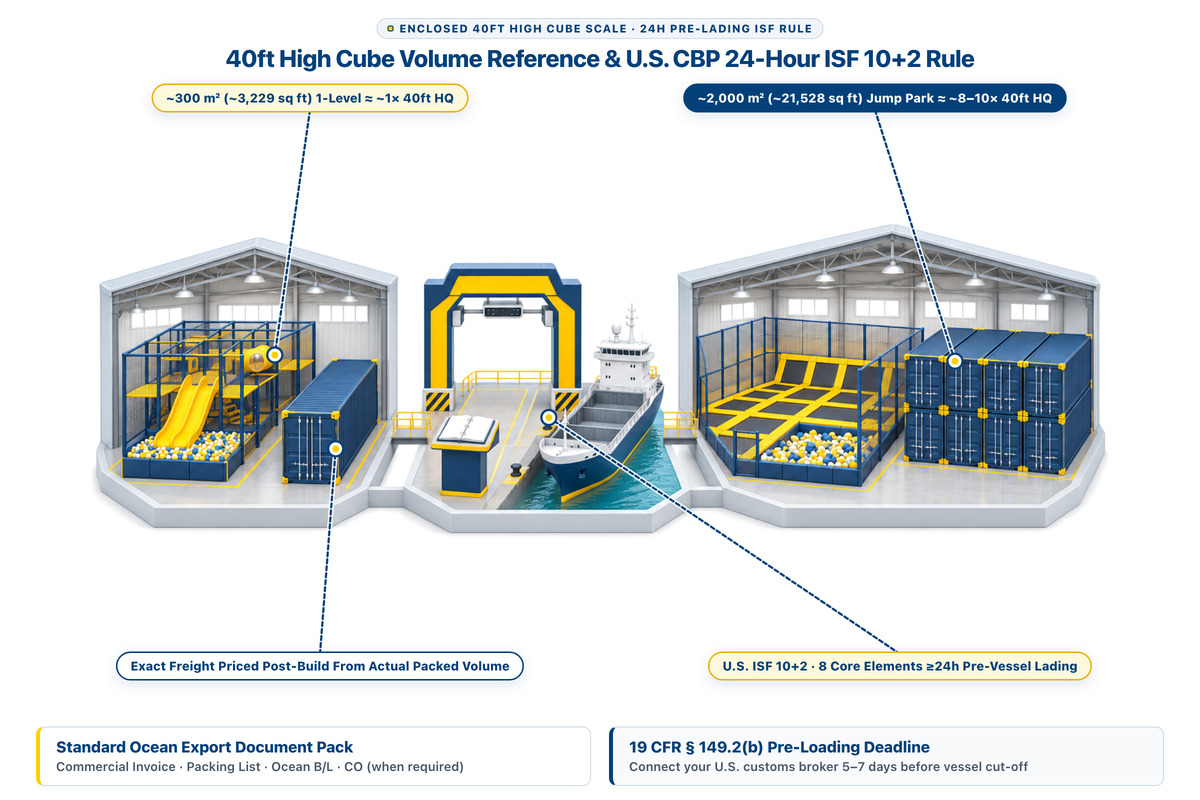
| Typical ~300 m² (~3,229 sq ft) Single-Level Indoor Playground | Roughly 1× 40ft HQ Container | Dedicated FCL (Full Container Load) avoids shared-cargo damage; exact volume shifts with deck height, themed decorative panels, and slide geometry |
| Mid-Size ~800–1,250 m² (~8,611–13,455 sq ft) Mixed Venue | Multi-Container FCL Shipment | Staged container dispatch coordinated with building dust-free handover |
| Large ~2,000 m² (~21,528 sq ft) Trampoline-Anchored Park | Roughly 8 to 10× 40ft HQ Containers | High cube count driven by 70 mm (2.76 in) beveled court pads, 20 cm (7.87 in) foam-pit cubes, and aerial steel trusses |
Why reputable factories calculate final ocean freight after fabrication finishes: during early 2D budgeting, container counts can be estimated from square footage (for example, roughly 1× 40ft HQ around 300 m² / 3,229 sq ft), and you can model equipment FOB ranges using our indoor playground equipment cost calculator—or map multi-attraction venue layouts in our how to start a family entertainment center guide. However, ocean carrier spot rates fluctuate monthly, and adding a tall horn slide or multi-lane slide changes exact packed cubic meters. Measuring the actual packed stack at the end of production ensures you pay real container space rather than padded upfront freight markups.
Export Document Pack & Mandatory U.S. CBP ISF “10+2” Deadline
Once containers are booked, we prepare the standard ocean export document set for your customs broker:
- Commercial Invoice and itemized Packing List (detailing carton/crate counts, gross/net weights, and cubic volume);
- Ocean Bill of Lading (B/L) (original or telex release upon balance clearance);
- Certificate of Origin (CO) issued upon request when required by destination customs authorities;
- Applicable ASTM / EN structural certificates and 16 CFR third-party laboratory test reports.
Critical U.S. pre-loading deadline (ISF 10+2): If your shipment enters the United States by ocean vessel, U.S. Customs and Border Protection (CBP) enforces the Importer Security Filing and Additional Carrier Requirements rule (19 CFR Part 149). Under 19 CFR § 149.2(b), the ISF Importer or their licensed customs broker must electronically transmit eight core importer data elements (seller, buyer, importer of record number, consignee number, manufacturer/supplier, ship-to party, country of origin, and commodity HTSUS number) no later than 24 hours before the cargo is laden aboard the vessel at the foreign port—with container stuffing location and consolidator filed as early as possible and no later than 24 hours prior to U.S. port arrival. Missing the 24-hour pre-loading window exposes importers to monetary penalties, increased inspections, and cargo delays, so connect your U.S. customs broker with our shipping coordinator at least 5 to 7 days before vessel cut-off.
Step 5: Customs Clearance, Tariff Lookup (US, UK, EU), and 2026 CPSC CPC Rules
Be skeptical of supplier blogs that print fixed tariff numbers or “duty-free” promises. Customs tariff schedules, trade remedies (including U.S. Section 301 actions on Chinese-origin headings), and VAT thresholds are updated periodically by national governments—and a multi-zone indoor playground invoice may span primary Chapter 95 play/gymnastic headings (often evaluated around 9506.99 subheadings depending on structural configuration) alongside separate tariff lines if standalone mats, blowers, or electronics ship separately.
Per official U.S. CBP importer guidance, while eligible importers may file entries on their own, many first-time commercial buyers consult a CBP-licensed customs broker to review the factory’s draft Commercial Invoice, Packing List, and reference HS codes before vessel departure, verifying HTS classifications (and CBP CROSS or Part 177 binding rulings where needed) against official government databases:
| Destination Market | Importer Registration Needed | Official Real-Time Tariff & Duty Portal | Product Safety & Entry Documentation |
|---|---|---|---|
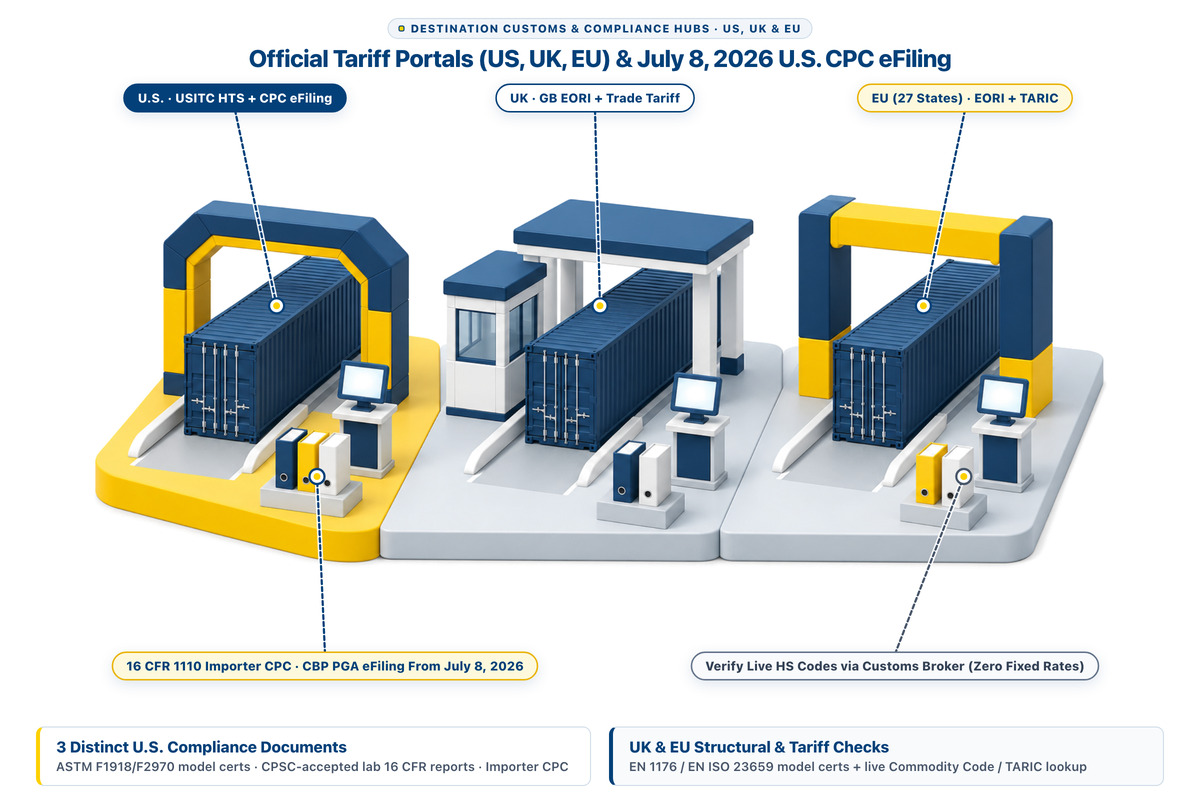
| United States | U.S. EIN / Importer of Record number + Customs Bond | USITC Harmonized Tariff Schedule (HTS) (hts.usitc.gov) + CBP CROSS Rulings | ASTM F1918 / ASTM F2970 model certs + CPSC-accepted lab 16 CFR / CPSIA English reports + U.S. importer CPC (eFiled via CBP PGA starting July 8, 2026) |
| United Kingdom | EORI number starting with GB for England, Wales & Scotland (and may need XI when moving goods to or from Northern Ireland) | UK Trade Tariff Portal (gov.uk/trade-tariff) for UK Commodity Code, duty & import VAT | EN 1176 / EN ISO 23659 model-specific structural certificates & accompanying test reports |
| European Union (27 States) | EU EORI number registered in first member state of entry | European Commission TARIC Portal (EC TARIC Database) + national import VAT | EN 1176 / EN ISO 23659 model-specific structural certificates & accompanying test reports |
Understanding the July 8, 2026 U.S. CPSC Certificate eFiling Rule
U.S. playground importers frequently confuse three distinct compliance documents—understanding who issues each one prevents customs holds:
- Factory structural certificates (ASTM F1918 / ASTM F2970 / EN 1176 / EN ISO 23659): Issued to the manufacturer for the specific tested multi-level play structure and trampoline court models—not loose ball pits, standalone toddler blocks, or motorized rides (review Zhenghan’s certificate scope). Watch out for suppliers presenting EN 13814—that standard covers amusement rides and fairground machinery, not indoor soft play or trampoline courts.
- CPSC-accepted third-party laboratory test reports (16 CFR / CPSIA): English-language mechanical/physical, solid flammability, and chemical test reports (covering sharp points/edges and rigid/pliable solid flammability under 16 CFR Part 1500, total substrate lead under CPSIA Section 101, and phthalates under 16 CFR Part 1307) issued by a CPSC-accepted testing laboratory.
- Children’s Product Certificate (CPC) per 16 CFR 1110 + 2026 eFiling: Under Section 14 of the CPSA (16 CFR part 1110), when regulated children’s products (intended primarily for kids 12 and younger) enter the U.S., the U.S. importer—not the foreign factory alone—must certify compliance in a written English CPC backed by those CPSC-accepted lab reports. Furthermore, under U.S. CPSC eFiling rules effective July 8, 2026, U.S. importers of most regulated consumer products must transmit (eFile) certificate data electronically to CBP through a PGA Message Set upon entry. We prepare the draft CPC tied to your U.S. importer details alongside supporting English test reports so you and your customs broker can complete CPC eFiling without delay—another reason why clearing goods honestly under your own Importer of Record beats grey-channel DDP schemes.
Step 6: Port Arrival, Unloading, Installation Options, and Post-Install Warranty
Once your vessel berths at destination port and customs releases the entry, smooth site execution comes down to avoiding port demurrage fees, staging parts cleanly, choosing the right assembly model, and activating your warranty.
| Months Out | Cross-Border Import Milestone | Owner Action vs. Zhenghan Factory Action |
|---|---|---|
| Month 1 | Building CAD check, ~7-day 2D layout + initial FOB budget, free 3D renders, contract & 30% deposit | Owner confirms clear ceiling heights & columns; Zhenghan locks structural drawings & spec sheet |
| Months 2–3 | 25–60 day fabrication across 4 size tiers (30–40d at ~300 m²; 50–60d above 2,000 m²), workshop trial assembly, 6-point QC & graded packing | Owner completes local MEP/flooring permits; Zhenghan completes pre-assembly, QC & labeled zone/crate packing |
| Month 4 | 70% balance, ISF 10+2 filing (24h pre-loading for U.S.), 40HQ vessel departure & transit | Zhenghan issues Invoice, Packing List, B/L (& CO if needed); buyer’s customs broker files ISF & entry |
| Month 5 | Destination customs clearance, inland drayage, dust-free unloading & zone staging | Broker clears duties/taxes & CPC eFiling; owner unloads into dust-free venue with forklift/crew |
| Month 6 | Supervised or guided assembly, final safety inspection & warranty activation | Local crew self-installs via manuals & online guidance OR dispatched Zhenghan technicians lead on-site assembly alongside local helpers |
Keep three operational rules front and center during arrival and build-out:
- Clear shipping release before vessel arrival and prepare a dust-free floor: Ports grant only a brief window of free terminal storage and container chassis days before charging steep daily demurrage and detention fees. Ensure Bill of Lading release and customs entry are ready ahead of arrival, verify truck dock height and freight-elevator dimensions beforehand, and finish all overhead painting, concrete grinding, and sprinkler work before opening EVA mat cartons.
- Match installation mode to venue complexity: Compact single-level playgrounds (150 to 350 m² / 1,615 to 3,767 sq ft) can often be assembled by your local carpenter/handyman crew at USD 0 factory technician labor using our zone-numbered labels, detailed installation manuals, 3D layout drawings, and remote engineer guidance. Multi-level playgrounds, trampoline parks, and aerial adventure venues across Europe and the Americas—such as Spain’s 2,800 m² (30,139 sq ft) Mundo Jump Park in Colloto, Mexico’s 2,915 m² (31,377 sq ft) Play Park Lincoln in Monterrey, and Budapest’s PINGULI Play House covering 1,250 m² (13,455 sq ft in Hungary, assembled in about one month by 2 Zhenghan technicians alongside local helpers)—use dispatched Zhenghan technicians at USD 150/person/day plus round-trip airfare, lodging, meals, visas, necessary travel expenses, and local assisting crew on site (explore our complete 6-step indoor playground installation guide, and see delivered overseas parks on Mundo Jump Park, Play Park Lincoln, and PINGULI Play House). Each dispatched technician brings 1+ year of factory-floor fabrication training plus 3+ years of field assembly across domestic and overseas parks.
- Warranty starts when installation finishes—ocean transit costs zero coverage days: Unlike suppliers whose warranty clock starts on the Bill of Lading date (often burning several weeks—depending on destination port—while containers cross the ocean and clear customs), Wenzhou Zhenghan activates coverage when on-site assembly finishes: 5 years on structural steel frames, 2 years on standard commercial PP trampoline mats, and 1 year on safety pads, springs, and other components, supported by 24-hour response and 7 to 10 day express replacement-part shipping.

Frequently Asked Questions
Is a special import license required to bring commercial playground equipment from China?
Most general commercial buyers in the United States do not need a special federal “import license” for indoor playground structures, though you do need an Importer of Record tax ID (EIN), a customs bond, timely ISF 10+2 filing, and CPSC Children’s Product Certificate (CPC) compliance—almost always handled smoothly by consulting a CBP-licensed customs broker. In Great Britain (England, Wales, and Scotland), businesses must register for an EORI number starting with GB before clearing customs, while EU buyers require an EU EORI number.
How many shipping containers does a 300 m² indoor playground take?
As a practical planning reference, a standard ~300 m² (~3,229 sq ft) single-level commercial indoor playground fits into roughly 1× 40ft High Cube (40HQ) container, whereas a 2,000 m² (21,528 sq ft) trampoline-anchored venue requires roughly 8 to 10× 40ft HQ containers. Because deck tiers, themed decorative panels, and spiral or multi-lane slide geometry change cubic volume, exact container count and ocean freight are calculated transparently after production from actual packed cargo volume.
How does the July 8, 2026 U.S. CPSC CPC eFiling rule affect playground imports?
Under 16 CFR part 1110, U.S. importers of regulated children’s products (intended primarily for kids age 12 and under) must issue an English Children’s Product Certificate (CPC) backed by CPSC-accepted third-party lab test reports. Starting July 8, 2026, U.S. importers bringing in most regulated consumer goods must transmit (eFile) compliance certificate data electronically to CBP through a PGA Message Set upon import entry. Buying directly under FOB China from a factory with valid English 16 CFR / CPSIA lab reports lets your customs broker complete CPC eFiling cleanly under your own company name.
Can I order just a few soft-play pieces or replacement slides from China?
Cross-border ocean freight, origin port handling, and destination customs brokerage carry fixed per-shipment minimums that outweigh the merchandise value of one or two small items. Direct factory importing delivers strong ROI when equipping a full commercial play zone or complete venue—while existing Zhenghan venue clients receive replacement spare parts typically within 7 to 10 days via express courier, and can ship custom venue expansion modules by sea freight.
Why is buying under FOB China safer than an “all-in DDP” door-to-door quote?
Unverified “all-in DDP” forwarders frequently bundle multiple buyers’ cargo under a pooled third-party tax ID rather than declaring your company as the legal Importer of Record. That leaves venue operators without clean customs entry records, commercial liability audit trails, or valid U.S. CPSC CPC eFiling credentials under 16 CFR part 1110. Buying under FOB China and clearing destination customs through your own licensed customs broker keeps ocean and port charges transparent while keeping every compliance record legally in your business name.
Start Your Direct Factory Layout and FOB China Quote
Ready to benchmark direct Wenzhou manufacturing costs and container volume for your building? Share your venue CAD drawing or dimensions, ceiling height, and target opening window to receive a custom 2D layout and initial FOB China budget estimate within ~7 days (with 24-hour inquiry response and a fixed quotation once your free 3D renderings and animated walkthrough video are approved). Contact our export engineering team or visit our Wenzhou commercial playground and trampoline manufacturer homepage to begin.
References
- International Trade Administration (trade.gov) — Know Your Incoterms (EXW, FOB, CIF & DDP Guide): https://www.trade.gov/know-your-incoterms
- U.S. CBP — Importer & Exporter Guidance (Customs Brokers & HTSUS): https://www.cbp.gov/trade/basic-import-export/importer-exporter-tips
- U.S. eCFR — 19 CFR § 149.2 Importer Security Filing (“10+2”) Timing Rules: https://www.ecfr.gov/current/title-19/chapter-I/part-149/section-149.2
- U.S. CPSC — CPC Compliance & July 8, 2026 CBP PGA eFiling Rules (16 CFR 1110): https://www.cpsc.gov/Business–Manufacturing/Testing-Certification/Childrens-Product-Certificate
- GOV.UK — Commercial Import Steps into Great Britain (GB EORI & Commodity Codes): https://www.gov.uk/import-goods-into-uk
- European Commission — TARIC Integrated Customs Tariff Portal: https://taxation-customs.ec.europa.eu/customs/customs-tariff/eu-customs-tariff-taric_en
Send your building floor plan, lowest ceiling clear height, target city and age mix for a custom 2D layout and FOB China budget within ~7 days.
Get a Free Layout and Budget