

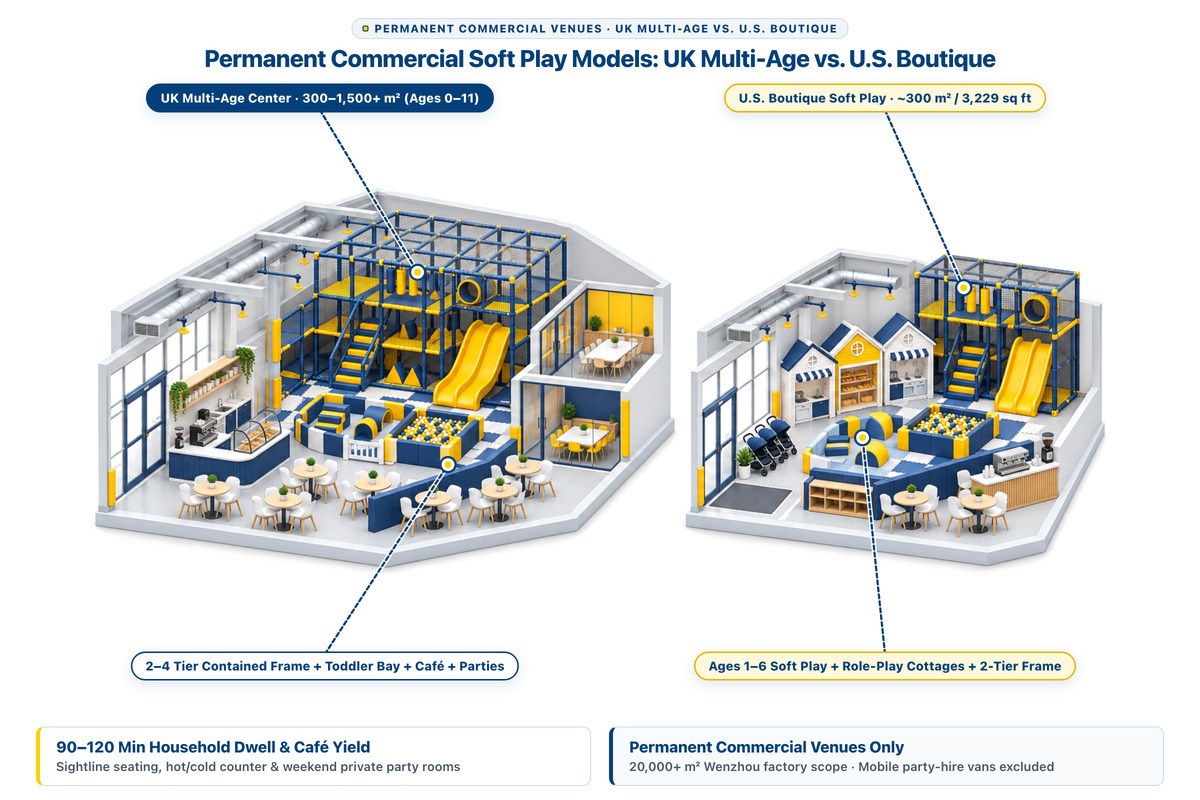
Learning how to start a soft play business begins with clearing up a transatlantic vocabulary split that trips up first-time investors. In the United Kingdom, opening a soft play facility means launching a full multi-tier commercial indoor children’s play venue complete with padded steel climbing towers, wave slides, ball pools, toddler zones, party rooms, and a parent café. In the United States and Canada, “soft play” usually describes padded toddler and preschool play zones (ages 1–6) or compact neighborhood play spaces—most often around 300 m² (3,229 sq ft) on a single floor inside shopping malls, retail strip plazas, or standalone buildings paired with family dining. Across both markets, well-run commercial venues share four structural requirements: verifying clear ceiling height and municipal land-use rules before signing a lease, specifying non-porous commercial-grade steel and vinyl assemblies, aligning safety certificates and local inspections with EN 1176 (UK/Europe) or ASTM F1918 and 2026 CPSC CPC eFiling (U.S.), and reserving at least roughly 6 months to run building fit-out alongside direct factory manufacturing. This guide covers permanent commercial soft play venues only—not weekend mobile party-hire foam sets, inflatable bounce rentals, or unsealed residential wooden toys.
ContentsUK Soft Play Center vs. US Soft Play Venue: Commercial Models (Not Mobile Hire)
Online forums routinely lump two completely unrelated business models under the same search phrase: van-loaded mobile party rental kits set up in living rooms on Saturdays, and permanent commercial indoor play facilities operating six or seven days a week under a commercial lease. At Wenzhou Zhenghan, our 20,000+ m² (215,278+ sq ft) workshops engineer and manufacture complete fixed-venue commercial soft play equipment packages rather than loose mobile rental pieces, because permanent venues build compounding neighborhood repeat traffic, recurring memberships, and high-margin weekend birthday bookings.
Understanding how regional buyer expectations differ between British and North American venues shapes your square footage, age zoning, and café counter capacity from Day 1:
| Commercial Dimension | UK Multi-Age Soft Play Venue Model | U.S. Commercial Soft Play & Boutique Venue Model | Excluded Mobile Party-Hire Model |
|---|---|---|---|
| Typical Floor Area | 300 – 1,500+ m² (3,229 – 16,146+ sq ft) inside light-industrial units, retail parks, or high-street shells | 150 – 500 m² (1,615 – 5,382 sq ft) neighborhood storefronts or mall bays (centered near ~300 m² / 3,229 sq ft) | 10 – 30 m² (108 – 323 sq ft) portable mats hauled in vans (outside Zhenghan scope) |
| Core Target Age Span | Ages 0–11 split into baby/toddler gated bays (ages 0–4) plus 2- to 4-tier junior climbing frames (ages 4–11) | Ages 1–6 dedicated toddler soft play + role-play village, often paired with a 2-tier ages 3–10 play frame | Toddlers at temporary 3-hour home or hall rentals |
| Primary Revenue Mix | Timed general admission (90–120 min), hot/cold café counter, weekend party rooms, and midweek toddler mornings | Open-play passes, monthly memberships, private party packages, grip socks, and specialty coffee/snacks | Weekend-only event setup labor and cleaning |
| Aesthetic & Design Focus | Coordinated light theming, high-visibility netting toward café tables, multi-lane slides, and dedicated party rooms | Clean pastel, macaron, or natural-tone color palettes emphasizing play functionality, role-play houses, and open sightlines | Generic portable white/pastel foam blocks |
Notice how food and beverage anchors dwell time in both countries. Parents rarely stay past 45 minutes on uncomfortable benches, whereas clear sightlines from a clean coffee and snack counter keep households on site for 90 to 120 minutes and lift per-visit spend. If espresso and food service will contribute half of your floor plan, compare dedicated hospitality zoning in our how to start a play cafe guide.
Finding Premises: Clear Ceiling Height, England Class E(d), Business Rates, and US Zoning
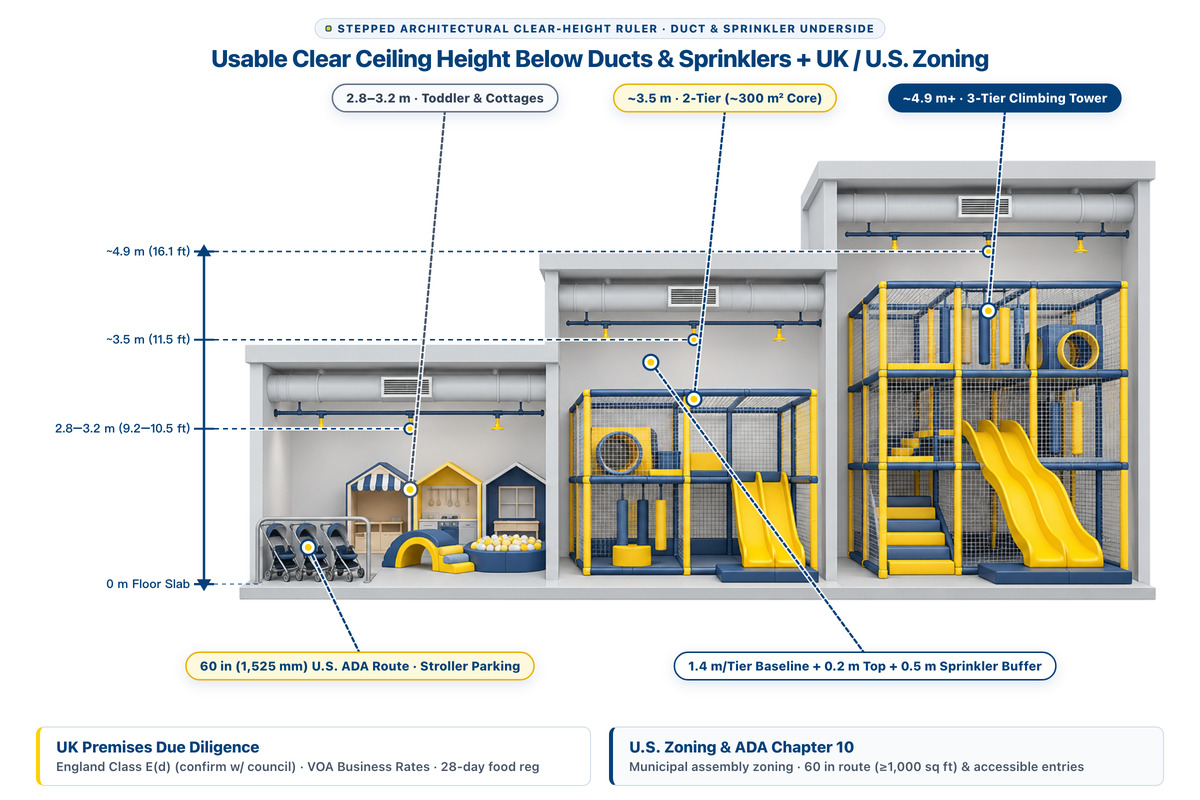
Signing a commercial lease before measuring overhead obstructions or checking municipal use classes is the single most expensive error first-time operators make. Real-estate listings almost always quote eaves or roof-slab height, whereas play structures must fit beneath the lowest overhead obstruction—fire-sprinkler heads, HVAC supply ducts, structural steel beams, lighting trays, or roller-shutter tracks.
Usable Clear Ceiling Height Benchmarks
Under our Wenzhou engineering team’s standard planning reference—which uses 1.4 m (4.6 ft) per deck level as a common industry baseline rather than a rigid legal rule, plus 0.2 m (0.7 ft) top frame allowance and 0.5 m (1.6 ft) clearance below sprinkler heads (always verify exact sprinkler clearances against local fire codes)—usable clear height maps to vertical capacity as follows:
| Usable Clear Height Below Lowest Obstruction | Recommended Soft Play Structural Configuration | Venue Layout Strategy |
|---|---|---|
| 2.8 – 3.2 m (9.2 – 10.5 ft) | Single-deck custom climbing bridges, 0.9 mm (0.035 in) PU toddler soft-play climbers, ball pit, EVA/EPP block pit, and themed role-play houses | Ideal for high-street retail storefronts, ground-floor condo retail, or under-mezzanine bays with customized deck heights |
| ~3.5 m (11.5 ft) | Standard 2-tier contained steel play frame (2 × 1.4 m + 0.2 m + 0.5 m), twin or wave slides, integrated toddler zone, and party rooms | Matches typical ~300 m² (3,229 sq ft) first-time neighborhood venues and suburban shopping-center units |
| ~4.9 m (16.1 ft) | 3-tier contained climbing tower (3 × 1.4 m + 0.2 m + 0.5 m), spiral tube slides, spider climb tower, and multi-lane fiberglass slides | Suits suburban retail-park boxes and light-industrial units targeting ages 1–12 |
| 5.2 – 7.0+ m (17.1 – 23.0+ ft) | 3- to 4-tier tall play frames (upgraded to heavier-wall galvanized pipe above 3 tiers), long-run slides, or adjacent commercial trampoline zones | Fits large trade-counter warehouses and destination family centers |
When drafting your initial floor plan, watch out for four layout mistakes our designers routinely correct on early client sketches (explore our complete indoor playground design and layout guide): (1) measuring to the roof sheet instead of the lowest duct or beam, (2) omitting interior structural columns, fire hydrants, or emergency exit doors on the drawing, (3) cramming oversized slides into a 300 m² (3,229 sq ft) unit at the expense of shoe cubbies, buggy/stroller parking, and parent tables, and (4) routing fast ages 6–11 slide exits directly across ages 1–3 crawling mats without a padded physical barrier.
UK Premises Checkpoints: England Class E(d), Business Rates, and 28-Day Food Registration
- Planning use classes in England: Under UK statutory instrument SI 2020/757 (The Town and Country Planning (Use Classes) (Amendment) (England) Regulations 2020, as made), premises used for indoor sport, recreation, or fitness (not involving motorized vehicles or firearms) principally serving visiting members of the public fall under Use Class E(d). Keep three strict boundaries in mind: SI 2020/757 applies to England only (Scotland, Wales, and Northern Ireland maintain separate planning use-class legislation), the citation reflects the 2020 as-made text, and the statute does not name soft play venues explicitly—so always confirm whether your specific unit and café mix require planning permission or change-of-use consent with your local planning authority before exchanging contracts.
- Non-domestic Business Rates: Per official GOV.UK guidance, business rates apply to most non-domestic properties—including shops, warehouses, and leisure units—across England and Wales (Scotland and Northern Ireland administer non-domestic rates separately). Local councils issue annual bills in February or March based on the property’s rateable value set by the Valuation Office Agency (VOA). Estimate your annual business rates liability and check small-business or retail/hospitality relief on GOV.UK before committing to a lease, as business rates often rival base rent on large industrial shells.
- 28-day UK food business registration: If your soft play venue serves coffee, cakes, paninis, or party catering, official GOV.UK guidance for England, Wales, and Northern Ireland requires registering as a food business with your local authority at least 28 days before trading (venues in Scotland register with their local council following Food Standards Scotland guidance).
U.S. Premises Checkpoints: Municipal Zoning and ADA Chapter 10 Routes
Across U.S. cities and counties, commercial land use is governed by local municipal zoning boards rather than a single national class—confirm commercial recreation/assembly occupancy, parking ratios, fire-sprinkler coverage, and county health permits (if serving food) during lease due diligence. In addition, under U.S. Access Board ADA Chapter 10: Play Areas standards, commercial play areas of 1,000 sq ft (93 m²) or larger must maintain ground-level accessible circulation routes at least 60 in (1,525 mm) wide (or 44 in / 1,120 mm in compact play areas under 1,000 sq ft) with 80 in (2,030 mm) vertical headroom; soft-contained play structures with three or fewer entry points require at least one entry on an accessible route, while structures with four or more entries require at least two.
Commercial Soft Play Equipment Specs: Contained Steel Frames, Toddler Zones, and Role-Play
Residential foam blocks sold online and thin-walled party-rental playpens split at the seams within weeks of commercial foot traffic. High-utilization soft play centers depend on sealed, wipe-clean vinyl surfaces and heavy galvanized structural framing engineered for daily cleaning and multi-year impact loads.
In our Wenzhou manufacturing plant, commercial indoor soft play packages combine five integrated module families—compare full structural systems on our commercial indoor playground equipment and custom indoor playground design pages:
| Soft Play Module Family | Target Age Group | Verified Wenzhou Zhenghan Commercial Material Specification | Operational & Hygiene Role |
|---|---|---|---|
| 1. Contained Multi-Tier Climbing Frame | Ages 3–12 (ages 1–3 with adult supervision) | Φ48 × 2.0 mm (1.89 × 0.08 in) galvanized steel round pipe on structures up to 3 tiers (upgraded to thicker-walled galvanized pipe such as 2.5 mm / 0.10 in on taller multi-tier builds) locked with cast-steel connectors; deck platforms built from 1.5 cm (0.59 in) fire-rated moisture-resistant board + 3 cm (1.18 in) high-density EPE foam + 0.45 mm (0.018 in) flame-retardant PVC vinyl; post padding sleeves 1.5 cm (0.59 in) thick (5.5 cm / 2.17 in ID, 8.5 cm / 3.35 in OD); machine-woven high-tenacity nylon safety netting secured with 8 × 350 mm (0.31 × 13.78 in) ties | Carries peak weekend capacity while maintaining clear parent sightlines through high-tenacity nylon mesh |
| 2. Commercial Slides (Wave, Tube & Fiberglass) | Ages 3–12 | Commercial-grade engineering plastic (UV-resistance grade 8, anti-static), sculpted fiberglass (such as multi-lane LED slides), and stainless-steel slides | Creates the visual centerpiece that drives birthday bookings and repeat visits |
| 3. Padded Ball Pool & Thickened PE Balls | Ages 1–8 | Perimeter walls cushioned with high-density EPE foam and 0.9 mm (0.035 in) heavy-duty PU leather, filled with odorless, BPA-free thickened PE pit balls with burr-free seams | Absorbs high-throughput toddler and junior play when positioned away from high-speed slide runouts |
| 4. Toddler Soft-Play Shapes, Blocks & Sand Pit | Ages 2–6 (ages 1–3 with adult) | Soft climbers and rockers wrapped in 0.9 mm (0.035 in) PU over high-density sponge; EVA or EPP building-block zones; optional ceramic-bead sand pit (smooth dust-free beads vs. messy quartz sand); 2 cm (0.79 in) high-density odorless interlocking EVA floor mats | Captures weekday morning preschool foot traffic on sealed, non-porous wipe-clean surfaces |
| 5. Integrated Themed Role-Play Houses | Ages 2–6 | Custom mini-supermarket, play kitchen, vet clinic, fire station, or dress-up cottages engineered directly into your 2D/3D venue layout using commercial board and wipe-clean finishes (no raw unsealed retail wood) | Extends calm imaginative dwell time beside parent café seating |
Three delivered international projects illustrate how these specifications adapt across small storefronts and large destination venues:
- Macaron Park — Costa Rica (360 m² / 3,875 sq ft): A compact 360 m² (3,875 sq ft) custom indoor playground showcasing current mainstream operator preferences—light sculptural framing paired with a clean pastel macaron color palette, combining a central multi-deck climbing maze, dedicated ages 2–6 role-play houses, a sensory sand pit, and cushioned toddler play zones.
- PINGULI Play House — Hungary (Budapest · 1,250 m² / 13,455 sq ft · completed 2025): A candy-themed European play destination integrating multi-tier contained play structures, slides, ball pools, and toddler zones; 2 dispatched Zhenghan technicians worked alongside local helpers to complete installation in roughly one month, and strong performance led the owner to return and order a second venue package (view PINGULI Play House gallery).
- Play Park Lincoln — Mexico (Monterrey · 2,915 m² / 31,377 sq ft · completed 2025): Installed inside a 7.0 m (23.0 ft) clear shell in Monterrey, Mexico, demonstrating how multi-tier soft-contained play frames, tube and multi-lane slides, and ball pits scale into large multi-attraction parks (view Play Park Lincoln gallery).

Safety Compliance & Inspections: EN 1176 / RoSPA in the UK vs. ASTM F1918 / CPC in the US
Commercial liability insurers, municipal landlords, and customs officers require documented compliance—yet safety frameworks differ sharply between the UK/Europe and the United States, and buyers must understand the exact boundary between factory model certification and local site inspection.
| Compliance & Inspection Layer | United Kingdom & European Track | United States Track | Factory vs. Operator Responsibility |
|---|---|---|---|
| Contained Play Frame Standard | EN 1176 (including EN 1176-10 for fully enclosed play equipment) + UK code of practice BS 8409:2009 | ASTM F1918 (soft-contained play equipment for ages 2–12) + U.S. CPSC soft-contained & commercial playground safety guidance | Zhenghan holds EN 1176 & ASTM F1918 certificates covering our tested multi-level play-structure models (view our certificates) |
| Chemical, Flammability & Import Rules | Accompanying EN 1176 mechanical/structural test reports for customs and insurer review | 16 CFR / CPSIA CPSC-accepted lab reports (16 CFR Part 1500 sharp edges & solid flammability, CPSIA Sec. 101 lead, 16 CFR Part 1307 phthalates) + U.S. importer CPC (16 CFR part 1110, CBP PGA eFiling mandatory July 8, 2026) | Zhenghan provides English third-party lab reports and prepares draft CPC paperwork; U.S. importer issues/eFiles the CPC via customs broker |
| Pre-Opening Site Sign-Off | Independent Post-Installation Inspection recommended by RoSPA & UK HSE prior to opening + local Building Control / fire risk assessment | Local municipal building/fire occupancy inspection + insurer loss-control walkthrough | Booked and paid locally by the venue operator with an independent body (such as RoSPA or RPII in the UK), using factory certs & drawings |
| Ongoing Operational Checks | Daily staff pre-session checks + Annual Independent Inspection; RoSPA recommends retaining inspection logs for 21 years | Daily/weekly staff hardware & padding checks per supplier maintenance manual | Zhenghan supplies handover inspection & maintenance guides; operator executes and archives logs |
Keep three practical compliance rules front and center during procurement and setup:
- Certificates cover tested multi-tier play-frame models—not loose items or fairground rides: Our EN 1176 and ASTM F1918 certificates apply specifically to our tested multi-level contained play structures (and ASTM F2970 / EN ISO 23659 if your venue adds commercial trampoline courts). Standalone ball pits, unframed toddler foam shapes, themed role-play houses, decorative facades, and motorized electric carousels fall outside a structural play-frame certificate. Equally important, reject any supplier quoting EN 13814 as a soft-play standard—EN 13814 governs fairground rides and amusement machinery, not contained indoor play frames.
- How UK RoSPA post-installation and annual inspections work: Published RoSPA Play Safety guidance (Indoor Soft Play Area Standards) notes that under UK HSE principles and UK court precedent, ordering compliant equipment is only Step 1—operators should obtain an independent Post-Installation Inspection (independent of both operator and supplier) before opening to the public, pair daily staff checks with an Annual Independent Inspection, and archive inspection records for 21 years. RoSPA also flags a vital chemical-cleaning rule for UK/US staff training: never pour hypochlorite bleach solutions (such as Milton fluid) onto urine spills inside play frames or mats, because acid in urine reacts with hypochlorite to release toxic chlorine gas; clean urine spills with mild detergent and water instead.
- July 8, 2026 U.S. CPSC CPC eFiling readiness: Under 16 CFR part 1110, U.S. importers bringing in regulated children’s products (intended primarily for kids 12 and under) must issue a written English Children’s Product Certificate (CPC) backed by CPSC-accepted third-party laboratory test reports—and starting July 8, 2026, certificate data for most regulated imported consumer products must be electronically filed (eFiled) with U.S. CBP via a PGA Message Set at entry.

Startup Costs, UK/US Tariff Portals, and Independent Build vs. Soft Play Franchise
Total capital needed to launch a commercial soft play venue spans four separate cost buckets—never budget from equipment price alone and forget building fit-out or pre-opening rent (you can also model monthly cash flow and payback in our indoor playground profitability and ROI calculator guide):
| Startup Budget Bucket | Key Line Items | UK & U.S. Estimation Rule |
|---|---|---|
| 1. Premises Deposit & Interior Fit-Out | Lease deposit, legal fees, floor leveling, HVAC/ventilation, fire alarms/sprinklers, accessible toilets, party rooms, and café plumbing/counters | Gather 2–3 itemized local contractor quotes; in England & Wales, verify VOA Business Rates on GOV.UK before signing |
| 2. Direct-Factory Soft Play Equipment | Custom 2D/3D design, galvanized play frame, slides, ball pool, toddler soft play, role-play houses, and 2 cm (0.79 in) play-area EVA mats | Mixed multi-tier venues: early planning benchmark around USD 120/m² (USD 11.15/sq ft) of total venue area (FOB China, already including play-zone EVA mats and integrated toddler zone; ninja/aerial thrills raise unit cost). Pure frameless toddler/role-play packages: quoted directly from your floor plan within ~7 days rather than using multi-tier averages (run numbers in our equipment cost guide) |
| 3. Ocean Freight, Customs Duties & Assembly | Graded export packing, 40ft HQ container shipping, destination customs brokerage, import duties/VAT, and local or technician-led installation | Check live commodity codes, duty, and VAT rates via GOV.UK Trade Tariff (gov.uk/trade-tariff; importing goods into England, Wales, or Scotland also requires an EORI number starting with GB, while Northern Ireland movements may require an XI EORI) or the U.S. USITC Harmonized Tariff Schedule (hts.usitc.gov) through a licensed customs broker—never rely on fixed blog duty percentages |
| 4. Café Appliances, Insurance & Working Capital | Locally purchased espresso/kitchen appliances, EPOS/ticketing system, public/commercial liability insurance deposit, staff training, and 3-month cash reserve | Source electrical catering gear domestically for local voltage and warranty service |
Why Independent Direct Sourcing Beats a Soft Play Franchise—Plus Three Cost Levers
Prospective owners searching for a soft play franchise often discover that franchise agreements charge a steep upfront license fee, deduct 6% to 7% in base royalties plus 1% to 2%+ in brand/marketing funds (8%+ combined gross-sales levies in published U.S. indoor playground FDD summaries, paid even in slow months), and lock franchisees into marked-up designated equipment resellers (see full FDD math in our indoor playground franchise vs. independent comparison). Working directly with our Wenzhou factory via our factory-direct indoor playground manufacturing in China gives you free custom 2D CAD layouts, 3D renderings, custom mascot/IP color schemes, and a walkthrough video with 0% ongoing revenue royalties.
If your first 3D concept exceeds your target capital ceiling, our engineers adjust your quote without downgrading Φ48 × 2.0 mm steel or 0.45 mm FR-PVC safety specs using three proven levers:
- Step down deck tier count (for instance, moving from a 3-tier tower to a high-efficiency 2-tier layout);
- Switch raised 3D sculpted frame panels to flat-printed frame decorative panels and trim panel coverage—matching today’s mainstream commercial preference for clean light theming, coordinated pastel/modern colors, and high play functionality;
- Swap high-cost thrill modules (such as tall channel-steel ropes or complex sculpted towers) for high-capacity wave slides, ball pools, and role-play cottages.

6-Month Launch Timeline: Design, Wenzhou Trial Assembly, 40ft HQ Shipping, and Handover
Reserve at least roughly 6 months from lease heads-of-terms to opening day, running your local building works and municipal registrations in parallel with Wenzhou fabrication and ocean shipping (review our 6-stage factory workflow and our step-by-step guide to importing playground equipment from China):
- Month 1 — CAD survey, ~7-day 2D layout + initial FOB budget & 3D sign-off: Share your dimensioned floor plan, column positions, and clear heights below beams/ducts/sprinklers. Within roughly 7 days, we deliver your zoned 2D CAD layout and preliminary FOB China budget, followed by free 3D renderings and a walkthrough video revised until approved.
- Months 2–3 — 30% T/T deposit, parallel building fit-out & 25–60 day fabrication: Production starts on a 30% T/T deposit while your local contractor completes flooring, café plumbing, ventilation, and fire/planning sign-offs (plus 28-day UK food business registration before trading). Standard factory lead times from approved drawings run 25–30 days up to 200 m² (≤2,153 sq ft), 30–40 days for 200–500 m² (2,153–5,382 sq ft, covering typical ~300 m² / 3,229 sq ft single-level venues), 40–50 days for 500–2,000 m² (5,382–21,528 sq ft), and 50–60 days above 2,000 m² (>21,528 sq ft).
- Late Month 3 (Pre-Shipment) — Workshop trial assembly, 6-point QC & graded export packing: Prior to packing, our workshop erects primary and complex steel frame sections for trial assembly to verify bolt alignment, completes 6-point quality inspection (checking steel tube diameter/wall thickness/welds/coating, safety nets, soft-pad stitching, slide edges/bolts, powered rides, and itemized part counts; live video or in-person inspection welcomed), and applies two-tier export packing—wrapping steel pipes and soft pads in poly-film/woven bags and zone-numbered cartons while crating oversized fiberglass slides, ball-dump machines, and interactive projection consoles in quarantine-compliant export wooden crates.
- Month 4–5 — 70% balance, U.S. 24-hour pre-loading ISF, ~1× 40ft HQ ocean shipping & customs clearance: After settling the 70% balance + actual-volume ocean freight—and, for U.S. ocean shipments, having your customs broker file the eight core ISF importer data elements at least 24 hours before vessel loading (19 CFR § 149.2(b))—containers depart China. A typical ~300 m² (~3,229 sq ft) single-level indoor soft play venue loads into roughly 1× 40ft High Cube (40HQ) container (exact volume varies with tier height and slide geometry). We coordinate ocean booking upon request and supply the Commercial Invoice, Packing List, Bill of Lading, and Certificate of Origin (when required), while your licensed UK/U.S. customs broker handles destination customs clearance, import duties/VAT, and U.S. CPC entry filings.
- Month 6 — Dust-free unloading, assembly, local inspection & post-install warranty: Unload only after ceiling paint, drywall sanding, and floor works are 100% dust-free, laying 2 cm (0.79 in) EVA floor mats last. Compact 150–350 m² (1,615–3,767 sq ft) single-level soft play venues are frequently self-installed by local contractors at USD 0 factory technician labor using our zone-coded cartons, step-by-step manuals, and online engineer support; larger multi-tier builds can bring in dispatched technicians from our 60+ technician team (1+ year workshop fabrication + 3+ years domestic/international site installation experience) at USD 150/person/day plus round-trip flights, visas, lodging, meals, travel expenses, and local assisting labor (see full site-prep rules in our indoor playground installation guide). UK owners then complete their locally booked independent Post-Installation Inspection before opening, while our 5-year structural steel frame and 1-year soft padding/parts warranty activates on installation completion (plus 2-year coverage on standard PP trampoline mats if jump zones are included), backed by 24-hour after-sales response and replacement spare parts typically arriving within 7–10 days via express courier.

Frequently Asked Questions
What is the difference between a UK soft play business and a U.S. soft play venue?
In the United Kingdom, a commercial “soft play business” refers to a full indoor children’s play center (300 to 1,500+ m² / 3,229 to 16,146+ sq ft) combining 2- to 4-tier padded steel climbing frames (ages 4–11), gated baby/toddler zones (ages 0–4), party rooms, and a hot/cold café. In North America, “soft play” typically denotes cushioned ages 1–6 toddler climbers, ball pools, and role-play villages—either standalone in 150 to 500 m² (1,615 to 5,382 sq ft) storefronts or integrated inside larger family play centers. Wenzhou Zhenghan manufactures permanent commercial equipment for both formats and does not supply mobile weekend party-hire foam sets.
Does a UK soft play facility require an independent RoSPA or RPII inspection before opening?
While EN 1176-10 and BS 8409:2009 are voluntary technical standards rather than standalone statutes, UK HSE and RoSPA Play Safety strongly recommend obtaining an independent Post-Installation Inspection (independent from both operator and manufacturer) before opening to the public, followed by daily staff safety checks and an Annual Independent Inspection with records kept for 21 years. Zhenghan provides the EN 1176 structural model certificate, engineering drawings, and daily check manuals, while the UK venue owner books the local independent inspector on site.
How much clear ceiling height does a soft play frame need—and can a 2.8–3.2 m retail unit still work?
Using our standard 1.4 m (4.6 ft) deck-tier baseline plus 0.2 m (0.7 ft) top structure allowance and 0.5 m (1.6 ft) sprinkler buffer, a 2-tier contained play frame needs roughly 3.5 m (11.5 ft) clear below the lowest beam, duct, or sprinkler head, and a 3-tier frame needs roughly 4.9 m (16.1 ft). Because 1.4 m (4.6 ft) is a common benchmark rather than a fixed rule, retail units with 2.8 to 3.2 m (9.2 to 10.5 ft) clear ceilings can still run full commercial soft play sessions using customized single-deck elevations paired with 0.9 mm (0.035 in) PU toddler climbers, ball pools, and themed role-play houses.
What UK planning use class, business rates, and food rules apply when opening a soft play center?
In England (Scotland, Wales, and Northern Ireland maintain separate planning legislation), indoor sport and recreation principally serving visiting members of the public fall under Use Class E(d) per SI 2020/757 (as made)—because the statute does not name soft play explicitly, always confirm planning or change-of-use requirements with your local planning authority before signing a lease. Budget early for non-domestic Business Rates via GOV.UK based on the Valuation Office Agency (VOA) rateable value in England and Wales, and register any café or party-catering operation with your local council at least 28 days before trading (or with your Scottish local council following Food Standards Scotland guidance).
Why do most commercial soft play operators build independently rather than buying a soft play franchise?
Soft play franchises typically collect upfront franchise fees plus 6% to 7% in base royalties and 1% to 2%+ in brand/marketing funds (8%+ combined gross-sales levies in published U.S. indoor playground FDD summaries) while restricting operators to marked-up equipment suppliers. Building independently with a direct Wenzhou manufacturer gives you custom 2D/3D layouts, pastel or bespoke mascot theming, and certified EN 1176 / ASTM F1918 structural frames while keeping 100% of admission, café, and birthday-party revenue inside your own company.
Start Your Custom Soft Play Layout and FOB Budget
Have a candidate UK industrial unit, high-street storefront, or U.S. retail bay in mind? Send your floor plan dimensions, column locations, and clear ceiling height below ducts and sprinklers to receive a free custom 2D soft play layout and preliminary FOB China budget within ~7 days—backed by 24-hour responses and a fixed quotation once you approve your free 3D renderings and walkthrough video. Explore our commercial soft play equipment range, review custom indoor playground design options, or contact Wenzhou Zhenghan directly to start planning.
References
- UK Statutory Instruments — SI 2020/757 Use Class E(d) Indoor Sport & Recreation (England, As Made): https://www.legislation.gov.uk/uksi/2020/757/made
- GOV.UK — Introduction to Business Rates (England & Wales Non-Domestic Properties): https://www.gov.uk/introduction-to-business-rates
- GOV.UK — Food Business Registration (At Least 28 Days Before Trading): https://www.gov.uk/food-business-registration
- GOV.UK — Trade Tariff: Look Up Commodity Codes, Duty and VAT Rates: https://www.gov.uk/trade-tariff
- GOV.UK — Import Goods into the UK: Step by Step (GB/XI EORI Rules): https://www.gov.uk/import-goods-into-uk
- RoSPA Play Safety — Indoor Soft Play Area Standards (EN 1176-10, BS 8409 & Inspections): https://www.rospa.com/play-safety/soft-play/soft-play-area-standards
- UK Health and Safety Executive (HSE) — Children’s Play and Leisure: Promoting a Balanced Approach: https://www.hse.gov.uk/entertainment/childs-play-statement.htm
- U.S. Access Board — ADA Chapter 10: Play Areas Guidelines: https://www.access-board.gov/ada/guides/chapter-10-play-areas/
- U.S. CPSC — Children’s Product Certificate (16 CFR 1110 & July 8, 2026 CBP PGA eFiling): https://www.cpsc.gov/Business–Manufacturing/Testing-Certification/Childrens-Product-Certificate
- U.S. CPSC — Playground Equipment Business Guidance & Soft Contained Play Safety: https://www.cpsc.gov/Business–Manufacturing/Business-Education/Business-Guidance/Playground-Equipment
- U.S. International Trade Commission (USITC) — Harmonized Tariff Schedule: https://hts.usitc.gov/
- U.S. eCFR — 19 CFR § 149.2 Importer Security Filing (“10+2”) Timing Rules: https://www.ecfr.gov/current/title-19/chapter-I/part-149/section-149.2
Send your building floor plan, lowest ceiling clear height, target city and age mix for a custom 2D layout and FOB China budget within ~7 days.
Get a Free Layout and Budget