

Asking are indoor playgrounds profitable deserves an honest engineering and financial answer rather than the unsourced “guaranteed 40% net margin in six months” claims scattered across supplier blogs. Well-planned commercial indoor playgrounds generate durable cash flow and multi-store expansion—evidenced by operators who reinvest in second locations once their first venue stabilizes—when four fundamentals align: stacking five complementary revenue streams instead of relying on weekend walk-in tickets alone, activating ages 1–6 toddler and café traffic on quiet weekday mornings, keeping monthly occupancy costs and ongoing franchise royalties from eating operating surplus, and controlling upfront capital expenditure (CapEx) through direct factory procurement. Because commercial rent, hourly wages, insurance rates, and admission pricing vary sharply between Dallas, Manchester, and Monterrey, no honest manufacturer can promise a universal payback month. Instead, this guide breaks down real public U.S. Franchise Disclosure Document (FDD) revenue disclosures, monthly cost funnels, indoor playground versus trampoline park economics, and an interactive startup budget, monthly profit, and payback calculator below so you can stress-test your own city’s numbers.
ContentsThe Short Answer: Five Revenue Streams That Drive Indoor Playground Profit
Standalone open-play admission tickets pay the base utility and staffing bills, yet venues relying on walk-in entry alone struggle whenever school is in session. High-performing commercial play centers layer five distinct revenue streams inside the same leased footprint—turning a single-ticket visit into a high-margin household spend and recurring monthly cash flow.
| Revenue Stream | Primary Customer Trigger | Gross-Margin Profile | Spatial Requirement on Your 2D Floor Plan |
|---|---|---|---|
| 1. Timed Walk-In & Online Admissions | Weekend family outings, rainy/cold weather play, and school-break visits (90–120 min or all-day bands) | High unit volume; covers base rent and floor supervision | Entry check-in desk, waiver kiosks, shoe cubbies, stroller parking, and main 2- to 3-tier play structure |
| 2. Private Birthday Party Packages | Parents booking stress-free 10- to 25-child weekend celebrations with dedicated room hosts | Highest margin engine: bundled room rental, play passes, food platters, and party add-ons collected upfront via deposit | 1 to 3+ enclosed or semi-private party rooms positioned near kitchen/café service and restrooms |
| 3. Parent Sightline Café & Concessions | Caregivers staying 90–120+ minutes buying specialty espresso, cold drinks, and kid-friendly snacks | Strong secondary spend per adult without adding extra play-frame square footage | Unobstructed seating counter separated from sock-only EVA mats by a 0.9 mm (0.035 in) PU padded barrier |
| 4. Monthly Memberships & Multi-Visit Passes | Local stay-at-home parents and grandparents with ages 1–5 toddlers visiting 1–3 times per week | Predictable recurring monthly EFT billing that smooths seasonal dips | Dedicated low-impact toddler soft play, EVA/EPP block pit, ceramic-bead sand pit, and role-play village |
| 5. Grip Socks, Field Trips & Private Hire | Mandatory reusable non-slip play socks, weekday school/daycare group bookings, and after-hours private buyouts | High-markup retail add-on at check-in plus off-peak bulk utilization | Front-counter sock shelving plus clear bus/group assembly zone |
(Note: Operators wishing to add coinless card-swipe arcade cabinets or compact VR units can ask our engineers to reserve dry electrical floor bays right on the initial 2D CAD plan while sourcing electronic cabinets locally.)
What Verifiable Public Disclosures and Repeat Orders Actually Show
Because private independent operators rarely publish audited tax returns online, smart investors triangulate viability from two verifiable public signals—while strictly separating gross revenue from net profit:
- Public U.S. FDD Item 19 gross-sales benchmark (with strict caveats): In its 2025 Franchise Disclosure Document (transcribed via FDD Exchange for 5,000 to 20,000 sq ft / 465 to 1,858 m² children’s indoor playgrounds), Momi Land reported 2024 average gross sales of USD 528,770 (median USD 581,506) across 3 company-owned Ohio locations against an Item 7 estimated initial investment of USD 305,400 to USD 544,000. Keep three boundaries clear: (1) those figures reflect gross sales before deducting rent, payroll, insurance, taxes, and 8% combined royalties/ad fees—not net owner take-home pay; (2) they come from 3 company-owned Ohio outlets (with zero franchised stores operating at year-end 2024); and (3) they reflect 5,000–20,000 sq ft (465–1,858 m²) U.S. centers rather than a ~300 m² (3,229 sq ft) independent storefront (always verify the current registered FDD directly before signing).
- Real-world operator reinvestment proof: In our Wenzhou factory’s delivered overseas portfolio, actions speak louder than marketing claims. After opening PINGULI Play House—a 1,250 m² (13,455 sq ft) candy-themed commercial indoor playground in Budapest, Hungary (completed in 2025 in roughly one month by 2 dispatched Zhenghan technicians working alongside local helpers)—the operator returned to Wenzhou Zhenghan and ordered a second complete venue set (view PINGULI Play House project photos and explore our commercial indoor playground equipment).

Monthly Operating Costs and Net Margin Reality: Where the Money Goes
When prospective buyers ask how much do indoor playground owners make, the answer hinges less on peak Saturday ticket sales and more on fixed monthly overhead. Two venues generating identical USD 40,000 monthly gross receipts can produce healthy five-figure monthly net cash flow in one building and break even in another if lease obligations or franchise fees run unchecked.
| Monthly Expense Category | Cost Behavior | Key Operational Benchmark & Official Lookup | Margin Control Rule |
|---|---|---|---|
| 1. Base Rent, CAM / Service Charge & Property Taxes | Fixed (paid whether 10 or 300 kids visit) | In England & Wales, include council Business Rates based on VOA rateable value (gov.uk/introduction-to-business-rates; Scotland & NI separate) | Avoid paying high-street ground-floor retail rent for dead basement or low-beam space that cannot hold revenue zones |
| 2. Staffing & Shift Payroll | Semi-variable (core manager + weekend party hosts) | Check regional hourly wage baselines via the U.S. Bureau of Labor Statistics (BLS) Recreation Workers handbook (bls.gov) | Design open sightlines with high-tenacity nylon netting so lean weekday crews supervise safely without blind spots |
| 3. Ongoing Franchise Royalties & Ad Levies | Gross-revenue tax (6%–8%+ on franchises; 0% on independent builds) | U.S. FDD summaries (FDD Exchange): Momi Land (2025 FDD, 5,000–20,000 sq ft / 465–1,858 m²) charges 7% royalty + 1% ad fund; Hyper Kidz (2024 FDD, 11,000–16,000 sq ft / 1,022–1,486 m²) charges 6% royalty + 2% brand fund + 2% local marketing + USD 290/mo tech + USD 250/mo bookkeeping fees (verify current registered FDDs before signing) | Building an independent brand direct with a factory eliminates 6%–8%+ gross-revenue deductions permanently |
| 4. Commercial Liability Insurance, Utilities & Card Fees | Fixed + Volume-linked | General/public liability underwriting, HVAC cooling/heating loads, card-processing fees, and POS/waiver subscriptions | Maintain documented ASTM F1918 / EN 1176 model certificates and daily inspection logs to support clean underwriting |
| 5. Party Supplies, Café COGS & Routine Sanitation | Variable (scales only with paid bookings) | Paper goods, catered food/coffee beans, mild vinyl-safe sanitizer, and minor wear-part replacements | Specify sealed 0.45 mm (0.018 in) FR-PVC decks and 0.9 mm (0.035 in) PU soft play to cut cleaning labor hours |
Look closely at Item 3 above to see why indoor playground profit margin diverges so sharply between franchisees and independent owners. Because franchise royalties are deducted from top-line gross sales rather than net profit, a 7% royalty + 1% ad fee (8% of gross revenue) on a venue operating at an illustrative 20% pre-royalty operating margin consumes 40% of that pre-royalty operating profit (cutting operating margin from 20% down to 12%) every month across a standard 10-year initial franchise term (as in Momi Land’s 2025 FDD and Hyper Kidz’s 2024 FDD). Compare full FDD fee structures in our indoor playground franchise vs. independent breakdown and map your 8-section business plan and financial pro forma using our indoor playground business plan guide.

Solving the Weekday Gap: How Profitable Venues Monetize Tuesday Mornings
Every commercial play operator faces the same calendar asymmetry: Saturdays and Sundays sell out weeks in advance for birthday parties, while Tuesday through Thursday mornings between 9:30 AM and 2:30 PM sit quiet if your floor plan only caters to ages 6–12 elementary schoolers sitting in classrooms.
Profitable operators engineer weekday morning cash flow directly into their floor plan and pricing calendar through four targeted mechanisms:
- Dedicate a gated ages 1–6 toddler & preschool anchor right beside parent seating: Children under age five are not bound by elementary school hours. Pairing cushioned 0.9 mm (0.035 in) PU soft climbers, an odorless BPA-free thickened PE ball pool, EVA or EPP building blocks, and a clean ceramic-bead sand pit gives stay-at-home parents, nannies, and grandparents a daily morning routine (explore commercial toddler soft play modules and compare UK vs. U.S. premises and RoSPA inspection rules in our how to start a soft play business guide).
- Add custom themed role-play houses for calm multi-hour dwell: Mini supermarkets, play kitchens, vet clinics, and fire-station cottages integrated into your custom venue plan—as seen in our delivered 360 m² (3,875 sq ft) Macaron Park project in Costa Rica—keep ages 2–6 absorbed in imaginative play while caregivers work on laptops or socialize over coffee.
- Price off-peak weekday memberships and coffee bundles: Offering a “Weekday Morning Play Pass” (valid Monday–Friday before 3:00 PM) converts occasional visitors into recurring monthly subscribers without cannibalizing peak Saturday admission capacity. Pair that with strong specialty espresso and Wi-Fi—see café-to-play zoning and sightline planning in our play cafe startup guide.
- Book weekday school field trips, preschool mornings, and sensory-friendly slots: Local nursery groups, homeschooling co-ops, and community organizations actively book exclusive 90-minute weekday morning slots when your venue provides bus drop-off access, clear sightlines, and clean accessible restrooms.

Calculate Your Venue Payback: Interactive Startup Budget & Monthly Profit Tool
In commercial venue finance, your payback timeline follows one transparent equation:
Payback Period (Months) = Total Pre-Opening Investment ÷ Monthly Net Operating Cash Flow
Notice that cutting unnecessary bloat out of the numerator (upfront investment) accelerates break-even just as powerfully as raising monthly revenue—provided you never compromise structural safety. Sourcing directly from our Wenzhou factory lowers upfront CapEx in three concrete ways:
- Direct-from-factory FOB planning baseline: For standard mixed commercial indoor playgrounds, early budgeting starts around USD 120 per square meter (USD 11.15 per square foot) of total leased venue area (FOB China), which already includes custom 2D/3D design, the multi-tier play structure, play-zone 2 cm (0.79 in) EVA floor mats, and the integrated toddler zone (packaging and actual-volume sea freight, destination customs duties, and installation are settled separately; adding heavy steel thrill rigs like ninja courses, aerial ropes, or tall drop slides pushes unit cost higher, whereas purely frameless toddler/role-play rooms are quoted directly from your floor plan within ~7 days; see detailed pricing drivers).
- Three structural value-engineering levers (custom indoor playground design): If your preliminary 3D concept exceeds your target CapEx, our engineers can (1) adjust main climbing-frame tier count, (2) switch raised 3D sculpted frame panels to flat-printed frame decorative panels and trim excessive decorative panel faces—matching current mainstream demand for clean light theming and functional play value—or (3) swap costly high-steel thrill rigs for high-throughput wave slides and role-play cottages.
- Structured equipment financing for U.S. buyers: Eligible U.S. small businesses can preserve cash reserves by pairing U.S. SBA 504 loans (up to $5.5 million for real estate and long-term heavy machinery/equipment, excluding working capital) or SBA 7(a) loans (up to $5 million covering building improvements, equipment purchase and installation, FF&E, and working capital) with direct factory invoices.
Plug your candidate building area, local build-out estimates, expected daily visitors, average per-visitor spend (tickets + parties + café + socks averaged per guest), and monthly rent/payroll into the interactive calculator below. Leaving the equipment quote box blank automatically applies our USD 120/m² FOB China preliminary planning rate; entering a formal Zhenghan quote overrides it immediately. All operational inputs are yours to set, and the payback estimate reflects pre-tax, pre-loan-interest operating cash flow without seasonal smoothing.
Indoor Playground Budget and Payback Calculator
Enter what you know. Leave a field empty if you do not have the number yet.
Equipment uses our first-budget rate of about USD 120 per m² of total venue area, FOB China, for design and equipment; every other figure is yours. The result leaves out loan interest, taxes and seasonality.
Get a fixed equipment quote for your layoutRunning Conservative vs. Target Scenarios Before Signing a Lease
Treat the calculator above as a sensitivity filter rather than a single static projection. Experienced multi-unit operators run three passes before committing a lease security deposit:
- Downside weekday test: Enter only 60% to 70% of your target daily visitor count while keeping fixed rent, base payroll, utilities, and insurance at 100%. If monthly profit stays positive during quiet school-term months (such as September or February), your lease-to-area ratio has a genuine safety cushion.
- Blended per-visitor yield check: Instead of guessing a high single-ticket price, compute your blended spend per visitor by dividing projected monthly ticket receipts, weekend party-package deposits, café coffee/snack orders, and grip-sock sales by total monthly child entries. Adding even USD 3 to USD 5 per guest in espresso and party upgrades lifts net monthly surplus without adding a single square meter of rent.
- CapEx vs. royalty sensitivity: Compare your payback months at USD 0 ongoing franchise fee (direct factory ownership) against adding 6% to 8% of monthly gross revenue into the “Other monthly costs” box. Seeing how many extra months an ongoing gross-sales royalty adds to break-even clarifies why direct sourcing compounds long-term owner equity.
Indoor Playground vs. Trampoline Park Profitability: Space, Clear Height, and Yield
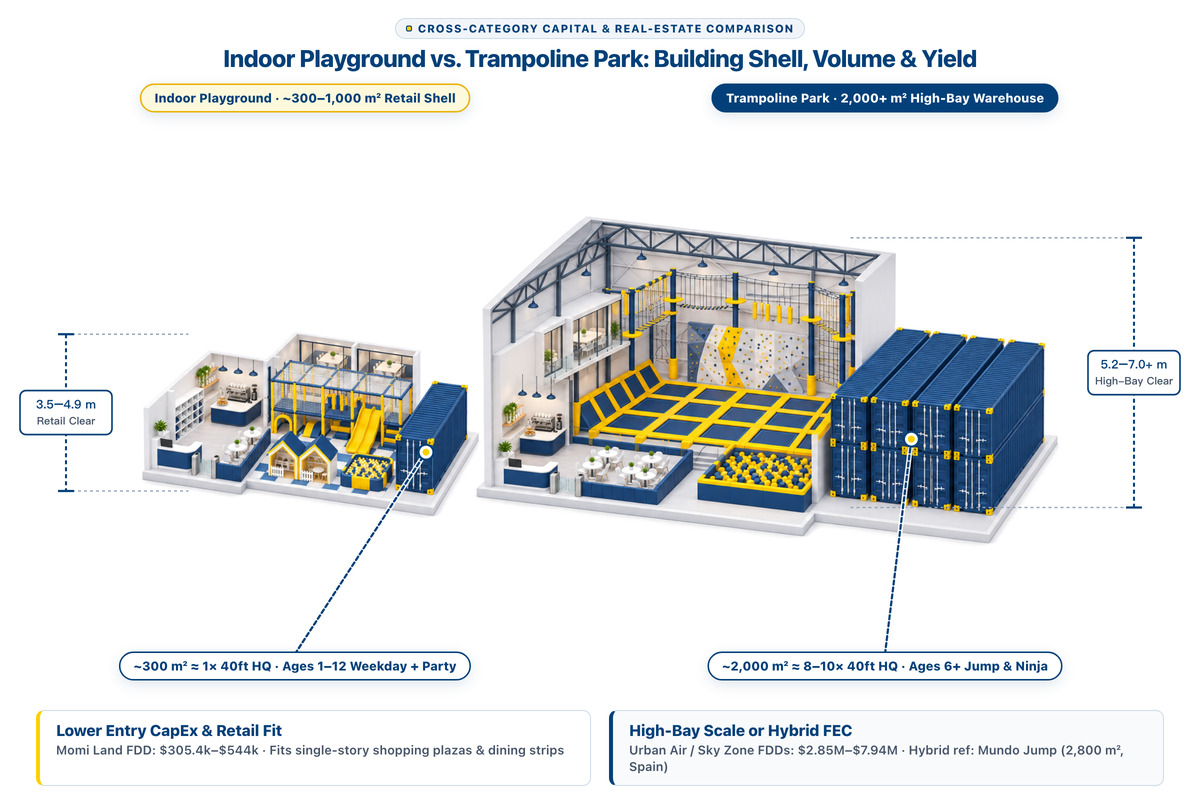
Investors weighing are indoor playgrounds profitable frequently cross-shop are trampoline parks profitable before signing a commercial lease. Neither format is universally “more profitable”—each wins inside a specific building envelope, capital bracket, and demographic radius:
| Economic & Engineering Factor | Commercial Indoor Playground (Contained Soft Play) | Commercial Trampoline & Adventure Park |
|---|---|---|
| Typical Venue & First-Time Footprint | ~300 – 1,000 m² (3,229 – 10,764 sq ft)—most first-time owners start near ~300 m² (3,229 sq ft) on one floor paired with dining or inside a mall | 2,000+ m² (21,528+ sq ft) wide-span industrial warehouse or big-box retail shell |
| Minimum Usable Clear Height | ~3.5 m (11.5 ft) for 2 tiers; ~4.9 m (16.1 ft) for 3 tiers (customizable down to 2.8–3.2 m / 9.2–10.5 ft for single-deck/toddler spaces) | 5.2 m+ (17.1 ft+) clear for standard jump courts; 6.0 – 7.0+ m (19.7 – 23.0+ ft) for stacked ropes, zip lines, and dry slides |
| Ocean Container Volume Benchmark | ~300 m² (~3,229 sq ft) single-level playground ≈ 1× 40ft HQ container (exact volume measured after packing) | ~2,000 m² (~21,528 sq ft) trampoline park ≈ 8 to 10× 40ft HQ containers |
| Core Demographic & Repeat Pattern | Ages 1–12; high weekday morning toddler repeat visits + strong ages 3–10 weekend birthday parties | Ages 6+, tweens, teens & adults; higher individual hourly ticket & evening/weekend group event spend |
| Upfront CapEx & Franchise Benchmarks | Moderate shell/HVAC build-out; U.S. FDD summary Momi Land (2025 FDD, 5,000–20,000 sq ft / 465–1,858 m²) spans $305.4k–$544k | Heavy MEP, slab & insurance baseline; U.S. Urban Air (2026 FDD, official investment page across 2.0/2.5 formats) spans $2.85M–$7.94M, and Sky Zone (2026 FDD summary via Franchise Direct, varying by park size) spans $3.25M–$5.68M (compare trampoline park startup costs) |
| Core Structural Specs & Zhenghan Warranty | Φ48 × 2.0 mm (1.89 × 0.08 in) galvanized pipe (up to 3 tiers) + cast-steel connectors, 0.45 mm (0.018 in) FR-PVC decks, machine-woven nylon net; 5-year frame / 1-year parts post-install warranty | 80 × 80 × 2.75 mm (3.15 × 3.15 × 0.11 in) columns, U.S.-imported TenCate 260 g/m² (7.67 oz/yd²) PP jump mats (2-year mat warranty), 180 mm (7.09 in) galvanized 80# manganese-steel springs on standard courts (260 mm / 10.24 in pro athletic springs on pro beds), 70 mm (2.76 in) beveled EPE + 0.55 mm (0.022 in) 1000 × 1000D matte FR-PVC pads (5-yr frame / 2-yr PP mat / 1-yr parts) |
What if your candidate warehouse offers 1,500 to 3,000+ m² (16,146 to 32,292+ sq ft) and 6.0 to 7.0 m (19.7 to 23.0 ft) clear height? Combining both lines inside one multi-age hub—like Spain’s 2,800 m² (30,139 sq ft) Mundo Jump Park in Colloto (7.0 m clear height), where our Wenzhou workshops fabricated both the interconnected commercial trampoline park equipment and the contained soft play, slides, climbing walls, and interactive attractions (view Mundo Jump Park)—captures weekday toddler mornings and high-ticket teen weekend sessions under one roof. Read our how to start a family entertainment center guide for full multi-zone phasing strategies.
Four Margin Killers to Avoid—and How Commercial Specs Protect Uptime
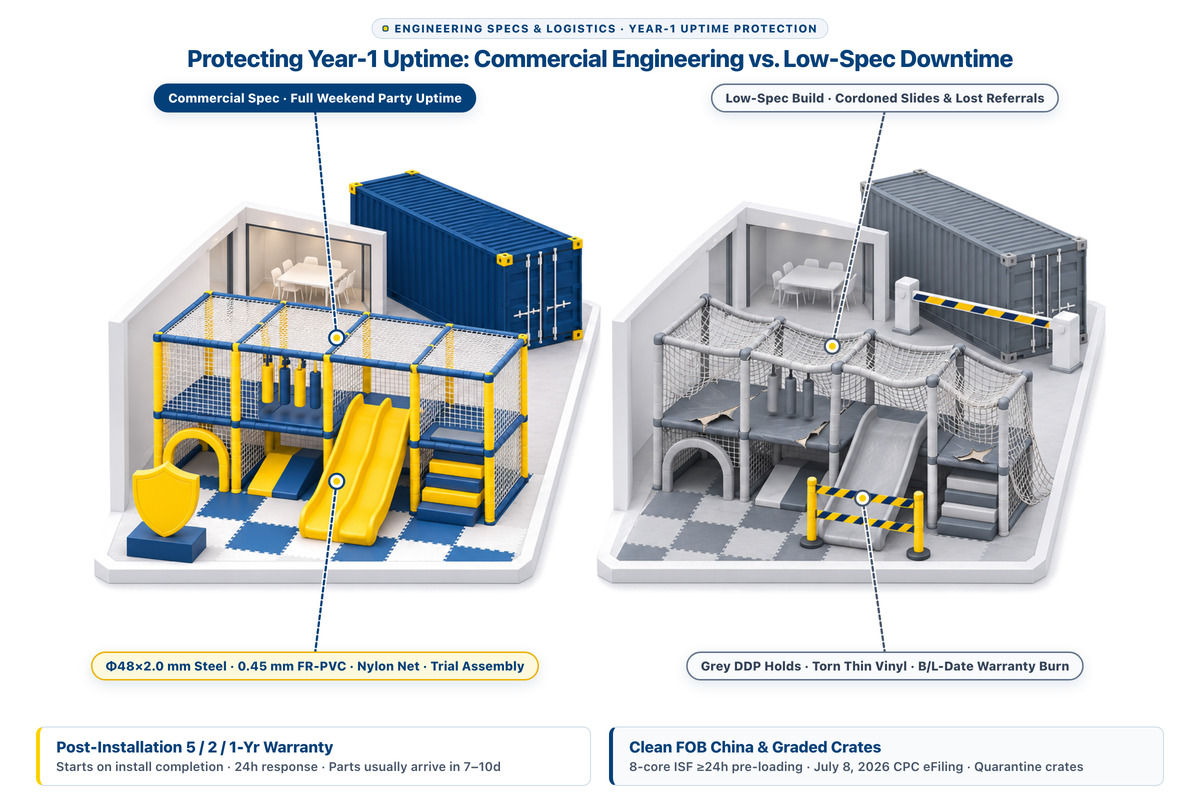
Even a busy location can lose tens of thousands of dollars in Year 1 if pre-opening logistics or low-grade materials force unscheduled closures. Protect your operating cash flow against four common profit leaks:
- Paying rent during avoidable fabrication and site-handover clashes: Commercial leases rarely offer endless rent-free fit-out months. Reserve at least roughly 6 months overall and run local MEP/flooring construction in parallel with our 25 to 60 day size-tiered Wenzhou production schedule (30–40 days for 200–500 m² / 2,153–5,382 sq ft), completing floor leveling, paint, and overhead MEP 100% dust-free before unloading soft pads and laying 2 cm (0.79 in) EVA mats. Before container loading, our technicians perform workshop trial assembly on primary steel frames and 6-point pre-shipment QC so your installers never lose weeks waiting on misdrilled brackets (see our 6-stage delivery workflow).
- Grey-channel “all-in DDP” customs holds or wood-quarantine delays: Clearing containers under unverified third-party tax IDs risks port seizures, demurrage bills, and invalid U.S. importer CPSC CPC eFiling (effective July 8, 2026 via CBP PGA Message Set under 16 CFR part 1110 for regulated children’s products). Buy honestly on FOB China terms (direct China playground sourcing details), have your U.S. customs broker transmit the 8 core ISF (“10+2”) importer data elements at least 24 hours before vessel loading (with container stuffing location and consolidator filed at least 24 hours prior to U.S. port arrival under 19 CFR § 149.2(b)), and rely on our two-tier export packing—zone-coded poly-film/woven bags and cartons for steel and pads, plus quarantine-compliant export wooden crates for oversized fiberglass slides, ball-dump machines, and interactive projection consoles (full China import playbook).
- Cordoning off broken attractions built with thin residential-grade vinyl or weak netting: Closing your main slide tower on a Saturday afternoon kills party referrals. Specifying Φ48 × 2.0 mm (1.89 × 0.08 in) galvanized steel pipe (on structures up to 3 tiers) with cast-steel connectors, 1.5 cm (0.59 in) fire/moisture-resistant deck boards under 3 cm (1.18 in) EPE and 0.45 mm (0.018 in) FR-PVC, machine-woven high-tenacity nylon safety netting, and UV-8 anti-static engineering-plastic slides (alongside fiberglass and stainless-steel slides) keeps attractions earning revenue year-round.
- Warranty clocks that burn out on the ocean: Some exporters start their 12-month warranty on the Bill of Lading date, costing buyers weeks of coverage while containers cross the water and clear customs. At Wenzhou Zhenghan, your 5-year structural steel frame, 2-year standard PP trampoline mat, and 1-year soft-pad/parts warranty starts on the day installation finishes—backed by 24-hour after-sales replies with replacement parts usually arriving in 7 to 10 days.
Frequently Asked Questions
How much do indoor playground owners make, and why do gross sales differ from net profit?
Owner earnings depend heavily on venue size, monthly rent-to-revenue ratio, party-room booking density, and whether the venue pays ongoing franchise royalties. For example, while the 2025 Momi Land FDD (summary via FDD Exchange) reported USD 528,770 average gross sales across 3 company-owned U.S. stores (5,000–20,000 sq ft / 465–1,858 m²), gross sales represent top-line receipts before deducting rent, staffing, insurance, utilities, taxes, and 8% combined franchise royalties/ad fees. Always model net operating profit using your actual city lease quote and local wage rates in the calculator above rather than trusting generic blog averages.
Which revenue stream generates the highest margin in a commercial indoor playground?
Private birthday party packages and parent café concessions consistently deliver the strongest gross-margin contribution once fixed rent is covered by walk-in admissions and monthly memberships. Bundled party packages collect advance deposits for 10 to 25+ children, utilize compact party rooms in predictable 90- to 120-minute turnovers, and introduce new local families to your venue at zero extra customer-acquisition cost.
How can an indoor playground stay profitable on quiet Tuesday through Thursday mornings?
Design at least one dedicated ages 1–6 gated toddler zone—combining 0.9 mm (0.035 in) PU soft climbers, odorless BPA-free thickened PE ball pools, EVA/EPP block pits, ceramic-bead sand pits, and themed role-play houses—paired with unobstructed parent café tables, Wi-Fi, and discounted weekday-morning monthly passes. Preschoolers and stay-at-home caregivers turn off-peak mornings into steady recurring cash flow while elementary-age kids are in school.
Is an indoor playground or a trampoline park more profitable for a first-time investor?
For first-time operators with moderate startup capital or single-story retail spaces around ~300 to 1,000 m² (3,229 to 10,764 sq ft)—most often near ~300 m² (3,229 sq ft) for first-time venues—and 3.5 to 4.9 m (11.5 to 16.1 ft) clear ceilings, a commercial indoor playground offers lower build-out, HVAC, and shipping barriers (roughly 1× 40ft HQ container around ~300 m²) plus resilient weekday toddler repeat visits. Commercial trampoline parks (2,000+ m² / 21,528+ sq ft, 5.2 m+ / 17.1 ft+ clear ceilings, 8–10× 40ft HQ containers at ~2,000 m²) command higher teen/adult ticket prices and group event spend when backed by larger capital reserves and high-bay industrial real estate.
How does buying direct from a Wenzhou manufacturer shorten the payback period?
Direct factory sourcing compresses the upfront investment numerator in your payback equation (FOB China early planning benchmark near USD 120/m² / USD 11.15/sq ft of total venue area, including play-zone 2 cm / 0.79 in EVA mats and integrated toddler zones), eliminates 6% to 8%+ ongoing franchise gross-revenue royalties, prevents costly on-site rework via workshop trial assembly, and protects operating cash flow with a 5-year structural steel / 2-year PP mat / 1-year parts warranty activated upon installation completion.
Get a Free 2D Layout and FOB Equipment Budget for Your Pro Forma
Want real factory equipment numbers to plug into your financial model instead of rough ballpark estimates? Send your candidate building dimensions, clear ceiling height below ducts and sprinklers, and target age mix to receive a custom 2D floor layout and preliminary FOB China equipment budget within ~7 days—with 24-hour inquiry responses and a fixed price presented with your free 3D renderings and walkthrough video once your layout and theme are finalized. Browse our commercial indoor playground equipment, compare commercial trampoline park equipment, or contact our Wenzhou engineering team to start your pro forma.
References
- U.S. Federal Trade Commission (FTC) — A Consumer’s Guide to Buying a Franchise (FDD Item 5, 6, 7 & Item 19 Rules): https://www.ftc.gov/business-guidance/resources/consumers-guide-buying-franchise
- U.S. Bureau of Labor Statistics (BLS) — Occupational Outlook Handbook: Recreation Workers: https://www.bls.gov/ooh/personal-care-and-service/recreation-workers.htm
- U.S. Small Business Administration (SBA) — 504 Fixed-Asset Loans (up to $5.5M): https://www.sba.gov/funding-programs/loans/504-loans
- U.S. Small Business Administration (SBA) — 7(a) Business Loans (Equipment, Real Estate & Working Capital up to $5M): https://www.sba.gov/funding-programs/loans/7a-loans
- GOV.UK — Introduction to Business Rates (Non-Domestic Occupancy Costs in England & Wales): https://www.gov.uk/introduction-to-business-rates
- U.S. Consumer Product Safety Commission (CPSC) — Children’s Product Certificate (16 CFR 1110 & July 8, 2026 eFiling): https://www.cpsc.gov/Business–Manufacturing/Testing-Certification/Childrens-Product-Certificate
- U.S. Code of Federal Regulations (eCFR) — 19 CFR § 149.2 Importer Security Filing (“10+2”) Timing Rules: https://www.ecfr.gov/current/title-19/chapter-I/part-149/section-149.2
Send your building floor plan, lowest ceiling clear height, target city and age mix for a custom 2D layout and FOB China budget within ~7 days.
Get a Free Layout and Budget